Jungian Concept
Is Shadow Work Dangerous?
Shadow Work can become harmful when it overwhelms coping capacity, encourages unsupported certainty, replaces treatment, or is used without appropriate boundaries.

Definition
Shadow Work is not inherently dangerous, but intense self-directed practices can become destabilizing or misleading. Risk increases when exercises involve trauma, dissociation, severe symptoms, sleep deprivation, coercive groups, unsupported memory claims, or replacement of professional care.
When self-reflection becomes risky
Risk is not determined by whether an exercise feels dark or spiritual. It depends on the person’s current stability, the intensity and duration of the practice, the material being approached, the quality of support, and whether interpretations remain open to correction.
Warning signs to stop
- Rapidly increasing panic, agitation, sleeplessness, or inability to function
- Dissociation, feeling unreal, losing time, or severe confusion
- Growing certainty that symbols prove extraordinary claims
- Compulsive journaling that replaces sleep, work, relationships, or care
- Pressure from a coach, group, or online figure to ignore boundaries
Safer boundaries
Choose ordinary material, limit sessions, remain connected to daily routines, write alternative explanations, and stop before becoming overwhelmed. Work with a qualified clinician when trauma, severe symptoms, or major functional impairment is present.
Urgent situations
If there is imminent risk of harm, severe loss of contact with reality, or an acute medical or psychiatric emergency, seek immediate local emergency assistance rather than continuing a self-guided exercise.
Origin and Development
Jung’s concept of the shadow developed within analytical psychology and clinical work. Modern “Shadow Work” combines that concept with journaling, coaching, spirituality, and social-media practices of widely varying quality. The modern label should not be confused with one standardized treatment.
Examples
- A person treats every conflict as proof that the other person is projecting.
- A journal exercise produces escalating panic or dissociation but is continued as a test of courage.
- A facilitator claims symbolic material proves a recovered memory.
- Someone abandons appropriate treatment because Shadow Work is presented as a complete cure.
Common Misconceptions
- Discomfort does not automatically mean healing.
- Every criticism is not projection.
- Every dream is not a hidden trauma message.
- A strong emotional insight is not necessarily accurate.
- Seeking professional help is not failure to do inner work.
Continue your study
Recommended Reading
Books selected because they directly develop ideas discussed on this page.
Man and His Symbols
Man and His Symbols is an illustrated introduction to dreams, symbols, archetypes, and individuation written by Carl Jung and four close collaborators for general readers.
Aion: Researches into the Phenomenology of the Self
Aion is Jung’s advanced study of the Self, the shadow, opposites, and the religious, astrological, Gnostic, and alchemical symbols of psychological totality.
Paid links. As an Amazon Associate I earn from qualifying purchases.
Related Concepts
Shadow
In Jungian psychology, the shadow is the part of the personality containing qualities, impulses, and capacities that the conscious ego does not recognize or accept as its own.
Projection
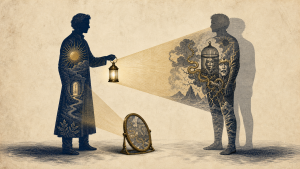
Projection is the largely unconscious process of experiencing one’s own psychological content as if it belonged primarily or entirely to another person, group, or object.

Complex
In Jungian psychology, a complex is an emotionally charged network of associations that can temporarily influence perception, emotion, and behavior.
Related Practices

Shadow Work
Shadow work is a modern term for reflective practices that explore qualities, emotions, and patterns a person habitually rejects, hides, or fails to recognize in themselves.

Jungian Therapy
Jungian therapy is a depth-oriented form of psychotherapy that explores conscious and unconscious patterns through relationships, dreams, symbols, and personal history.
Related Books

Man and His Symbols
Man and His Symbols is an illustrated introduction to dreams, symbols, archetypes, and individuation written by Carl Jung and four close collaborators for general readers.

Aion: Researches into the Phenomenology of the Self
Aion is Jung’s advanced study of the Self, the shadow, opposites, and the religious, astrological, Gnostic, and alchemical symbols of psychological totality.