Archetype
Father Archetype
The father archetype is a recurring pattern associated with authority, order, law, protection, tradition, judgment, and orientation.
Definition
The father archetype is a recurring pattern associated with authority, order, law, protection, tradition, judgment, and orientation.
Core Characteristics
Recurring themes include relationship, conflict, authority, adaptation, and development. The pattern is best treated as a field of possibilities rather than a fixed personality label.
Constructive Expression
Constructively, the pattern can support structure, guidance, responsibility, and the transmission of knowledge across generations.
Shadow Expression
In distorted form it can appear as domination, rigid certainty, punitive judgment, emotional distance, or rebellion against every form of authority.
Associated Symbols
Kings, judges, teachers, sky gods, ancestral figures, houses of law, and inherited names may carry father imagery depending on context.
Overview
The father archetype is a recurring pattern associated with authority, order, law, protection, tradition, judgment, and orientation.
Constructive Expression
Constructively, the pattern can support structure, guidance, responsibility, and the transmission of knowledge across generations.
Shadow Expression
In distorted form it can appear as domination, rigid certainty, punitive judgment, emotional distance, or rebellion against every form of authority.
Associated Images
Kings, judges, teachers, sky gods, ancestral figures, houses of law, and inherited names may carry father imagery depending on context.
How to Recognize the Pattern
Look for a cluster of role, emotion, conflict, and imagery rather than one isolated resemblance. Archetypal interpretation becomes stronger when the same pattern appears across several parts of a story or dream and when the interpretation accounts for both constructive and destructive possibilities. Personal associations should be examined before comparative mythology is added.
Questions for Reflection
Where does this pattern create energy or direction? Where does it narrow choice? Which person or group has been made to carry the pattern, and what qualities remain unrecognized in the observer? These questions keep archetypal language connected to lived responsibility.
Related Concepts
Archetype
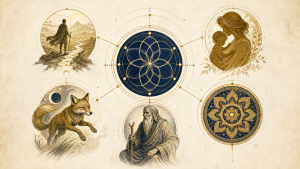
An archetype is an inherited organizing pattern in Jung’s theory that can shape recurring forms of imagery, emotion, perception, and behavior without prescribing one fixed image.
Collective Unconscious
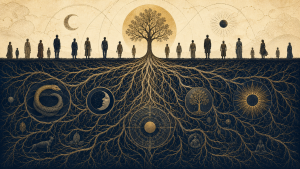
In Jungian psychology, the collective unconscious is a proposed inherited layer of the psyche expressed through universal patterns called archetypes.
Shadow
In Jungian psychology, the shadow is the part of the personality containing qualities, impulses, and capacities that the conscious ego does not recognize or accept as its own.