Book
Psychological Types
Carl Jung’s foundational study of introversion, extraversion, and the psychological functions of thinking, feeling, sensation, and intuition.

Summary
Psychological Types develops Jung’s account of introversion and extraversion, differentiated conscious functions, and the problems created when one-sided attitudes exclude other modes of experience. The book combines intellectual history, comparative portraits, and Jung’s own typological synthesis.
Key Topics
- Introversion and extraversion
- Thinking, feeling, sensation, and intuition
- Dominant, auxiliary, and inferior functions
- Type differences in philosophy, literature, and relationships
- Individuation beyond rigid labels
Reader Guidance
Best for readers who want Jung’s actual model rather than a four-letter summary. The historical chapters are demanding; the general description and definitions are the most direct entry points.
This is a demanding primary source rather than a quick personality manual. Read the historical chapters selectively, keep a glossary for attitude and function, and resist translating every passage directly into modern MBTI language.
Jung describes dynamic preferences and problems of one-sided development, not permanent internet-profile identities. Pair the book with the site’s psychological-types and MBTI comparison pages.
Why this book matters
Jung’s theory of types explains recurring differences in attention, judgment, perception, and psychological adaptation. It also warns against mistaking a preferred conscious standpoint for the whole personality.
Attitudes and functions
Introversion and extraversion describe broad directions of psychic orientation. Thinking and feeling are rational functions of judgment; sensation and intuition are irrational functions of perception. “Irrational” here means not based primarily on deliberate judgment, not unreasonable.
Not a fixed personality box
Jung’s model includes development, compensation, and conflict with less conscious functions. A type description identifies a pattern of differentiation; it does not set a permanent limit on ability or identity.
Relationship to MBTI
MBTI drew inspiration from this book but introduced a standardized inventory, four-letter codes, and judging–perceiving. Readers should not attribute every later function-stack rule directly to Jung.
Public-domain audio
Listen free on LibriVox
Related Concepts
Psychological Types
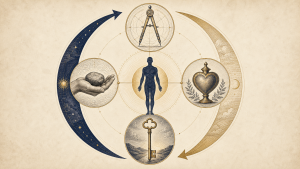
Jung’s psychological types combine two attitudes—introversion and extraversion—with four functions: thinking, feeling, sensation, and intuition.

Introversion
Introversion is a Jungian attitude in which conscious energy and motivation give greater priority to the subject’s inner impressions, ideas, and standpoint.

Extraversion
Extraversion is a Jungian attitude in which conscious energy and motivation give greater priority to external people, events, objects, and shared conditions.

Thinking
Thinking is the Jungian function that evaluates experience through concepts, logical relationships, and judgments about what something means.

Feeling
Feeling is the Jungian function that evaluates experience by assigning value: acceptable or unacceptable, important or unimportant, welcomed or rejected.

Sensation
Sensation is the Jungian function that perceives immediate concrete reality through the physical senses and awareness of bodily states.

Intuition
Intuition is the Jungian function that perceives possibilities, patterns, and implications through unconscious processes rather than direct sensory evidence.

Dominant Function
The dominant function is the psychological function a person uses most habitually and has developed most fully under conscious control.

Auxiliary Function
The auxiliary function supports the dominant function by adding a different mode of perception or judgment and helping consciousness adapt more flexibly.

Inferior Function
The inferior function is the least differentiated function in a person's conscious typology and the opposite of the dominant function.

Carl Jung and MBTI
The Myers-Briggs Type Indicator was inspired by Carl Jung’s psychological types, but its four-letter system and assessment method were developed by Katharine Cook Briggs and Isabel Briggs Myers.

Personal Unconscious vs Collective Unconscious
The personal unconscious contains forgotten or repressed individual material, while the collective unconscious names inherited archetypal patterns shared across human life.

Carl Jung’s Theory of Personality
Carl Jung’s personality theory combines psychological attitudes and functions with a broader model of ego, persona, shadow, unconscious life, and individuation.