Jungian Concept
Personal Unconscious vs Collective Unconscious
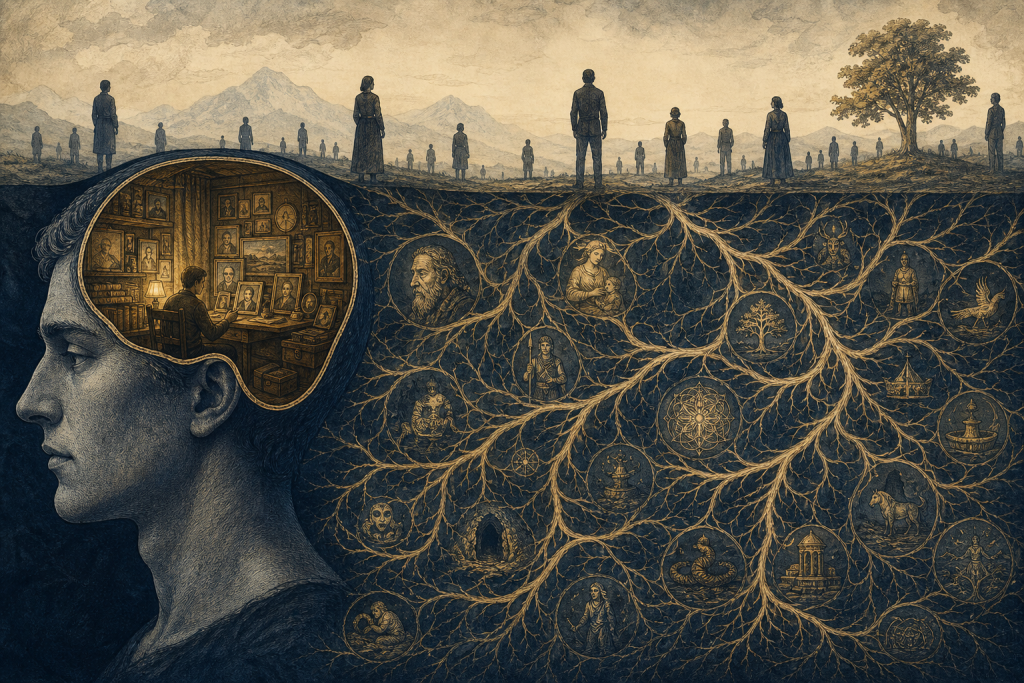
The personal unconscious contains forgotten or repressed individual material, while the collective unconscious names inherited archetypal patterns shared across human life.
Definition
In Jungian theory, the personal unconscious is built from an individual life, while the collective unconscious is a proposed inherited layer of archetypal predispositions that cannot be explained by personal experience alone.
The personal unconscious
The personal unconscious includes experiences that were forgotten, ignored, weakly perceived, repressed, or not yet integrated. Its contents arise from the individual’s history. Jung’s theory of complexes belongs largely here: emotionally charged networks of memory, expectation, image, and bodily response can influence attention and behavior without deliberate choice.
The collective unconscious
The collective unconscious is Jung’s more controversial proposal that the psyche includes inherited forms or predispositions called archetypes. These are not inherited memories of specific events. They are tendencies to organize experience in recurring patterns that become visible through culturally and personally shaped images.
A practical comparison
| Personal unconscious | Collective unconscious |
|---|---|
| Develops through individual experience | Proposed as inherited and species-wide |
| Includes forgotten and repressed material | Includes archetypal predispositions |
| Often organized in complexes | Expressed through recurring symbolic patterns |
| Interpreted through biography and context | Compared cautiously with myth and culture |
Why both layers matter in interpretation
A Jungian reading should not leap from an image to mythology while ignoring the dreamer’s life. Personal associations, current events, health, relationships, and culture come first. Archetypal amplification can widen inquiry only after the immediate context has been respected.
Complexes and archetypes can interact
The two layers are analytically distinct but not sealed apart. A personal complex can gather imagery around an archetypal theme, while an archetypal image is always experienced through a particular biography. A mother image, for example, may involve the dreamer’s actual parent, cultural expectations, bodily memories, and a wider recurring pattern of nurture or engulfment.
A debated theory
The collective unconscious remains one of Jung’s most influential and disputed ideas. Critics question its biological assumptions, cross-cultural generalizations, and standards of evidence. Responsible study should present it as a historical psychological theory with interpretive value for some readers—not as an established neurological structure or proof of paranormal connection.
Origin and Development
Jung developed the distinction as analytical psychology separated from Freud’s psychoanalysis. The personal layer retained repressed and forgotten material; the collective layer supported Jung’s account of recurring mythic and symbolic patterns.
Examples
- A forgotten childhood humiliation influencing a present reaction belongs to the personal unconscious.
- A dream expressing a recurring initiation pattern may invite archetypal comparison, though personal context remains primary.
Common Misconceptions
- The collective unconscious is not a shared telepathic database.
- An archetypal parallel does not prove one fixed meaning.
- Personal and cultural learning still shape every image.
Continue your study
Recommended Reading
Books selected because they directly develop ideas discussed on this page.
The Archetypes and the Collective Unconscious
The Archetypes and the Collective Unconscious collects major essays in which Carl Jung develops his accounts of archetypes, collective psychic patterns, rebirth, the mother, the child,…
Psychological Types
Carl Jung’s foundational study of introversion, extraversion, and the psychological functions of thinking, feeling, sensation, and intuition.
Two Essays on Analytical Psychology
Two central essays in which Carl Jung explains the ego, personal and collective unconscious, persona, anima, and the movement toward individuation.
Paid links. As an Amazon Associate I earn from qualifying purchases.
Related Concepts

Personal Unconscious
In Jungian psychology, the personal unconscious contains experiences, perceptions, and emotionally charged material outside an individual’s present awareness.
Collective Unconscious
In Jungian psychology, the collective unconscious is a proposed inherited layer of the psyche expressed through universal patterns called archetypes.
Complex
In Jungian psychology, a complex is an emotionally charged network of associations that can temporarily influence perception, emotion, and behavior.
Archetype
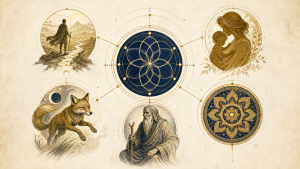
An archetype is an inherited organizing pattern in Jung’s theory that can shape recurring forms of imagery, emotion, perception, and behavior without prescribing one fixed image.
Projection
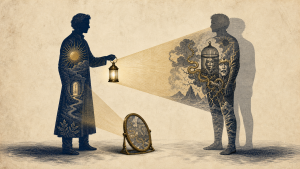
Projection is the largely unconscious process of experiencing one’s own psychological content as if it belonged primarily or entirely to another person, group, or object.
Related Books
The Archetypes and the Collective Unconscious
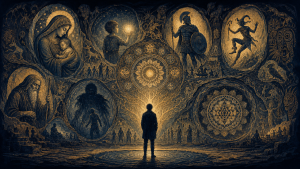
The Archetypes and the Collective Unconscious collects major essays in which Carl Jung develops his accounts of archetypes, collective psychic patterns, rebirth, the mother, the child, and individuation.

Psychological Types
Carl Jung’s foundational study of introversion, extraversion, and the psychological functions of thinking, feeling, sensation, and intuition.

Two Essays on Analytical Psychology
Two central essays in which Carl Jung explains the ego, personal and collective unconscious, persona, anima, and the movement toward individuation.