
Jungian Concept
Archetypes vs. Complexes in Jungian Psychology
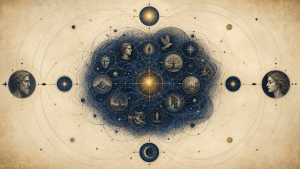
An archetype is a broad organizing pattern in Jung’s theory; a complex is a personally charged network of associations that can intensify perception and reaction.
Definition
Archetypes and complexes overlap in Jungian psychology but are not the same. Archetypes are proposed collective patterns known through variable images and motifs. Complexes are emotionally charged personal patterns that may be activated in everyday life.
The Short Answer
In Jungian psychology, an archetype is a broad, inherited organizing pattern associated with the collective unconscious. A complex is an emotionally charged network of memories, expectations, perceptions, and reactions that develops around a personally meaningful theme.
The distinction is useful because the two ideas often overlap without being identical. An archetype describes a recurring pattern that Jung understood as larger than one person’s biography. A complex describes a pattern that becomes psychologically active in a particular person, especially when a situation touches an emotionally loaded theme.
Archetypes Are Patterns, Not Fixed Characters
Jung used “archetype” for a theoretical organizing tendency inferred from recurring images, emotions, and forms of experience. An archetype is not a ready-made picture stored in the mind, a personality-test category, or a universal script that determines a person’s behavior.
For example, mother, hero, trickster, child, wise guide, and journey images can recur across dreams, stories, art, and religion. The particular image is shaped by culture and personal experience. Jungian writers distinguish the archetype itself from an archetypal image: the image is the concrete dream figure, character, symbol, or story; the archetype is the proposed pattern inferred through many different expressions.
That is why a dream about a teacher, a grandmother, a queen, or a dangerous animal does not prove one fixed “archetypal meaning.” Personal associations, relationships, culture, and the rest of the dream still matter.
Complexes Are Personally Charged Patterns
A complex is organized around affect: the emotional charge that makes a theme unusually compelling, painful, idealized, threatening, or difficult to see clearly. It may include memories, bodily reactions, expectations, self-images, and assumptions about other people.
Someone may react sharply to criticism, feel unusually small around authority, repeatedly idealize unavailable partners, or assume exclusion in a new group. A Jungian approach would not decide from one reaction that a particular complex is present. It would ask what was triggered, what associations appeared, what the present situation actually contains, and whether a recurring pattern can be observed over time.
Jung described complexes as having relative autonomy. That does not mean a separate personality literally takes control. It means an activated pattern can narrow attention and intensify a reaction before the person fully understands what is happening.
How They Relate
Jung did not treat archetypes and complexes as sealed categories. A complex may be rooted strongly in a person’s own history while also gathering imagery around an archetypal theme. A difficult relationship with an actual parent, for instance, can involve personal memories and an internal image of care, dependence, authority, or abandonment. The personal history should not be erased by calling it “the mother archetype.”
In the same way, an archetypal image may stir strong emotion without establishing that a complex is active. A striking dream, story, or work of art can feel significant, but significance alone is not a diagnosis or an explanation of someone’s relationships.
A Practical Comparison
| Archetype | Complex |
|---|---|
| A proposed organizing pattern in Jung’s theory | An emotionally charged network of associations |
| Associated with the collective unconscious | Associated especially with personal history and the personal unconscious |
| Known indirectly through varied images, motifs, and experiences | Often noticed through disproportionate reactions, recurring conflicts, or repeated interpretations |
| Does not prescribe one fixed image or meaning | Does not excuse behavior or establish a clinical diagnosis |
| May provide a broader symbolic pattern around a situation | May make a particular situation feel urgent, familiar, or difficult to evaluate clearly |
Example: Authority
Imagine a person who becomes immediately defensive whenever a supervisor asks a routine question. The present interaction may be fair, unfair, stressful, or ambiguous; that needs to be assessed on its own terms. If the same intense reaction recurs across different authority relationships, the person might explore whether an authority-related complex is being activated.
Archetypal language might widen the inquiry to cultural images of the ruler, judge, father, mentor, rebel, or tyrant. But those parallels do not replace the person’s actual work conditions, history, or responsibility for their response. The archetypal material is contextual, not a shortcut past evidence.
Why the Difference Matters for Projection
When people use Jungian terms loosely, they may call any strong feeling an archetype or claim that another person is “just a projection.” Neither move is careful. Projection can involve attributing an inner quality, fear, wish, or image to another person, but it does not make the other person unreal or remove the need for ordinary judgment.
A complex can make projection more likely because an emotionally charged pattern may shape how another person is perceived. The better question is not “what archetype is this person?” but “what happened, what did I infer, what evidence supports that inference, and what personal associations may be influencing me?” The Projection Journal Worksheet offers a structured way to separate those questions.
Using the Ideas Responsibly
These concepts are most useful as ways to make reflection more precise. They become less useful when used to label other people, turn ordinary conflict into a symbolic drama, or deny real harm and practical circumstances.
If a recurring emotional pattern causes significant distress, impaired functioning, or safety concerns, an online concept page cannot determine its cause. A qualified mental-health professional can offer individualized assessment and support.
Where to Continue
Read Archetype for the distinction between patterns and images, Complex for a closer account of emotionally charged associations, and Constellation for the language Jung used when a complex is activated. Readers interested in the broader process can continue to Individuation.
Sources and Further Reading
Origin and Development
Jung developed his theory of complexes from word-association research and later connected complexes with archetypal themes. His account of archetypes evolved across his work and remains debated within contemporary analytical psychology.
Examples
A recurring, intense reaction to authority may suggest an authority-related complex. Images of a judge, ruler, father, tyrant, or mentor can provide wider archetypal parallels, but neither the complex nor the archetype supplies a fixed explanation.
Common Misconceptions
- Archetypes are not fixed personality types or universal dream dictionaries.
- Complexes are not diagnoses or excuses for harmful behavior.
- An archetypal theme does not erase personal history or cultural context.
- A strong reaction does not prove that someone else is “only a projection.”
Related Concepts

Archetype
An archetype is an inherited organizing pattern in Jung’s theory that can shape recurring forms of imagery, emotion, perception, and behavior without prescribing one fixed image.
Complex
In Jungian psychology, a complex is an emotionally charged network of associations that can temporarily influence perception, emotion, and behavior.