Interactive Tool
The Origins and History of Consciousness vs. Ego and Archetype
A practical comparison of The Origins and History of Consciousness and Ego and Archetype for readers choosing the book that best matches their question and experience level.
Purpose
A practical comparison of The Origins and History of Consciousness and Ego and Archetype for readers choosing the book that best matches their question and experience level.
Instructions
Identify the question you need the book to answer, compare the scope of both records, and use the related book cards for edition and verified Amazon availability.
Privacy
This reading guide does not collect, transmit, or store personal information.
Important Disclaimer
Educational reading guidance only. Amazon availability and prices can change. As an Amazon Associate, Individuationing may earn from qualifying purchases.
The Short Answer
A practical comparison of The Origins and History of Consciousness and Ego and Archetype for readers choosing the book that best matches their question and experience level.
What The Origins and History of Consciousness Contributes
Neumann arranges creation, mother, separation, hero, dragon, and transformation myths into a symbolic sequence describing the emergence of ego consciousness and its later relationship with the larger psyche.
What Ego and Archetype Contributes
Edinger presents individuation as a developing relationship between ego-consciousness and the Self, using religious images, myths, dreams, art, and clinical interpretation to discuss separation, alienation, encounter, inflation, and renewed relationship.
How to Choose
Choose the title whose stated scope answers your immediate question. Prefer the more introductory work when the vocabulary is new; prefer the denser primary or specialist work when you need exact arguments, source context, or sustained interpretation.
A Responsible Reading Sequence
Read the introduction and one representative chapter of each before committing to a complete sequence. Keep separate notes for the author’s claim, supporting evidence, interpretive assumptions, and your unanswered questions.
Keep the Distinctions Clear
Neither book should be treated as diagnosis, prediction, or unquestionable doctrine. Symbolic and psychological claims should be distinguished from historical, medical, scientific, and theological claims.
Continue your study
Recommended Reading
Books selected because they directly develop ideas discussed on this page.
The Origins and History of Consciousness
Erich Neumann’s The Origins and History of Consciousness uses mythic sequences to propose an archetypal model of ego development and the differentiation of consciousness.
Ego and Archetype
Ego and Archetype is Edward F. Edinger’s influential Jungian study of individuation and the changing relationship between the conscious ego and the Self.
Paid links. As an Amazon Associate I earn from qualifying purchases.
Related Books
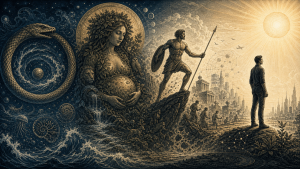
The Origins and History of Consciousness
Erich Neumann’s The Origins and History of Consciousness uses mythic sequences to propose an archetypal model of ego development and the differentiation of consciousness.

Ego and Archetype
Ego and Archetype is Edward F. Edinger’s influential Jungian study of individuation and the changing relationship between the conscious ego and the Self.