Book
The Origins and History of Consciousness
Erich Neumann’s The Origins and History of Consciousness uses mythic sequences to propose an archetypal model of ego development and the differentiation of consciousness.
Summary
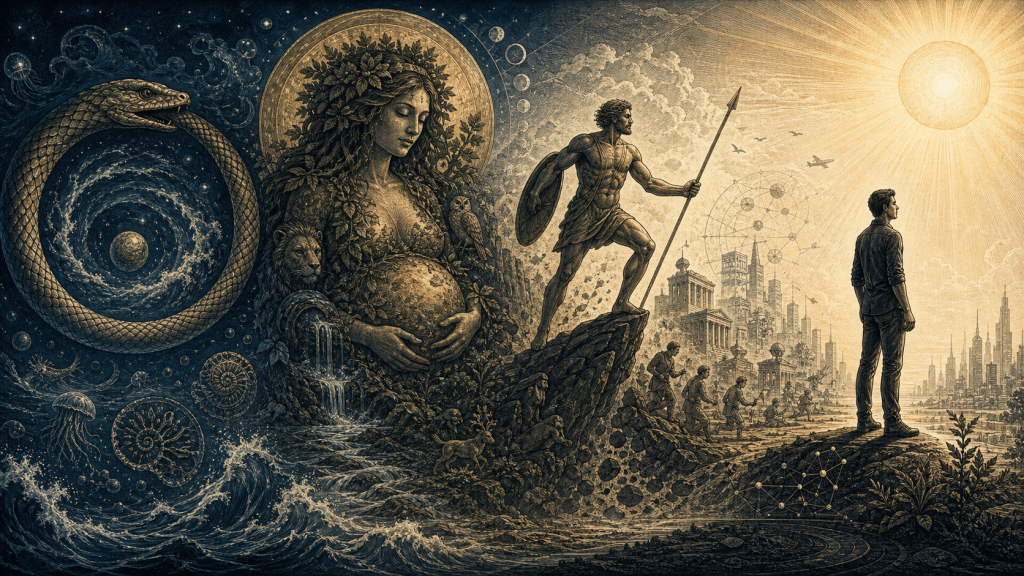
Neumann arranges creation, mother, separation, hero, dragon, and transformation myths into a symbolic sequence describing the emergence of ego consciousness and its later relationship with the larger psyche.
Key Topics
- Uroboros and original unity
- Great Mother symbolism
- Separation of the world parents
- Hero and dragon myths
- Ego development and centroversion
- Collective unconscious and individuation
- Mythological stages of consciousness
Reader Guidance
Intermediate to advanced. Read as a historically situated symbolic model, not as a universal developmental law, empirical anthropology, clinical diagnosis, or timeless account of gender.
What Is The Origins and History of Consciousness?
The Origins and History of Consciousness is Erich Neumann’s most influential attempt to organize mythology and analytical psychology into a developmental account of consciousness. First published in German in 1949 and in R. F. C. Hull’s English translation in 1954, the book carries a foreword by Carl Jung.
Neumann proposes that recurring mythic patterns can illuminate the differentiation of ego consciousness from an original unconscious condition. The book is ambitious, systematic, and historically important. It is also speculative, shaped by mid-twentieth-century anthropology and gender theory, and best read critically rather than as established developmental science.
The Book’s Central Argument
Neumann treats creation myths, divine families, monsters, heroes, and transformation stories as symbolic expressions of psychic development. He suggests that the development of individual consciousness and the mythic history of culture show analogous stages.
The sequence begins with the uroboros, the self-contained serpent that eats its own tail, representing an undifferentiated condition in which opposites have not yet separated. From there, Neumann traces the emergence of ego consciousness through separation, struggle, heroic action, and a later effort to establish a more conscious relationship with the collective unconscious.
This is an interpretive model, not a literal account of infancy, evolution, or world history. Its value lies in the patterns it helps a reader examine; its danger lies in mistaking an elegant symbolic system for universal proof.
Part One: The Mythological Stages
The Uroboros
The uroboros symbolizes original unity, enclosure, self-containment, and the absence of a stable distinction between ego and world. Neumann connects it with creation images, circularity, and a condition in which consciousness has not yet become an independent center.
The Great Mother
As differentiation begins, the containing ground appears in maternal imagery. Neumann emphasizes its ambivalence: it can nourish, protect, generate, engulf, immobilize, or destroy. This symbolic “Great Mother” must not be confused automatically with an actual mother or with women as a group.
Separation of the World Parents
Creation stories often portray heaven and earth, light and darkness, or parental figures being separated. Neumann reads this as an image of consciousness establishing distinctions. The gain is clarity and an independent standpoint; the cost is the loss of original unity.
The Hero and the Dragon
The hero represents an increasingly active ego that confronts overwhelming powers, rescues a captive or treasure, and attempts to establish a new order. The dragon conflict dramatizes the risks of being swallowed by unconscious forces as well as the risks of identifying with heroic conquest.
Transformation
The later mythic stages concern transformation rather than simple victory. The task shifts from separation alone toward a more complex relation between ego consciousness and the larger psyche. This anticipates Neumann’s account of individuation, although his terminology and sequence are distinctly his own.
Part Two: Development of Personality
The second part translates the mythological sequence into a psychological model. Neumann discusses original unity, separation of psychic systems, the consolidation and crisis of consciousness, and what he calls centroversion—a tendency toward organization around a more comprehensive center.
Centroversion links the developing ego with the Self. Healthy development, in this model, does not end with an ego that has defeated the unconscious. It requires a differentiated ego capable of entering relationship with unconscious material without being possessed or dissolved by it.
How the Book Extends Jung
Neumann draws directly on Jung’s theories of archetypes, collective psychic patterns, compensation, and individuation. Jung’s foreword presents the book as a continuation of work he believed a younger scholar needed to undertake.
Neumann differs in his drive to arrange a vast range of images into one developmental architecture. Jung often resisted fixing archetypal material into a single system; Neumann made system-building the book’s central strength and central vulnerability.
Why the Book Remains Influential
- It offers a memorable map connecting mythology with ego development.
- It places the hero story inside a larger sequence rather than treating heroic victory as the final goal.
- It emphasizes the ambivalence of archetypal images rather than reducing them to positive symbols.
- It influenced later Jungian writing on creativity, development, the feminine, and cultural symbolism.
- It gives readers a substantial example of how comparative mythology was used in early analytical psychology.
Major Criticisms and Limitations
A Linear Universal Sequence
The book can imply that all people and cultures move through one hierarchy of consciousness. Contemporary readers should distinguish a symbolic sequence from a universal developmental law and remain alert to evidence that does not fit the model.
Gender Essentialism
Neumann frequently describes consciousness and unconsciousness through fixed “masculine” and “feminine” polarities. These claims reflect the period and should not be applied rigidly to bodies, gender identities, psychological abilities, or social roles.
Decontextualized Myth
Images from very different cultures are sometimes placed together as evidence for the same archetypal stage. Comparative interpretation can reveal resemblance, but it can also erase language, ritual use, historical change, colonization, and the explanations offered within the traditions themselves.
Speculation Versus Evidence
Mythic parallels are not clinical diagnoses, biological evidence, or proof of a historical evolution of mind. The model belongs to depth-psychological interpretation and must be evaluated alongside modern developmental psychology, anthropology, history, and cultural scholarship.
How to Read It Well
- Learn Jung’s basic concepts of ego, Self, archetype, and collective unconscious first.
- Treat each stage as a working symbolic hypothesis rather than a fact about every person.
- Keep mythic figures connected to their particular culture and source.
- Mark gender claims that depend on binary or essentialist assumptions.
- Ask what the model reveals and what it excludes.
- Compare Neumann’s sequence with alternative developmental and mythological interpretations.
Who Should Read This Book?
This is an intermediate-to-advanced work for readers interested in analytical psychology, mythology, consciousness, individuation, and the history of depth psychology. It is not the easiest first Jungian book. Readers new to the field may benefit from beginning with Man and His Symbols and the site’s introductory concept pages.
Edition Represented Here
This page represents the 2014 Princeton Classics paperback, translated by R. F. C. Hull, with a foreword by C. G. Jung: ISBN 978-0-691-16359-8. Edition details and the Amazon purchase link were checked against the exact listing rather than inferred from the title alone.
Sources and Further Reading
Related Concepts

Shadow
In Jungian psychology, the shadow is the part of the personality containing qualities, impulses, and capacities that the conscious ego does not recognize or accept as its own.

Individuation
Individuation is Jung’s term for the lifelong process of becoming a more differentiated and integrated psychological whole.
Collective Unconscious
In Jungian psychology, the collective unconscious is a proposed inherited layer of the psyche expressed through universal patterns called archetypes.
Ego
In Jungian psychology, the ego is the central complex of consciousness: the organizing “I” that experiences identity, makes choices, and adapts to inner and outer life.
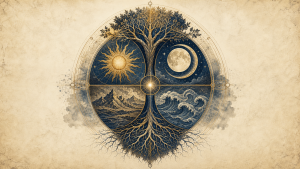
Self
The Self is Jung’s concept of the whole psyche—conscious and unconscious—and the archetypal principle of its organization, development, and potential integration.
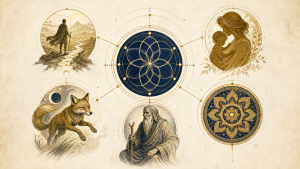
Archetype
An archetype is an inherited organizing pattern in Jung’s theory that can shape recurring forms of imagery, emotion, perception, and behavior without prescribing one fixed image.

Psychological Opposites
Psychological opposites are conflicting conscious and unconscious positions whose tension can reveal one-sidedness and support development.

Participation Mystique
Participation mystique is a Jungian term for an unconscious state of identity in which the boundary between subject and object, self and other, is insufficiently differentiated.
Related Practices
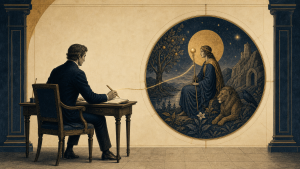
Active Imagination
Active imagination is Jung’s method of consciously engaging emerging images, emotions, or figures through sustained attention and expression while preserving awareness and judgment.

Jungian Dream Analysis
Jungian dream analysis explores a dream’s personal associations, structure, emotional context, and possible compensatory relationship to conscious life without using fixed symbol definitions.
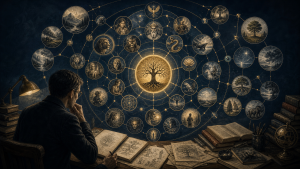
Symbol Amplification
Symbol amplification is a Jungian method of comparing an image with mythic, religious, artistic, historical, and cultural parallels while staying anchored to personal context.
Related Psychologists
Carl Jung
Carl Gustav Jung was a Swiss psychiatrist who founded analytical psychology and developed influential ideas about complexes, archetypes, the collective unconscious, psychological types, and individuation.
Erich Neumann
Erich Neumann was a German-born Israeli analytical psychologist who extended Jungian psychology through studies of consciousness, mythology, ethics, creativity, and Jewish thought.
Edward F. Edinger
Edward F. Edinger was an American psychiatrist, Jungian analyst, lecturer, and author who became a prominent interpreter of Jung’s work on the ego, Self, individuation, alchemy, and religious symbolism.