Interactive Tool
Carl Jung Books: A Complete Reading Guide
A practical guide to Carl Jung’s books, with beginner starting points, subject-based reading paths, and links to detailed book pages.

Purpose
Help readers choose a Carl Jung book based on experience level, interests, and reading goals without pretending that one sequence suits everyone.
Instructions
Start with the pathway closest to your goal. Open each linked book page for an original summary, key topics, reading guidance, and available editions.
Privacy
This guide does not collect, transmit, or store personal information.
Important Disclaimer
Book links may include Amazon affiliate links. Recommendations are editorial and are not ranked by commission.
Where should a beginner start?
Start with Man and His Symbols if you want the clearest broad introduction. It was created for a general audience and introduces dreams, symbols, archetypes, and the unconscious without requiring familiarity with Jung’s technical vocabulary.
Choose Memories, Dreams, Reflections if you want a biographical entrance into Jung’s inner life and the experiences that shaped his psychology. It is not a conventional autobiography, but it gives important context for his interests in dreams, religion, myth, and individuation.
A beginner reading order
- Man and His Symbols — the most accessible overview.
- Memories, Dreams, Reflections — biographical and intellectual context.
- Modern Man in Search of a Soul — essays that bridge clinical practice and cultural questions.
- Two Essays on Analytical Psychology — a more systematic account of the psyche and individuation.
- The Archetypes and the Collective Unconscious — a deeper study of archetypal theory.
Choose by subject
Shadow, Self, and individuation
Read Aion for Jung’s mature account of the Self, shadow, anima and animus, and symbolic opposites. It is demanding and works better after an introductory book.
Personality and psychological functions
Psychological Types is the primary source for introversion, extraversion, and the functions of thinking, feeling, sensation, and intuition. Jung’s model is more flexible and developmental than many later personality tests suggest.
Dreams and symbols
Begin with Man and His Symbols, then use Jung’s essays on dreams alongside practical study of personal associations and dream series. Jung did not treat a symbol dictionary as a substitute for the dreamer’s own context.
Art and active imagination
The Red Book documents Jung’s sustained encounter with images and figures from his inner life. Its historical and artistic importance is considerable, but it is not the easiest first Jung book.
How to read Jung well
Read slowly, distinguish Jung’s own claims from later popular adaptations, and follow unfamiliar terms into the glossary. When Jung discusses religion, alchemy, mythology, or astrology, ask whether he is making a psychological, historical, symbolic, or metaphysical claim. Those categories are often blurred in summaries of his work.
You do not need to read the Collected Works from first volume to last. A subject-based path is usually more useful, and the individual book pages below will help you choose the next step.
Continue your study
Recommended Reading
Books selected because they directly develop ideas discussed on this page.
Man and His Symbols
Man and His Symbols is an illustrated introduction to dreams, symbols, archetypes, and individuation written by Carl Jung and four close collaborators for general readers.
Memories, Dreams, Reflections
Memories, Dreams, Reflections is a semi-autobiographical account assembled from Carl Jung's recollections, manuscripts, and conversations with editor Aniela Jaffé.
The Red Book: Liber Novus
The Red Book: Liber Novus records and artistically develops Carl Jung's confrontation with inner figures and images during a formative period of his psychology.
Paid links. As an Amazon Associate I earn from qualifying purchases.
Related Concepts

Individuation
Individuation is Jung’s term for the lifelong process of becoming a more differentiated and integrated psychological whole.
Shadow
In Jungian psychology, the shadow is the part of the personality containing qualities, impulses, and capacities that the conscious ego does not recognize or accept as its own.
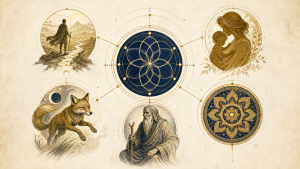
Archetype
An archetype is an inherited organizing pattern in Jung’s theory that can shape recurring forms of imagery, emotion, perception, and behavior without prescribing one fixed image.
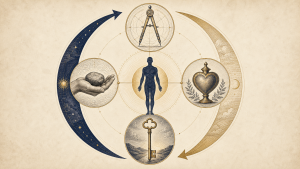
Psychological Types
Jung’s psychological types combine two attitudes—introversion and extraversion—with four functions: thinking, feeling, sensation, and intuition.
Collective Unconscious
In Jungian psychology, the collective unconscious is a proposed inherited layer of the psyche expressed through universal patterns called archetypes.
Related Practices

Jungian Dream Analysis
Jungian dream analysis explores a dream’s personal associations, structure, emotional context, and possible compensatory relationship to conscious life without using fixed symbol definitions.

Active Imagination
Active imagination is Jung’s method of consciously engaging emerging images, emotions, or figures through sustained attention and expression while preserving awareness and judgment.

Shadow Work
Shadow work is a modern term for reflective practices that explore qualities, emotions, and patterns a person habitually rejects, hides, or fails to recognize in themselves.
Related Books

Man and His Symbols
Man and His Symbols is an illustrated introduction to dreams, symbols, archetypes, and individuation written by Carl Jung and four close collaborators for general readers.

Memories, Dreams, Reflections
Memories, Dreams, Reflections is a semi-autobiographical account assembled from Carl Jung's recollections, manuscripts, and conversations with editor Aniela Jaffé.
The Red Book: Liber Novus
The Red Book: Liber Novus records and artistically develops Carl Jung's confrontation with inner figures and images during a formative period of his psychology.
The Archetypes and the Collective Unconscious
The Archetypes and the Collective Unconscious collects major essays in which Carl Jung develops his accounts of archetypes, collective psychic patterns, rebirth, the mother, the child, and individuation.
Aion: Researches into the Phenomenology of the Self
Aion is Jung’s advanced study of the Self, the shadow, opposites, and the religious, astrological, Gnostic, and alchemical symbols of psychological totality.