
Book
Synchronicity: An Acausal Connecting Principle
Carl Jung’s principal essay proposing synchronicity as a framework for meaningful coincidence not adequately described by ordinary causal explanation.

Summary
Jung’s essay gathers clinical anecdotes, historical parallels, scientific discussions, and a marriage experiment to argue for an acausal principle connecting inner states and external events through meaning.
Key Topics
- Meaningful coincidence
- Causality and acausality
- Probability and selection
- Rhine’s parapsychology experiments
- Astrological marriage data
- Observer involvement
Reader Guidance
Read as a speculative theoretical essay, not as proof that coincidences carry predetermined messages. Separate Jung’s examples, his proposed principle, and the strength of the supporting evidence.
Read the argument slowly and separate Jung’s definition, the examples offered, and the conclusions drawn from them. Pair the book with ordinary probability, selective attention, and confirmation-bias explanations. That comparison preserves the text’s historical importance without treating every coincidence as evidence of an acausal principle.
The central proposal
Synchronicity describes a coincidence experienced as meaningfully connected even when no ordinary causal link is apparent. Jung proposed that meaning might sometimes organize the relation between psychic and physical events.
Evidence and interpretation
The essay combines very different materials: personal reports, clinical observations, historical divination systems, experimental research, and statistics. These sources do not all carry the same evidentiary weight.
The astrology experiment
Jung’s marriage data are often quoted as proof of astrology. His own discussion is more complicated and considers expectations, selection, and the changing results of successive samples.
How to read it responsibly
Use the essay to understand Jung’s mature attempt to connect psyche, matter, and meaning. Do not treat subjective significance as sufficient evidence for a factual, predictive, medical, or supernatural claim.
Related Concepts
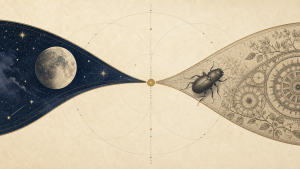
Synchronicity
Synchronicity is Jung’s term for a meaningful coincidence between an inner psychological state and an external event when no adequate causal connection is apparent.

Archetype
An archetype is an inherited organizing pattern in Jung’s theory that can shape recurring forms of imagery, emotion, perception, and behavior without prescribing one fixed image.

Collective Unconscious
In Jungian psychology, the collective unconscious is a proposed inherited layer of the psyche expressed through universal patterns called archetypes.

Carl Jung and Astrology
Carl Jung discussed astrology as a historical symbolic system and explored astrological data in relation to synchronicity, without establishing astrology as validated causal science.