
Jungian Concept
Synchronicity
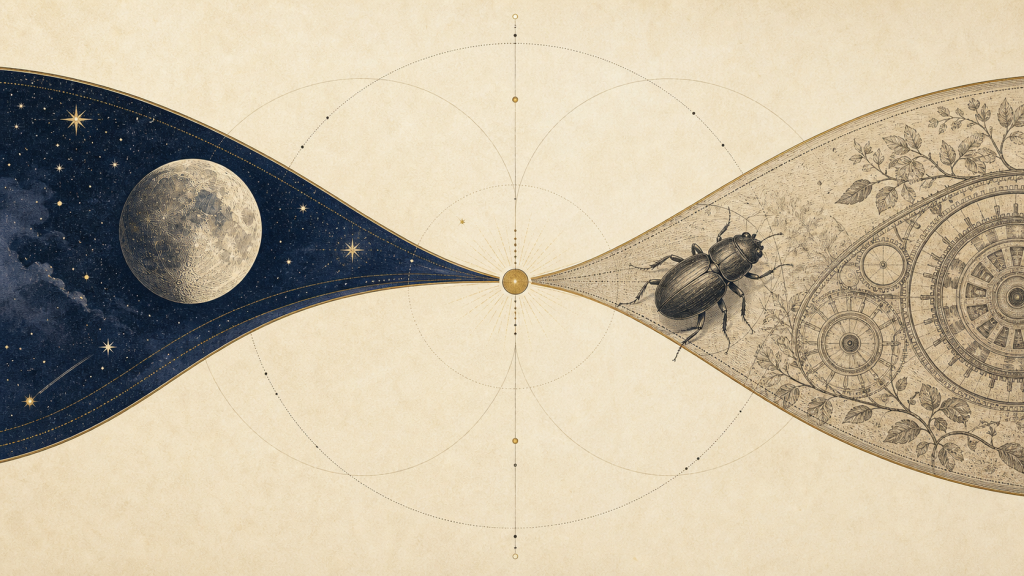
Synchronicity is Jung’s term for a meaningful coincidence between an inner psychological state and an external event when no adequate causal connection is apparent.
Definition
Synchronicity describes a meaningful correspondence between an inner psychological event and an external event without an evident causal link. It is a Jungian theoretical concept, not proof of fate or supernatural communication.
What Is Synchronicity?
Synchronicity is Carl Jung’s term for a meaningful coincidence between a psychological event—such as a dream, image, or idea—and an external event when no adequate causal explanation connects them.
The concept is more specific than “anything that feels like a sign.” Jung’s model requires both a correspondence in meaning and an apparently noncausal relationship. The experience is meaningful to the person, but that meaning does not automatically establish a supernatural message or objective plan.
A Simple Example
Someone dreams vividly of an unusual animal and encounters the same animal unexpectedly the next day during an emotionally important decision. The timing and symbolic correspondence may feel significant even though neither event appears to have caused the other.
A responsible account records the experience without turning it into proof of what the person should do. The coincidence may stimulate reflection while ordinary evidence, probability, and consequences remain essential.
Jung’s Acausal Connecting Principle
Jung described synchronicity as an “acausal connecting principle.” He developed the theory while exploring the relationship between psyche, matter, probability, and meaning, including discussions with physicist Wolfgang Pauli.
This was a speculative attempt to describe certain experiences, not a generally accepted scientific law. Contemporary readers should distinguish Jung’s theoretical proposal from the psychological fact that humans notice patterns and assign meaning to coincidences.
Synchronicity vs. Confirmation Bias
People naturally remember striking matches and overlook the many thoughts or dreams that do not correspond with later events. Selective attention, frequency illusion, probability, vague matching, and hindsight can explain many apparent synchronicities.
Considering these explanations does not make an experience emotionally meaningless. It prevents meaning from hardening into certainty. A coincidence can matter personally without proving causation, prophecy, fate, or special status.
How to Reflect Without Overinterpreting
- Write down the inner and outer events accurately before elaborating them.
- Identify the specific correspondence rather than relying on a vague resemblance.
- Consider ordinary causal, statistical, and attentional explanations.
- Ask what the event evokes or clarifies psychologically.
- Do not use a coincidence as the sole basis for medical, legal, financial, or safety decisions.
When Pattern-Finding Becomes Harmful
Repeatedly treating ordinary events as personalized messages can increase anxiety, impair judgment, or accompany serious mental-health symptoms. If perceived signs feel commanding, threatening, or impossible to ignore—or interfere with sleep, safety, or functioning—seek qualified professional support rather than intensifying symbolic interpretation.
Keep a Prospective Record
To reduce hindsight bias, record the inner event before searching for a match. Include its date, exact details, possible meanings, and how common the predicted outer event might be. Later, record matches and nonmatches using the same standard. This prospective method cannot settle Jung’s metaphysical proposal, but it reveals when memory has sharpened a vague impression after the fact and helps preserve personal meaning without overstating evidence.
Sources and Further Reading
Origin and Development
Jung used the term publicly by the early 1930s and developed it most fully in his 1952 essay “Synchronicity: An Acausal Connecting Principle.” His collaboration and correspondence with physicist Wolfgang Pauli influenced the broader theoretical context.
Examples
A striking dream image appears unexpectedly in waking life during a period when the image carries unusual personal importance. The experience may prompt reflection, but its significance and cause remain open questions.
Common Misconceptions
- Not every coincidence is synchronicity.
- Personal meaning is not proof of supernatural causation.
- Synchronicity does not reliably predict the future.
- Coincidences should not replace evidence-based decisions.
- Pattern-detection biases remain relevant even when an event feels profound.
Continue your study
Recommended Reading
Books selected because they directly develop ideas discussed on this page.
Aion: Researches into the Phenomenology of the Self
Aion is Jung’s advanced study of the Self, the shadow, opposites, and the religious, astrological, Gnostic, and alchemical symbols of psychological totality.
Memories, Dreams, Reflections
Memories, Dreams, Reflections is a semi-autobiographical account assembled from Carl Jung's recollections, manuscripts, and conversations with editor Aniela Jaffé.
The Eternal Drama
The Eternal Drama is Edward F. Edinger’s Jungian exploration of major Greek myths and divine figures as recurring images of psychological conflict, development, and transformation.
Paid links. As an Amazon Associate I earn from qualifying purchases.
Related Concepts

Individuation
Individuation is Jung’s term for the lifelong process of becoming a more differentiated and integrated psychological whole.

Collective Unconscious
In Jungian psychology, the collective unconscious is a proposed inherited layer of the psyche expressed through universal patterns called archetypes.

Personal Unconscious
In Jungian psychology, the personal unconscious contains experiences, perceptions, and emotionally charged material outside an individual’s present awareness.
Complex
In Jungian psychology, a complex is an emotionally charged network of associations that can temporarily influence perception, emotion, and behavior.

Self
The Self is Jung’s concept of the whole psyche—conscious and unconscious—and the archetypal principle of its organization, development, and potential integration.
Archetype
An archetype is an inherited organizing pattern in Jung’s theory that can shape recurring forms of imagery, emotion, perception, and behavior without prescribing one fixed image.

Psychological Inflation
Psychological inflation is an expanded or diminished self-estimate caused by identifying the ego with an archetype, role, group, insight, or unconscious content.

Carl Jung’s Philosophy
Carl Jung’s philosophy centers on psychological wholeness, symbols, opposites, meaning, and the relationship between conscious and unconscious life.

Carl Jung and Astrology
Carl Jung discussed astrology as a historical symbolic system and explored astrological data in relation to synchronicity, without establishing astrology as validated causal science.
Related Archetypes

Related Practices

Related Books
Aion: Researches into the Phenomenology of the Self
Aion is Jung’s advanced study of the Self, the shadow, opposites, and the religious, astrological, Gnostic, and alchemical symbols of psychological totality.

Memories, Dreams, Reflections
Memories, Dreams, Reflections is a semi-autobiographical account assembled from Carl Jung's recollections, manuscripts, and conversations with editor Aniela Jaffé.
The Eternal Drama
The Eternal Drama is Edward F. Edinger’s Jungian exploration of major Greek myths and divine figures as recurring images of psychological conflict, development, and transformation.
The Psyche in Antiquity, Book One
The Psyche in Antiquity, Book One is Edinger’s psychological tour of early Greek philosophy from the Milesians through Plotinus.

Synchronicity: An Acausal Connecting Principle
Carl Jung’s principal essay proposing synchronicity as a framework for meaningful coincidence not adequately described by ordinary causal explanation.
Related Psychologists

Carl Jung
Carl Gustav Jung was a Swiss psychiatrist who founded analytical psychology and developed influential ideas about complexes, archetypes, the collective unconscious, psychological types, and individuation.

Marie-Louise von Franz
Marie-Louise von Franz was a Swiss Jungian analyst and scholar known for her work on dreams, fairy tales, alchemy, and the process of individuation.

Aniela Jaffé
Aniela Jaffé was a German-born Swiss Jungian analyst, author, and longtime collaborator who recorded and edited the material behind Memories, Dreams, Reflections.