Jungian Concept
Carl Jung and Religion
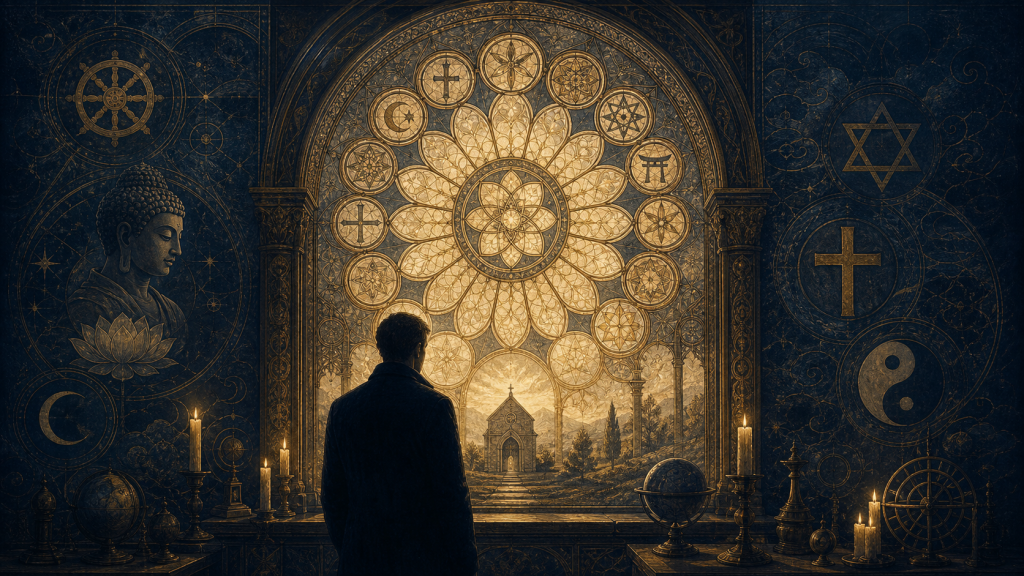
Carl Jung approached religion as a psychological and symbolic phenomenon whose images can organize experience, while avoiding a clinical proof of theological claims.
Definition
Jung studied religions as expressions of the psyche and treated religious images as psychologically real when they shape experience, behavior, and meaning.
Religion as psychological fact
Jung often separated the psychologist’s task from metaphysical judgment. A psychologist can examine an experience’s images, emotional force, developmental role, and consequences without claiming to prove or disprove the object of belief.
The numinous
Jung used the idea of the numinous for experiences felt as powerful, compelling, and beyond ordinary ego control. Such experiences may support transformation, but intensity alone does not guarantee truth, health, or moral value.
Christian symbolism
Jung wrote extensively about Christianity, Christ as a symbol of the Self, evil, opposites, and the changing God-image. His interpretations remain influential and controversial because they translate theological images into psychological terms.
Comparative religion
He also engaged with Gnosticism, Buddhism, Hindu traditions, Taoism, and alchemy. Readers should distinguish Jung’s psychological comparisons from the self-understanding of those traditions and consult specialist scholarship alongside him.
What did Carl Jung believe about religion?
Carl Jung treated religion as a major psychological fact: human beings create, inherit, experience, and organize their lives around images of ultimacy. His work does not fit cleanly into “believer” or “nonbeliever.” He wrote sympathetically about religious experience while also interpreting doctrines and sacred images through psychological concepts.
Jung’s clinical question was often pragmatic: what role does a religious image play in a person’s psychic life? Does it support responsibility and integration, or does it encourage inflation, avoidance, and projection? This focus differs from deciding whether a theological claim is objectively true.
Religion as experience and symbol
Jung used the term numinous for experiences that feel powerful, compelling, and greater than ordinary conscious control. Such experiences can reorganize a life, but intensity alone does not make an interpretation correct. Psychological reflection remains necessary.
Religious symbols can carry tensions that rational formulas do not easily resolve: good and evil, life and death, spirit and body, individuality and community. Jung believed symbols remain alive when they continue to generate reflection rather than collapsing into a single literal explanation.
Jung and Christianity
Christian imagery occupies a central place in Jung’s writings because it shaped European history and his own background. He interpreted Christ as an image related to the Self, analyzed the problem of evil, and argued that inherited symbols may require psychological development. These interpretations are controversial and should not be confused with standard Christian theology.
How to evaluate Jung’s religious claims
Separate psychological interpretation from history and theology, verify quotations, and compare Jung with scholars from the traditions he discusses. His work can illuminate the psychological function of symbols without settling metaphysical questions for the reader.
Religion, projection, and psychological inflation
Jung believed religious images could carry profound psychological value, but he also warned about identifying the ego with them. A person who mistakes a powerful inner experience for proof of personal chosenness may become inflated. Conversely, dismissing every religious image as meaningless can leave important emotional and cultural material unexamined.
Projection is another central problem. Sacred authority can be used to place denied qualities wholly outside oneself—idealized in a leader or condemned in an opponent. Psychological reflection asks what belongs to the individual without claiming that religion is only projection.
Was Jung religious, spiritual, or agnostic?
Any single label is incomplete. Jung’s public statements vary with context, and his private experiences strongly shaped his thought. The safest conclusion is that he took religious experience and symbolism seriously while maintaining a distinction between psychological statements and what could be proven metaphysically.
Origin and Development
Jung’s engagement with Christianity began in his family and continued through his clinical work, comparative studies, and later writings on symbolism, alchemy, and the God-image. His approach was psychological rather than a simple confession of doctrine.
Examples
- Interpreting mandalas as images of psychic order
- Studying Christ symbolism in relation to the Self
- Comparing Western and Eastern symbolic traditions
- Examining how religious images change across history
Common Misconceptions
- Psychological reality is not the same as theological proof.
- Jung was not simply an orthodox theologian or a dismissive atheist.
- His cross-cultural comparisons can be illuminating while also reflecting limitations of his era.
Continue your study
Recommended Reading
Books selected because they directly develop ideas discussed on this page.
Aion: Researches into the Phenomenology of the Self
Aion is Jung’s advanced study of the Self, the shadow, opposites, and the religious, astrological, Gnostic, and alchemical symbols of psychological totality.
The Christian Archetype
The Christian Archetype is Edward F. Edinger’s Jungian commentary on central episodes in the life of Christ and their possible psychological significance.
Transformation of the God-Image
Transformation of the God-Image is Edinger’s Jungian elucidation of Answer to Job, developed from seminars at the C. G. Jung Institute of Los Angeles.
Paid links. As an Amazon Associate I earn from qualifying purchases.
Related Concepts
Self
The Self is Jung’s concept of the whole psyche—conscious and unconscious—and the archetypal principle of its organization, development, and potential integration.
Archetype
An archetype is an inherited organizing pattern in Jung’s theory that can shape recurring forms of imagery, emotion, perception, and behavior without prescribing one fixed image.
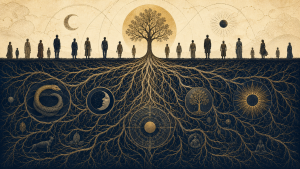
Collective Unconscious
In Jungian psychology, the collective unconscious is a proposed inherited layer of the psyche expressed through universal patterns called archetypes.
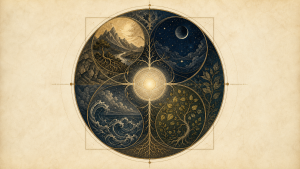
Mandala
A mandala is a centered, often circular symbolic form that Jung associated with psychic order, wholeness, containment, and the Self.

Individuation
Individuation is Jung’s term for the lifelong process of becoming a more differentiated and integrated psychological whole.
Related Books
Aion: Researches into the Phenomenology of the Self
Aion is Jung’s advanced study of the Self, the shadow, opposites, and the religious, astrological, Gnostic, and alchemical symbols of psychological totality.
The Christian Archetype
The Christian Archetype is Edward F. Edinger’s Jungian commentary on central episodes in the life of Christ and their possible psychological significance.
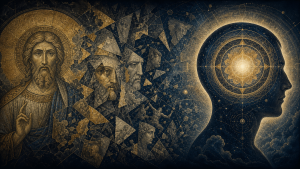
Transformation of the God-Image
Transformation of the God-Image is Edinger’s Jungian elucidation of Answer to Job, developed from seminars at the C. G. Jung Institute of Los Angeles.

The Bible and the Psyche
The Bible and the Psyche is Edinger’s Jungian commentary on individuation symbolism in biblical books from Genesis through Esther.

The Sacred Psyche
The Sacred Psyche is Edward F. Edinger’s psychological interpretation of the Psalms, developed from lectures and focused on their continuing significance in individual experience.
Related Psychologists
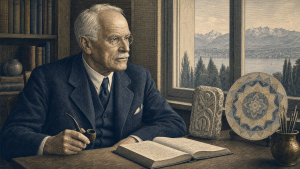
Carl Jung
Carl Gustav Jung was a Swiss psychiatrist who founded analytical psychology and developed influential ideas about complexes, archetypes, the collective unconscious, psychological types, and individuation.
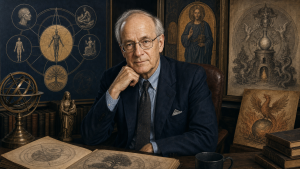
Edward F. Edinger
Edward F. Edinger was an American psychiatrist, Jungian analyst, lecturer, and author who became a prominent interpreter of Jung’s work on the ego, Self, individuation, alchemy, and religious symbolism.