Interactive Tool
The Origins and History of Consciousness vs. The Creation of Consciousness
Compare Erich Neumann’s large developmental mythology with Edward Edinger’s compact account of individual meaning and consciousness.

Purpose
Help readers choose between two closely related Jungian or post-Jungian books without buying a title that does not match their question.
Instructions
Use the comparison by identifying your main question, reading the “Which One” section, and then opening the verified book records below for edition and availability details.
Privacy
This reading guide does not collect, transmit, or store personal information.
Important Disclaimer
Educational reading guidance only. Amazon availability and prices can change. As an Amazon Associate, Individuationing may earn from qualifying purchases.
The Short Answer
Compare Erich Neumann’s large developmental mythology with Edward Edinger’s compact account of individual meaning and consciousness.
The First Book
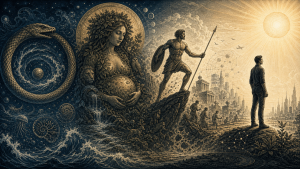
Neumann proposes a symbolic sequence from uroboric unity through separation, heroic consciousness, and transformation. The scale is ambitious and historically influential, but it must not be used to rank cultures or present mythology as established developmental science.
The Second Book
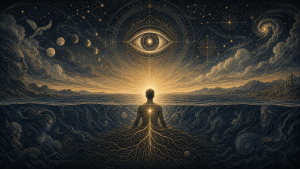
Edinger focuses on the individual’s contribution to consciousness and the religious implications of psychological development. The book is shorter, more concentrated, and more explicitly shaped by his reading of Jung and Western religious symbolism.
Which One Should You Read?
Choose Neumann for a panoramic mythic-developmental model. Choose Edinger for a concise statement about meaning, responsibility, and the ego’s relation to a larger psychic process.
A Useful Reading Sequence
Read Edinger first for orientation, then approach Neumann with modern anthropology and developmental scholarship nearby. Track which claims are symbolic and which appear historical.
What to Compare While Reading
Keep a two-column reading note rather than asking which author or volume is simply “right.” Record the central question, the kind of evidence being used, the historical setting, and the practical consequence of each interpretation. Separate direct statements from editorial framing and later commentary. When both books use the same word—such as Self, archetype, consciousness, soul, or symbol—check whether they mean exactly the same thing. Note what each volume explains well, what it leaves unresolved, and which claims need support from history, religious studies, anthropology, psychology, or another field. This method makes the comparison useful even when the books belong to different genres.
Before You Buy
Use the linked book records to confirm author, edition, format, and publication details. A commentary is not interchangeable with Jung’s primary text, and an abridged, illustrated, or lecture-based edition may serve a different purpose from a collected-work volume. Library borrowing and preview access are sensible ways to test a difficult book before purchasing it. If you buy through an Amazon link on this page, Individuationing may receive a commission at no additional cost to you.
Important Limit
Neither work should be treated as a validated universal sequence. Their value is interpretive and historical, not a license for cultural hierarchy.
How This Comparison Was Built
This guide distinguishes primary text from later commentary, identifies the question each book is best suited to answer, and links only to editions already verified in the site’s book catalog. Availability and prices can change on Amazon. The links below may earn this site a commission at no additional cost to you.
Continue your study
Recommended Reading
Books selected because they directly develop ideas discussed on this page.
The Origins and History of Consciousness
Erich Neumann’s The Origins and History of Consciousness uses mythic sequences to propose an archetypal model of ego development and the differentiation of consciousness.
The Creation of Consciousness
The Creation of Consciousness is Edward F. Edinger’s concise proposal for a modern Jungian worldview joining the scientific pursuit of knowledge with the religious search for…
Paid links. As an Amazon Associate I earn from qualifying purchases.
Related Concepts

Individuation
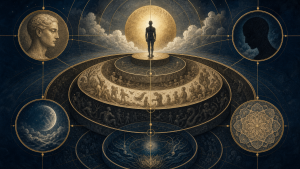
Individuation is Jung’s term for the lifelong process of becoming a more differentiated and integrated psychological whole.
Analytical Psychology
Analytical psychology, often called Jungian psychology, is Carl Jung’s approach to the psyche, unconscious life, symbols, and psychological development.
Related Books
The Origins and History of Consciousness
Erich Neumann’s The Origins and History of Consciousness uses mythic sequences to propose an archetypal model of ego development and the differentiation of consciousness.
The Creation of Consciousness
The Creation of Consciousness is Edward F. Edinger’s concise proposal for a modern Jungian worldview joining the scientific pursuit of knowledge with the religious search for meaning.