
Jungian Concept
Imago
An imago is an internal, subjectively shaped image of another person that must be distinguished from the person’s objective reality.

Definition
A subjectively conditioned internal image of a person or object, distinct from that person or object’s independent reality.
What Is an Imago?
In analytical psychology, an imago is the internal image through which a person experiences someone important. It is shaped by actual encounters, memory, emotion, expectation, fantasy, and broader patterns in the psyche. The imago is psychologically real, but it is not identical with the external person.
The Person and the Internal Image
No relationship is experienced without interpretation. Problems arise when the internal image becomes invisible and its qualities are treated as obvious facts about the other person. A parent, partner, teacher, leader, or opponent may then carry meanings that belong partly to earlier relationships or unconscious expectations.
Parental Imagos
Jung used the idea particularly to distinguish a person’s inner father- or mother-image from the literal parent. The internal image can remain active long after circumstances change. It may influence authority, intimacy, approval, conflict, and the kinds of people who attract unusually strong reactions.
How Imagos Appear
- Expecting a partner to provide the safety associated with an idealized caregiver
- Reacting to a supervisor as though disagreement will bring childhood punishment
- Dreaming of a familiar person whose behavior differs sharply from waking life
- Feeling immediate trust or distrust before enough evidence exists
Working with an Imago
Separate three layers: what the person has observably done, what you interpret it to mean, and what earlier image or expectation may be activated. This does not require blaming yourself or excusing harmful behavior. It creates room for both external evidence and subjective contribution.
Limits
The concept should never be used to claim that abuse, manipulation, discrimination, or danger is “only projection.” Internal images affect perception, but other people also act in consequential ways that require boundaries and evidence-based judgment.
Imago, Projection, and Relationships
An imago is the internal image; projection is one process through which qualities of that image may be experienced as belonging entirely to another person. The concepts overlap, but they are not identical. An imago can organize expectations and emotional reactions even when a person recognizes that the external relationship is more complicated.
This distinction helps preserve two kinds of evidence at once. A reaction may contain material from earlier relationships, while the present person may also be behaving in ways that deserve trust, caution, confrontation, or distance.
How to Recognize an Imago
Possible signs include unusually rapid idealization or distrust, expectations that feel older than the present relationship, recurring dreams in which one person carries a fixed role, and repeated conflicts with different people who are experienced in strikingly similar ways. None of these signs proves that an interpretation is correct.
Use the projection journal worksheet to separate observation, interpretation, emotion, and personal association. The goal is better discrimination—not automatically deciding that the problem is “all projection.”
Origin and Development
Jung used imago to distinguish inner representations—especially parental images—from literal parents and other external people.
Examples
- A supervisor carrying the emotional meaning of a punitive parent
- An idealized partner expected to repair earlier deprivation
- A dream figure based on someone familiar but functioning symbolically
Common Misconceptions
- An imago is not a photographically accurate memory.
- Recognizing an imago does not make external behavior unreal.
- The concept is not permission to ignore boundaries.
Continue your study
Recommended Reading
Books selected because they directly develop ideas discussed on this page.
Aion: Researches into the Phenomenology of the Self
Aion is Jung’s advanced study of the Self, the shadow, opposites, and the religious, astrological, Gnostic, and alchemical symbols of psychological totality.
Man and His Symbols
Man and His Symbols is an illustrated introduction to dreams, symbols, archetypes, and individuation written by Carl Jung and four close collaborators for general readers.
Ego and Archetype
Ego and Archetype is Edward F. Edinger’s influential Jungian study of individuation and the changing relationship between the conscious ego and the Self.
Paid links. As an Amazon Associate I earn from qualifying purchases.
Related Concepts

Projection
Projection is the largely unconscious process of experiencing one’s own psychological content as if it belonged primarily or entirely to another person, group, or object.

Complex
In Jungian psychology, a complex is an emotionally charged network of associations that can temporarily influence perception, emotion, and behavior.
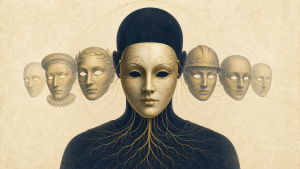
Persona
In Jungian psychology, the persona is the social identity or “mask” through which a person adapts to roles, expectations, and relationships.

Participation Mystique
Participation mystique is a Jungian term for an unconscious state of identity in which the boundary between subject and object, self and other, is insufficiently differentiated.

Personal Unconscious
In Jungian psychology, the personal unconscious contains experiences, perceptions, and emotionally charged material outside an individual’s present awareness.

Constellation
Constellation is the activation of a complex or archetypal pattern by a situation, causing connected emotions, memories, expectations, and behaviors to become unusually available.
Related Archetypes

Great Mother
The Great Mother is an archetypal pattern of origin, nourishment, protection, fertility, containment, engulfment, and destructive power.

Wise Old Person
The Wise Old Person is an archetypal guide figure associated with meaning, counsel, insight, and the danger of identifying with borrowed authority.

Child
The Child archetype represents vulnerable beginnings, unrealized potential, renewal, dependence, abandonment, and a future personality still developing.
Related Dream Symbols

Mirror
A mirror in a dream may concern self-recognition, appearance, identity, reversal, duplication, self-judgment, projection, or the unsettling failure to recognize oneself.

House
A house in a dream may represent the dreamer, a structure of personality, family life, memory, safety, or a psychological situation, depending on context.
Related Practices

Personal Association in Dream Work
Personal association explores the dreamer’s own memories, feelings, language, culture, sensory responses, and current circumstances around a specific dream image.

Shadow Work
Shadow work is a modern term for reflective practices that explore qualities, emotions, and patterns a person habitually rejects, hides, or fails to recognize in themselves.

Jungian Dream Analysis
Jungian dream analysis explores a dream’s personal associations, structure, emotional context, and possible compensatory relationship to conscious life without using fixed symbol definitions.
Related Books
Aion: Researches into the Phenomenology of the Self
Aion is Jung’s advanced study of the Self, the shadow, opposites, and the religious, astrological, Gnostic, and alchemical symbols of psychological totality.

Man and His Symbols
Man and His Symbols is an illustrated introduction to dreams, symbols, archetypes, and individuation written by Carl Jung and four close collaborators for general readers.

Ego and Archetype
Ego and Archetype is Edward F. Edinger’s influential Jungian study of individuation and the changing relationship between the conscious ego and the Self.
Related Psychologists

Carl Jung
Carl Gustav Jung was a Swiss psychiatrist who founded analytical psychology and developed influential ideas about complexes, archetypes, the collective unconscious, psychological types, and individuation.

Jolande Jacobi
Jolande Jacobi was a Swiss psychologist, author, and early interpreter of C. G. Jung whose systematic introductions helped make analytical psychology accessible.