Practice
Personal Association in Dream Work
Personal association explores the dreamer’s own memories, feelings, language, culture, sensory responses, and current circumstances around a specific dream image.
Purpose
To generate context-sensitive possibilities for a dream image while resisting fixed symbolic meanings, unlimited associative drift, and interpretations that override evidence or safety.
Instructions
- Record the dream in sequence.
- Select one emotionally charged or central image.
- Describe it literally before interpreting.
- List memories, feelings, phrases, sensory responses, relationships, and recent experiences it evokes.
- Add waking-life and cultural context.
- Return to the whole dream and test which associations fit its action and tone.
- Write at least two plausible readings, including an ordinary explanation.
- Keep the conclusion provisional and name disconfirming evidence.
Reflection Questions
- Which association is immediate, and which is best supported?
- What dream detail remains unexplained?
- Am I avoiding an ordinary explanation?
- How do personal and cultural contexts differ?
- What alternative reading deserves equal consideration?
Cautions and Boundaries
This educational practice is not diagnosis or therapy. A dream cannot establish another person’s motives, predict events, or replace evidence, professional advice, consent, or safety planning. Pause if the exercise increases panic, confusion, dissociation, sleep disruption, or difficulty distinguishing imagination from external events.
What Is Personal Association in Dream Work?
Personal association is the practice of exploring what a dream image evokes for the person who dreamed it. Instead of beginning with a universal definition, the dreamer records memories, feelings, phrases, sensory impressions, relationships, and recent events connected with the image.
In Jungian dream work, personal associations are an important starting point. They help prevent a symbol from being reduced to a fixed dictionary meaning. A snake, house, water, or bird may evoke very different material for different dreamers.
Why Begin With the Dreamer’s Own Context?
A dream occurs within a particular life. The dreamer’s history, culture, language, body, relationships, fears, hopes, and current circumstances affect what an image can plausibly mean. Beginning with that context provides evidence that a generic interpretation cannot supply.
Personal association does not prove that one meaning is correct. It produces possibilities that can be compared with the dream’s setting, action, emotional tone, ending, and waking-life situation.
Personal Association Is Not Endless Free Association
The goal is not to follow every thought until the original image disappears. Stay close to the image and repeatedly return to it. If the dream contains a locked door, explore associations to that door as it appeared: its material, condition, location, ownership, emotional effect, and role in the action.
A useful association clarifies the image’s place in the dream. An association may be interesting yet still lead away from the dream. Record it without forcing it into the interpretation.
A Step-by-Step Practice
- Record the dream first. Write what happened in sequence before analyzing it. Include the setting, people, objects, actions, changes, and ending.
- Select one image. Choose an image that feels emotionally charged, strange, repeated, or central to the action.
- Describe it literally. Note only what the dream presented. Separate observation from interpretation.
- List immediate associations. Write memories, people, places, sayings, media, bodily sensations, emotions, and personal experiences that arise.
- Add current context. Ask what was happening before the dream and what concerns were active in waking life.
- Return to the whole dream. Which associations fit the plot, mood, and ending? Which ones require ignoring important details?
- Develop alternatives. Write at least two plausible interpretations, including an ordinary explanation.
- Keep the conclusion provisional. State what the image may suggest and what evidence would weaken that reading.
Useful Association Prompts
- What is the first memory I have of this image?
- Where have I encountered something like it recently?
- What feeling or body response appears when I picture it?
- Who or what in my life shares its qualities?
- What words, expressions, stories, songs, films, or family sayings connect with it?
- What does this image mean in my culture, faith, profession, or community?
- What does the image do in the dream rather than merely represent?
- How would the meaning change if the dream’s ending were different?
Example: A Bird at a Closed Window
Suppose a dream includes a dark bird tapping at a closed window. One dreamer may associate birds with a beloved grandparent who watched them. Another may remember a frightening collision with a window. Someone else may connect the bird with migration, a recent job offer, a local species, or a poem.
The window also matters. Is it protecting the dreamer, preventing contact, offering a view, or creating a collision? Does the bird enter, leave, wait, or become injured? Personal associations become more useful when tested against these details rather than converted immediately into a message such as “the bird means freedom.”
When to Use Amplification
Symbol amplification adds parallels from mythology, religion, folklore, literature, art, and history. It can widen an image after personal context has been explored. It should not erase the dreamer’s experience or treat one cultural tradition as universal.
Personal association and amplification answer different questions. Association asks, “What does this image connect with in this life?” Amplification asks, “Where else has a similar image appeared, and what additional possibilities might those contexts reveal?”
Testing an Interpretation
A responsible interpretation should account for more of the dream without contradicting known facts. Consider:
- Does it fit the image’s actual behavior and emotional tone?
- Does it explain the dream’s movement from beginning to end?
- Does it acknowledge both personal and external realities?
- Can the interpretation coexist with another plausible reading?
- Does it invite reflection rather than command a major decision?
- What observation, memory, or later dream would challenge it?
Common Mistakes
- Choosing the most dramatic meaning instead of the best-supported one
- Ignoring recent experiences, stress, medication, sleep disruption, or ordinary memory processing
- Leaving the original image behind through an unlimited chain of associations
- Assuming a symbol has the same meaning for everyone
- Using symbolic language to deny concrete harm, conflict, illness, or practical responsibility
- Treating an interpretation as a prediction, diagnosis, or instruction
Reflection Questions
- Which association feels most immediate, and which is most strongly supported?
- What detail in the dream have I not yet accounted for?
- Am I using a symbolic explanation to avoid an ordinary one?
- How might my cultural or family background shape this association?
- What alternative interpretation deserves equal consideration?
- What small, reversible reflection could test this reading without treating it as fact?
Boundaries and Safety
This practice is educational, not diagnostic or therapeutic. Dreams do not establish another person’s motives, reveal hidden crimes, predict events, or provide medical guidance. A symbolic interpretation must never override evidence, consent, safety planning, professional advice, or concrete action when harm is occurring.
If dream work increases panic, confusion, loss of sleep, dissociation, or difficulty distinguishing imagination from external events, pause the practice and seek appropriate support. The aim is reflective curiosity with intact reality testing.
Language, Idiom, and Private Meaning
Associations often hide in exact wording: nicknames, puns, family phrases, bilingual meanings, misheard words, brand names, songs, and local idioms. Record the dream’s original language before translating or generalizing it. A dictionary definition may miss the private history carried by a phrase. Cultural amplification should follow this linguistic work rather than replacing it.
Sources and Further Reading
- Daryl Sharp, Jung Lexicon: Association, Amplification, and Dreams.
- Christian Roesler, research on dream content and the dreamer’s waking-life situation.
- Jungian Dream Analysis for the wider interpretive framework.
- Personal Association Worksheet for a private, structured way to record associations.
Continue your study
Recommended Reading
Books selected because they directly develop ideas discussed on this page.
Man and His Symbols
Man and His Symbols is an illustrated introduction to dreams, symbols, archetypes, and individuation written by Carl Jung and four close collaborators for general readers.
Memories, Dreams, Reflections
Memories, Dreams, Reflections is a semi-autobiographical account assembled from Carl Jung's recollections, manuscripts, and conversations with editor Aniela Jaffé.
The Red Book: Liber Novus
The Red Book: Liber Novus records and artistically develops Carl Jung's confrontation with inner figures and images during a formative period of his psychology.
Paid links. As an Amazon Associate I earn from qualifying purchases.
Public-domain audio
Listen free on LibriVox
Related Concepts
Personal Unconscious
In Jungian psychology, the personal unconscious contains experiences, perceptions, and emotionally charged material outside an individual’s present awareness.
Complex
In Jungian psychology, a complex is an emotionally charged network of associations that can temporarily influence perception, emotion, and behavior.
Archetype
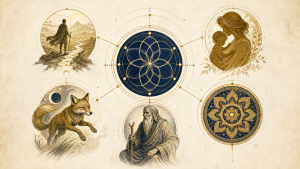
An archetype is an inherited organizing pattern in Jung’s theory that can shape recurring forms of imagery, emotion, perception, and behavior without prescribing one fixed image.
Projection
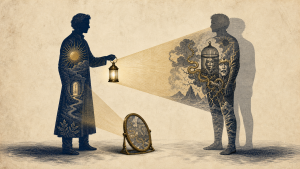
Projection is the largely unconscious process of experiencing one’s own psychological content as if it belonged primarily or entirely to another person, group, or object.
Synchronicity
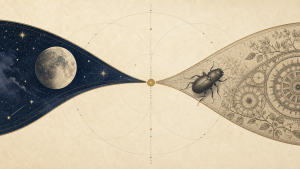
Synchronicity is Jung’s term for a meaningful coincidence between an inner psychological state and an external event when no adequate causal connection is apparent.
Mandala
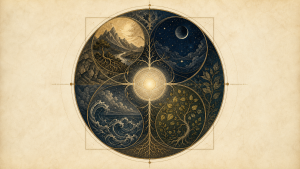
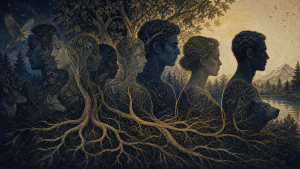
A mandala is a centered, often circular symbolic form that Jung associated with psychic order, wholeness, containment, and the Self.
Participation Mystique
Participation mystique is a Jungian term for an unconscious state of identity in which the boundary between subject and object, self and other, is insufficiently differentiated.

Enantiodromia
Enantiodromia is the emergence of an unconscious counter-position after a conscious attitude becomes rigid, extreme, or chronically one-sided.

Imago
An imago is an internal, subjectively shaped image of another person that must be distinguished from the person’s objective reality.
Constellation
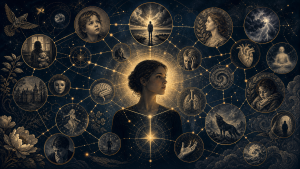
Constellation is the activation of a complex or archetypal pattern by a situation, causing connected emotions, memories, expectations, and behaviors to become unusually available.
Related Archetypes

Wise Old Person
The Wise Old Person is an archetypal guide figure associated with meaning, counsel, insight, and the danger of identifying with borrowed authority.
Child
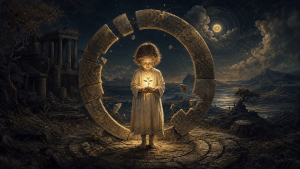
The Child archetype represents vulnerable beginnings, unrealized potential, renewal, dependence, abandonment, and a future personality still developing.
Trickster
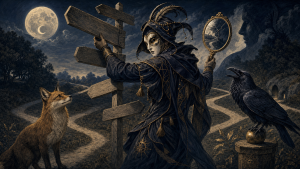
The Trickster is an archetypal boundary-breaker whose humor, appetite, deception, mistakes, and reversals can expose rigidity while also causing real harm.

Maiden (Kore)
The Maiden, or Kore, is an archetypal image of youth, potential, vulnerability, separation, descent, renewal, and an identity not yet fully differentiated.

Puer Aeternus
Puer aeternus, the eternal-youth archetype, carries possibility, freedom, renewal, and imagination but becomes one-sided when potential repeatedly replaces commitment and lived experience.

Senex
The Senex archetype carries time, structure, discipline, memory, authority, limit, and responsibility; one-sided, it may harden into rigidity, control, sterility, or punitive order.
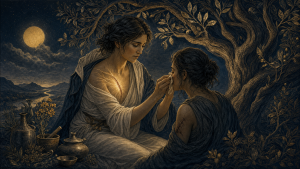
Wounded Healer
The Wounded Healer archetype holds vulnerability and the capacity to help in tension while requiring self-knowledge, competence, accountability, and clear boundaries.
Related Dream Symbols
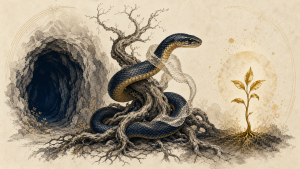
Snake
A snake in a dream can evoke danger, instinct, transformation, healing, sexuality, wisdom, or something unfamiliar—but its meaning depends on the dream’s details and the dreamer’s associations.

House
A house in a dream may represent the dreamer, a structure of personality, family life, memory, safety, or a psychological situation, depending on context.

Water
Water in a dream may relate to emotion, bodily life, the unconscious, renewal, danger, depth, or overwhelming experience, depending on its form and context.

Forest
A forest in a dream may suggest an unfamiliar psychological territory, instinctive life, concealment, danger, refuge, disorientation, or a path of discovery.

Door
A door in a dream may suggest access, exclusion, transition, opportunity, secrecy, protection, choice, or a boundary between psychological situations.

Mirror
A mirror in a dream may concern self-recognition, appearance, identity, reversal, duplication, self-judgment, projection, or the unsettling failure to recognize oneself.

Bird
A bird in a dream may raise questions about perspective, movement, voice, care, migration, territory, vulnerability, or confinement, depending on the species and complete context.

Mountain
A mountain dream may evoke challenge, perspective, endurance, isolation, boundary, permanence, sacred space, or a goal, depending on the mountain and the dreamer’s relationship to it.
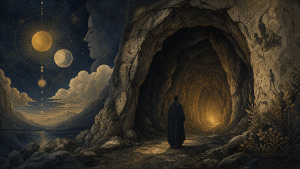
Cave
A cave in a dream may evoke concealment, shelter, descent, gestation, fear, burial, or contact with what lies outside ordinary awareness.

Bridge
A bridge in a dream may represent passage, connection, risk, separation, transition, or the practical means of moving between two conditions.

River
A river in a dream may evoke movement, time, emotion, direction, boundary, renewal, danger, or a process larger than conscious control.
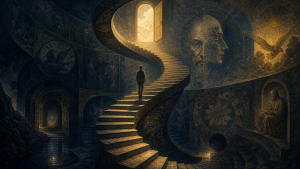
Stairs
Stairs in a dream may emphasize gradual movement between levels, effort, access, hierarchy, descent, ascent, repetition, or an interrupted transition.

Cat Dream Meaning
A cat in a dream may draw attention to autonomy, closeness, watchfulness, vulnerability, instinct, or a specific personal relationship with cats.
Spider Dream Meaning
A spider dream may involve creativity, patient construction, entanglement, fear, predation, attention to detail, or an ordinary encounter with spiders.
Teeth Falling Out Dream Meaning
Dreams of teeth falling out may involve appearance, speech, loss of control, aging, vulnerability, bodily sensation, or current dental concerns.
Flying Dream Meaning
Flying dreams may involve freedom, perspective, confidence, escape, inflation, instability, fear of falling, or the sensory qualities of sleep.
Fire Dream Meaning
Fire dreams may involve warmth, anger, danger, destruction, purification, energy, transformation, renewal, or a recent real-world concern.
Wedding Dream Meaning
A wedding dream may concern union, commitment, transition, conflict, public expectation, identity, memory, or an actual relationship and upcoming event.
Fish Dream Meaning
Fish in dreams may involve vitality, nourishment, depth, adaptation, capture, abundance, vulnerability, spiritual imagery, or ordinary experience with water and food.

Owl Dream Meaning
An owl dream may involve perception, night awareness, vigilance, knowledge, predation, silence, fear, death imagery, or a recent encounter with birds.
Horse Dream Meaning
A horse dream may concern vitality, movement, partnership, labor, status, control, freedom, fear, sexuality, or a specific history with horses.

Wolf Dream Meaning
A wolf dream may involve instinct, group belonging, threat, protection, isolation, pursuit, social order, wilderness, or learned cultural imagery.
Bathroom Dream Meaning
A bathroom dream may organize concerns about privacy, exposure, bodily needs, relief, cleanliness, shame, or finding an acceptable place to deal with something personal.
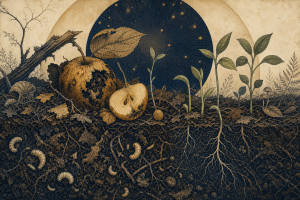
Maggots Dream Meaning
Maggots in a dream may focus attention on decay, disgust, neglected material, transformation, decomposition, contamination, or an organic process that continues outside conscious control.
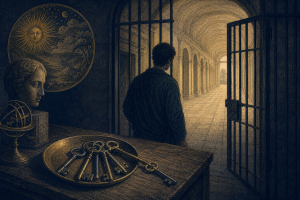
Going to Jail Dream Meaning
A jail dream may stage restriction, guilt, consequences, loss of choice, judgment, confinement, responsibility, or fear that a situation has become difficult to escape.
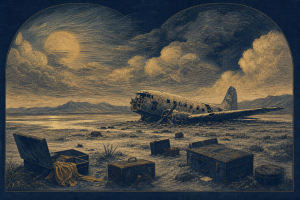
Plane Crash Dream Meaning
A plane-crash dream may dramatize disrupted plans, rapid loss of control, fear of failure, danger at a distance, an ambitious trajectory breaking down, or ordinary anxiety about travel.

Childbirth Dream Meaning
A childbirth dream may concern creation, responsibility, vulnerability, transition, labor, bodily memory, a developing project, or anxiety about an irreversible new phase.

Funeral Dream Meaning
A funeral dream may organize grief, memory, social ritual, unfinished goodbye, fear of loss, or recognition that a role, relationship, expectation, or life phase has ended.

Finding Money Dream Meaning
Finding money in a dream may raise questions about value, opportunity, ownership, resources, luck, self-worth, obligation, or the discovery of something useful that was overlooked.

Black Bear Dream Meaning
A black-bear dream may involve strength, territorial boundaries, caution, protection, appetite, solitude, maternal defense, wilderness, or fear of a powerful presence.

Partner Cheating Dream Meaning
A dream about a partner cheating may express insecurity, fear of replacement, past betrayal, emotional distance, comparison, unmet needs, or ordinary relationship anxiety without proving actual infidelity.
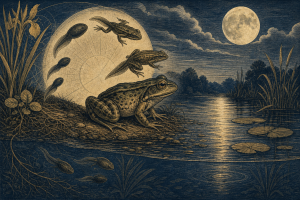
Frog Dream Meaning
A frog dream may organize themes of adaptation, transition between environments, sensitivity, sound, fertility, disgust, transformation, or attention to conditions that support life.

Crab Dream Meaning
A crab dream may concern protection, vulnerability beneath a hard exterior, indirect movement, defensiveness, grasping, tidal change, nourishment, or life at a boundary.

Turtle Dream Meaning
A turtle dream may involve protection, patience, pacing, withdrawal, endurance, vulnerability, home, age, or movement between water and land.
Cockroach Dream Meaning
A cockroach dream may involve disgust, persistence, contamination, neglected conditions, survival, intrusion, or a recent real-world encounter.
Tsunami Dream Meaning
A tsunami dream may involve overwhelming change, fear, helplessness, collective danger, emotional intensity, disaster imagery, or recent media exposure.
Tiger Dream Meaning
A tiger dream may concern power, beauty, predation, territoriality, fear, protection, captivity, cultural imagery, or a recent encounter with animal media.
Shoes Dream Meaning
Shoes in dreams may involve movement, readiness, identity, social presentation, protection, work, fit, loss, or an ordinary concern about clothing.
Cutting Hair Dream Meaning
A hair-cutting dream may involve appearance, identity, consent, change, control, loss, relief, ritual, or a recent real haircut or grooming concern.
Broken Glass Dream Meaning
Broken glass in a dream may involve danger, damaged boundaries, visibility, fragility, anger, cleanup, transition, or memory of an actual breakage.
Snake Bite Dream Meaning
A snake-bite dream may involve sudden threat, bodily alarm, conflict, transformation imagery, medical fear, betrayal concerns, or a recent snake-related stimulus.
Death Dream Meaning
A death dream may involve grief, fear, transition, separation, memory, identity change, health anxiety, or ordinary processing of loss and mortality.
Dream Within a Dream Meaning
A dream within a dream may involve false awakening, uncertainty, layered perspective, sleep disruption, reality checking, narrative complexity, or anxiety about being unable to wake.
Lion Dream Meaning
A lion dream may involve authority, courage, predation, pride, protection, status, family structure, captivity, or familiar cultural imagery.
Ant Dream Meaning
Ants in dreams may involve cooperation, repetitive labor, organization, intrusion, small accumulated problems, persistence, or a literal pest concern.
Crow Dream Meaning
A crow dream may involve intelligence, observation, social signaling, scavenging, death imagery, adaptation, noise, or an ordinary encounter with urban wildlife.
Train Dream Meaning
A train dream may concern direction, schedules, collective movement, missed opportunities, limited routes, transitions, work, travel, or an actual journey.
Falling Off a Cliff Dream Meaning
Falling from a cliff in a dream may involve loss of footing, risk, transition, helplessness, exhilaration, bodily sleep sensations, or fear of irreversible consequences.
Tornado Dream Meaning
A tornado dream may involve rapidly changing danger, loss of control, concentrated force, family safety, weather anxiety, conflict, or recent storm coverage.
Dog Bite Dream Meaning
A dog-bite dream may involve violated trust, defensive aggression, fear, boundaries, loyalty conflict, bodily alarm, or a real experience with dogs.
Snow Dream Meaning
Snow in dreams may involve quiet, cold, concealment, renewal, isolation, danger, play, seasonal memory, or an ordinary response to weather.
Elevator Dream Meaning
An elevator dream may involve rapid change, status, limited control, confinement, transition between levels, mechanical fear, or an ordinary building experience.
Drowning Dream Meaning
A drowning dream may involve panic, helplessness, emotional overwhelm, rescue, bodily breathing disturbance, grief, or a literal fear of water.
Blood Dream Meaning
Blood in a dream may involve injury, vitality, menstruation, kinship, sacrifice, fear, illness, violence, or a recent bodily concern.
Killer Whale Dream Meaning
A killer-whale dream may involve intelligence, family bonds, coordinated power, ocean depth, captivity, danger, awe, or recent marine media.
Keys Dream Meaning
Keys in dreams may involve access, responsibility, privacy, permission, security, solution seeking, loss, or an ordinary concern about misplaced keys.
Bee Dream Meaning
Bees in dreams may involve cooperation, labor, pollination, sweetness, danger, social organization, environmental concern, or a literal fear of stings.
Zombie Dream Meaning
A zombie dream may involve contagion fears, emotional numbness, crowd pressure, exhaustion, dehumanization, survival narratives, or recent horror media.
Bat Dream Meaning
A bat dream may involve navigation in darkness, fear, social roosting, illness associations, transformation stories, wildlife encounters, or recent media.
Related Books
Man and His Symbols
Man and His Symbols is an illustrated introduction to dreams, symbols, archetypes, and individuation written by Carl Jung and four close collaborators for general readers.

Memories, Dreams, Reflections
Memories, Dreams, Reflections is a semi-autobiographical account assembled from Carl Jung's recollections, manuscripts, and conversations with editor Aniela Jaffé.
The Red Book: Liber Novus
The Red Book: Liber Novus records and artistically develops Carl Jung's confrontation with inner figures and images during a formative period of his psychology.
The Archetypes and the Collective Unconscious
The Archetypes and the Collective Unconscious collects major essays in which Carl Jung develops his accounts of archetypes, collective psychic patterns, rebirth, the mother, the child, and individuation.

Ego and Archetype
Ego and Archetype is Edward F. Edinger’s influential Jungian study of individuation and the changing relationship between the conscious ego and the Self.
The Eternal Drama
The Eternal Drama is Edward F. Edinger’s Jungian exploration of major Greek myths and divine figures as recurring images of psychological conflict, development, and transformation.

The Sacred Psyche
The Sacred Psyche is Edward F. Edinger’s psychological interpretation of the Psalms, developed from lectures and focused on their continuing significance in individual experience.
Encounter with the Self
Encounter with the Self is Edward F. Edinger’s Jungian commentary on William Blake’s illustrations of the Book of Job and their imagery of psychic and religious transformation.

Science of the Soul
Science of the Soul is a posthumous collection of five Edinger essays on psychotherapy, transference, vocation, the greater personality, and Jungian psychological method.

Melville’s Moby-Dick: An American Nekyia
Melville’s Moby-Dick is Edinger’s Jungian interpretation of Melville’s novel as an American nekyia—a descent into dangerous and transformative psychic depths.

The Mysterium Lectures
The Mysterium Lectures is Edinger’s extensive chapter-by-chapter guide to Jung’s Mysterium Coniunctionis and its relevance to dreams and psychological life.

The Bible and the Psyche
The Bible and the Psyche is Edinger’s Jungian commentary on individuation symbolism in biblical books from Genesis through Esther.