Jungian Concept
Carl Jung vs. Sigmund Freud
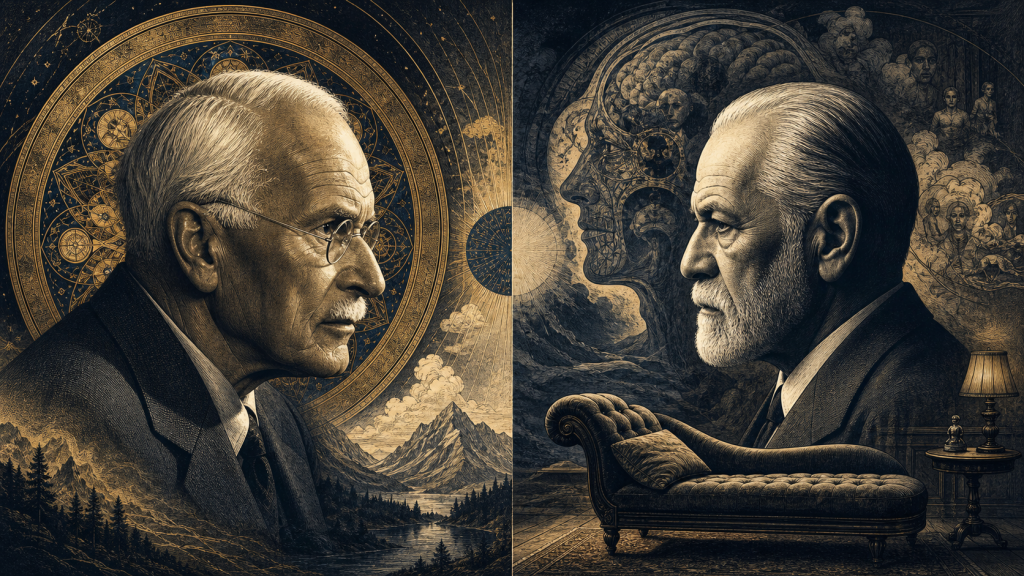
Carl Jung and Sigmund Freud shared an early psychoanalytic alliance but diverged over libido, religion, symbols, the unconscious, and the aims of psychological development.
Definition
A comparison of the overlapping foundations and major theoretical differences between Freud’s psychoanalysis and Jung’s analytical psychology.
What Jung and Freud shared
Both treated symptoms, dreams, slips, fantasies, and relationships as psychologically meaningful. Both argued that conscious intention does not fully explain human behavior, and both developed forms of depth psychology centered on unconscious processes.
The unconscious
Freud’s model emphasized repressed wishes, conflicts, and developmental history. Jung retained a personal unconscious but proposed an additional collective level expressed through archetypal patterns. This was one of their most consequential differences.
Dreams and symbols
Freud’s dream theory emphasized disguised wish fulfillment and the transformations performed by dream work. Jung placed greater weight on compensation, prospective possibilities, personal associations, and recurring mythic patterns. Neither method is accurately reduced to a universal symbol dictionary.
Development and therapy
Freud’s model focused strongly on conflict, repression, and psychosexual development. Jung’s later model emphasized the relation between ego and Self, psychological opposites, and individuation across adulthood. Modern clinicians may borrow from either tradition without accepting every historical claim.
Origin and Development
Jung became an important figure in the early psychoanalytic movement and served as the first president of the International Psychoanalytical Association. Their collaboration deteriorated as Jung developed positions that Freud considered incompatible with psychoanalysis, and their personal and professional break became final in the 1910s.
Examples
- Freud generally treated libido as sexual energy; Jung broadened libido into psychic energy.
- Freud emphasized repression and infantile conflict; Jung added inherited archetypal patterns and a collective unconscious.
- Freud often interpreted religion as illusion or wish fulfillment; Jung studied religion as psychologically consequential symbolic experience.
- Jung framed individuation and integration as central aims of later development.
Common Misconceptions
- Jung did not simply reject everything Freud taught.
- Freud did not claim every dream image had one fixed sexual meaning.
- Their disagreement was theoretical, institutional, and personal—not one single argument.
- MBTI is not a direct test created by Jung.
Continue your study
Recommended Reading
Books selected because they directly develop ideas discussed on this page.
Memories, Dreams, Reflections
Memories, Dreams, Reflections is a semi-autobiographical account assembled from Carl Jung's recollections, manuscripts, and conversations with editor Aniela Jaffé.
Man and His Symbols
Man and His Symbols is an illustrated introduction to dreams, symbols, archetypes, and individuation written by Carl Jung and four close collaborators for general readers.
The Archetypes and the Collective Unconscious
The Archetypes and the Collective Unconscious collects major essays in which Carl Jung develops his accounts of archetypes, collective psychic patterns, rebirth, the mother, the child,…
Paid links. As an Amazon Associate I earn from qualifying purchases.
Related Concepts
Analytical Psychology
Analytical psychology, often called Jungian psychology, is Carl Jung’s approach to the psyche, unconscious life, symbols, and psychological development.
Personal Unconscious
In Jungian psychology, the personal unconscious contains experiences, perceptions, and emotionally charged material outside an individual’s present awareness.
Collective Unconscious
In Jungian psychology, the collective unconscious is a proposed inherited layer of the psyche expressed through universal patterns called archetypes.
Psychic Energy
Psychic energy, often called libido by Jung, is a conceptual way of describing the intensity, direction, and movement of psychological interest and desire.

Individuation
Individuation is Jung’s term for the lifelong process of becoming a more differentiated and integrated psychological whole.
Complex
In Jungian psychology, a complex is an emotionally charged network of associations that can temporarily influence perception, emotion, and behavior.
Related Books

Memories, Dreams, Reflections
Memories, Dreams, Reflections is a semi-autobiographical account assembled from Carl Jung's recollections, manuscripts, and conversations with editor Aniela Jaffé.

Man and His Symbols
Man and His Symbols is an illustrated introduction to dreams, symbols, archetypes, and individuation written by Carl Jung and four close collaborators for general readers.
The Archetypes and the Collective Unconscious
The Archetypes and the Collective Unconscious collects major essays in which Carl Jung develops his accounts of archetypes, collective psychic patterns, rebirth, the mother, the child, and individuation.
Related Psychologists
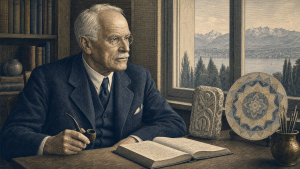
Carl Jung
Carl Gustav Jung was a Swiss psychiatrist who founded analytical psychology and developed influential ideas about complexes, archetypes, the collective unconscious, psychological types, and individuation.
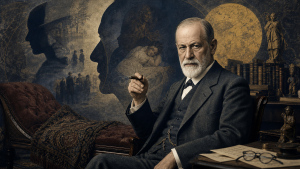
Sigmund Freud
Sigmund Freud was an Austrian neurologist and the founder of psychoanalysis whose work on unconscious conflict, dreams, sexuality, and transference profoundly shaped Carl Jung’s early career.