Psychologist
Sigmund Freud
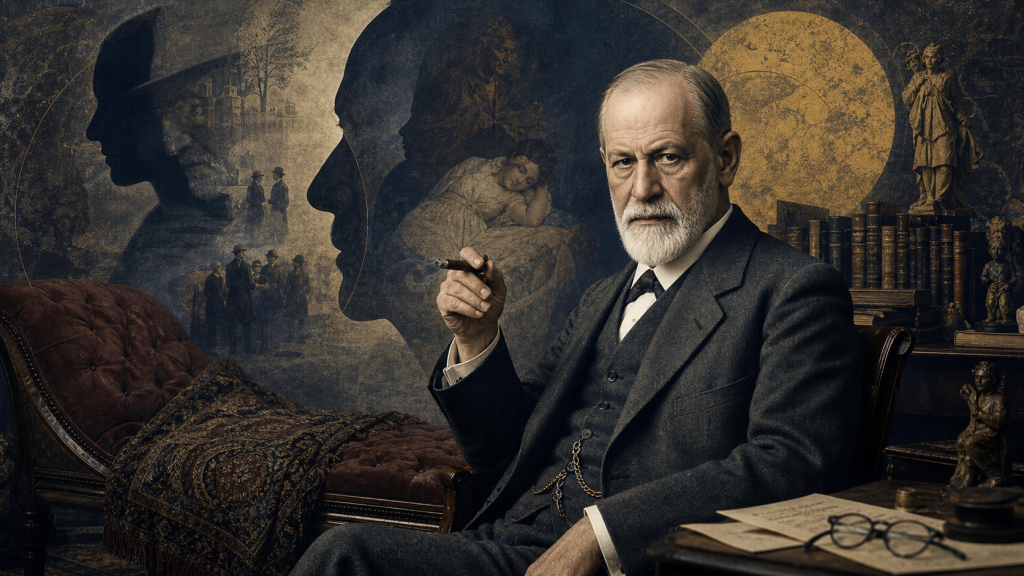
Sigmund Freud was an Austrian neurologist and the founder of psychoanalysis whose work on unconscious conflict, dreams, sexuality, and transference profoundly shaped Carl Jung’s early career.
Known For
Founder of psychoanalysis; theories of unconscious conflict, repression, dream work, psychosexual development, transference, and the structural model of id, ego, and superego.
Biography
Freud trained as a physician and neurologist in Vienna before developing psychoanalysis through clinical work, collaboration, and extensive theoretical writing. His movement transformed psychiatry, literature, cultural criticism, and ideas about unconscious motivation. He left Austria after the Nazi annexation and died in London.
Key Ideas
- Dynamic unconscious and repression
- Dream work and wish fulfillment
- Free association
- Transference and resistance
- Psychosexual development
- Id, ego, and superego
- Conflict between desire, defense, and social constraint
Freud and the birth of psychoanalysis
Freud developed a method centered on free association, interpretation, resistance, and transference. His theories changed substantially over time, so no single slogan captures the full body of work.
Relationship with Jung
Freud saw Jung as an important leader who might broaden the international reach of psychoanalysis. Jung valued Freud’s discovery of unconscious conflict but increasingly rejected the primacy Freud gave to sexuality and developed a broader theory of psychic energy, symbols, and collective patterns.
The break
Their alliance ended through accumulating theoretical, institutional, and personal tensions. The split helped define psychoanalysis and analytical psychology as distinct traditions.
Influence and criticism
Freud’s impact is undeniable, while many specific claims remain disputed or unsupported by modern evidence. Responsible study distinguishes historical importance, clinical concepts that evolved, and propositions requiring independent empirical support.
Continue your study
Recommended Reading
Books selected because they directly develop ideas discussed on this page.
Two Essays on Analytical Psychology
Two central essays in which Carl Jung explains the ego, personal and collective unconscious, persona, anima, and the movement toward individuation.
Memories, Dreams, Reflections
Memories, Dreams, Reflections is a semi-autobiographical account assembled from Carl Jung's recollections, manuscripts, and conversations with editor Aniela Jaffé.
Paid links. As an Amazon Associate I earn from qualifying purchases.
Public-domain audio
Listen free on LibriVox
Related Concepts

Personal Unconscious
In Jungian psychology, the personal unconscious contains experiences, perceptions, and emotionally charged material outside an individual’s present awareness.

Ego
In Jungian psychology, the ego is the central complex of consciousness: the organizing “I” that experiences identity, makes choices, and adapts to inner and outer life.

Projection
Projection is the largely unconscious process of experiencing one’s own psychological content as if it belonged primarily or entirely to another person, group, or object.

Complex
In Jungian psychology, a complex is an emotionally charged network of associations that can temporarily influence perception, emotion, and behavior.
Carl Jung vs. Sigmund Freud
Carl Jung and Sigmund Freud shared an early psychoanalytic alliance but diverged over libido, religion, symbols, the unconscious, and the aims of psychological development.

Analytical Psychology
Analytical psychology, often called Jungian psychology, is Carl Jung’s approach to the psyche, unconscious life, symbols, and psychological development.
Related Books

Two Essays on Analytical Psychology
Two central essays in which Carl Jung explains the ego, personal and collective unconscious, persona, anima, and the movement toward individuation.

Memories, Dreams, Reflections
Memories, Dreams, Reflections is a semi-autobiographical account assembled from Carl Jung's recollections, manuscripts, and conversations with editor Aniela Jaffé.