Interactive Tool
Criticisms of Carl Jung’s Theories
Major criticisms of Carl Jung’s theories concern empirical testability, broad interpretation, cultural generalization, historical gender assumptions, clinical evidence, and the risk of unfalsifiable explanation.

Purpose
Present Jung’s influence and limitations together so readers can distinguish historical importance, clinical interpretation, and empirical support.
Instructions
Read each criticism beside the strongest Jungian response. Then separate historical claims, clinical hypotheses, symbolic interpretations, and empirically testable propositions.
Privacy
This critical guide does not collect personal information.
Important Disclaimer
This is an educational overview, not a final verdict on every Jungian school or contemporary practitioner.
1. Testability and falsifiability
Concepts such as archetypes and synchronicity can be defined so broadly that contrary evidence is difficult to specify. Critics argue that a theory explaining nearly any outcome risks predicting none.
Jungian response: Some Jungians treat these concepts as interpretive frameworks rather than simple laboratory variables; others pursue operational definitions and outcome research. The response clarifies purpose but does not remove the need to state what would count against a claim.
2. Clinical evidence
Jung’s writings rely heavily on cases, comparative symbolism, and interpretive argument. These can generate hypotheses but do not by themselves establish treatment efficacy or universal mechanisms.
Jungian response: Contemporary analytical psychology has a growing psychotherapy research literature. Evidence for a treatment tradition, however, should not be treated as automatic confirmation of every theoretical proposition Jung made.
3. Cultural generalization
Jung compared myths and symbols across cultures, sometimes using categories shaped by European scholarship and colonial-era assumptions. Similarity can be overstated while historical context and local meaning are flattened.
Jungian response: Careful comparative work can identify recurring human problems without claiming identical meanings. It requires collaboration with cultural specialists and attention to power, translation, and difference.
4. Gender and sexuality
Classical anima–animus formulations often rely on binary and essentialist assumptions. Some descriptions of women, men, and homosexuality reflect the limitations of Jung’s period.
Jungian response: Many post-Jungians revise these ideas toward plurality, relational patterns, and excluded qualities rather than fixed sex-based inner figures. Readers should identify clearly when a modern revision differs from Jung’s original position.
5. Mysticism and authority
Jung’s engagement with religion, alchemy, astrology, and paranormal reports can blur psychological interpretation with claims about external reality. His authority is sometimes used online to legitimize assertions he did not establish.
Jungian response: Jung frequently distinguished psychological reality from metaphysical proof and sometimes acknowledged uncertainty. Responsible use preserves that distinction and verifies quotations and context.
A balanced conclusion
Jung can be historically influential, clinically generative, personally meaningful, and scientifically contestable at the same time. A strong knowledge base neither dismisses the tradition wholesale nor protects it from criticism.
What Are the Main Criticisms of Carl Jung’s Theories?
The main criticisms are that some Jungian claims are difficult to test or falsify, Jung often generalized across cultures, his classical gender theory reflects binary assumptions, and later admirers sometimes treat symbolic interpretation as scientific or metaphysical proof. Critics also question how far case studies and comparative mythology can support universal psychological claims.
Jungian responses usually distinguish clinical and interpretive usefulness from experimental proof. That distinction can preserve the value of a symbolic framework, but it does not turn every Jungian claim into established science. The strongest evaluation asks what kind of claim is being made and what evidence would be appropriate for it.
Continue your study
Recommended Reading
Books selected because they directly develop ideas discussed on this page.
Man and His Symbols
Man and His Symbols is an illustrated introduction to dreams, symbols, archetypes, and individuation written by Carl Jung and four close collaborators for general readers.
The Archetypes and the Collective Unconscious
The Archetypes and the Collective Unconscious collects major essays in which Carl Jung develops his accounts of archetypes, collective psychic patterns, rebirth, the mother, the child,…
Aion: Researches into the Phenomenology of the Self
Aion is Jung’s advanced study of the Self, the shadow, opposites, and the religious, astrological, Gnostic, and alchemical symbols of psychological totality.
Paid links. As an Amazon Associate I earn from qualifying purchases.
Related Concepts

Analytical Psychology
Analytical psychology, often called Jungian psychology, is Carl Jung’s approach to the psyche, unconscious life, symbols, and psychological development.
Archetype
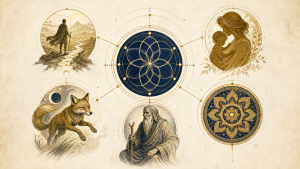
An archetype is an inherited organizing pattern in Jung’s theory that can shape recurring forms of imagery, emotion, perception, and behavior without prescribing one fixed image.

Collective Unconscious
In Jungian psychology, the collective unconscious is a proposed inherited layer of the psyche expressed through universal patterns called archetypes.

Anima and Animus
Anima and animus are Jung’s historically gendered terms for inner otherness, relational projection, and qualities excluded from conscious identity.
Synchronicity
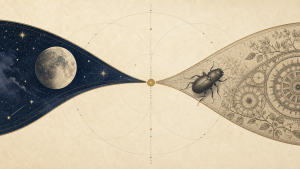
Synchronicity is Jung’s term for a meaningful coincidence between an inner psychological state and an external event when no adequate causal connection is apparent.
Psychological Types
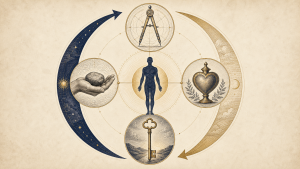
Jung’s psychological types combine two attitudes—introversion and extraversion—with four functions: thinking, feeling, sensation, and intuition.
Related Psychologists

Related Books

Man and His Symbols
Man and His Symbols is an illustrated introduction to dreams, symbols, archetypes, and individuation written by Carl Jung and four close collaborators for general readers.

The Archetypes and the Collective Unconscious
The Archetypes and the Collective Unconscious collects major essays in which Carl Jung develops his accounts of archetypes, collective psychic patterns, rebirth, the mother, the child, and individuation.
Aion: Researches into the Phenomenology of the Self
Aion is Jung’s advanced study of the Self, the shadow, opposites, and the religious, astrological, Gnostic, and alchemical symbols of psychological totality.

Memories, Dreams, Reflections
Memories, Dreams, Reflections is a semi-autobiographical account assembled from Carl Jung's recollections, manuscripts, and conversations with editor Aniela Jaffé.