
Assessment
Archetypal Image Context Check
A non-diagnostic checklist for deciding whether an image deserves archetypal amplification without ignoring personal history, culture, external reality, or uncertainty.

Purpose
To check whether archetypal amplification is contextually justified and ethically grounded.
Instructions
Choose one image and answer each item Yes, Partly, or No. Use unanswered items to guide further research and personal reflection.
Important Disclaimer
Educational and non-diagnostic. This checklist cannot prove an archetype, spiritual claim, prediction, or interpretation.
Should You Amplify This Image Archetypally?
The Archetypal Image Context Check helps prevent a common mistake: labeling every powerful image an archetype before examining personal and cultural meaning.
Answer Yes, Partly, or No
- I recorded the exact image and its full sequence.
- I gathered personal associations first.
- I considered literal memories and current circumstances.
- I identified the image’s cultural or religious context.
- The image has unusual emotional intensity or patterned structure.
- Its meaning is not exhausted by a familiar explanation.
- I found more than one reliable historical parallel.
- I can explain why those parallels fit this specific image.
- I considered external relationships as well as subjective meaning.
- I can hold the interpretation as a hypothesis.
- The interpretation increases responsibility rather than superiority.
- I am not using symbolism to avoid practical action.
Reading the Result
Several “No” answers mean more contextual work is needed. Even all “Yes” answers do not prove that an image is archetypal. The purpose is methodological discipline, not certification.
Inflation Warning
Pause if the interpretation makes you feel uniquely chosen, prophetic, spiritually superior, or exempt from ordinary evidence. Review Psychological Inflation.
Next Step
Use Circumambulation to remain close to the image and the Mandala Reflection Worksheet only when the image actually has centered or fourfold organization.
Context Before Archetype
An image may resemble an archetypal motif and still be better explained by personal memory, a recent event, cultural knowledge, or ordinary media exposure. Complete those parts of the check first. When an archetypal comparison remains useful, name the specific source and identify both similarities and differences. Broad labels such as “Hero” or “Mother” should open questions, not replace the image’s actual details.
Continue your study
Recommended Reading
Books selected because they directly develop ideas discussed on this page.
Man and His Symbols
Man and His Symbols is an illustrated introduction to dreams, symbols, archetypes, and individuation written by Carl Jung and four close collaborators for general readers.
The Archetypes and the Collective Unconscious
The Archetypes and the Collective Unconscious collects major essays in which Carl Jung develops his accounts of archetypes, collective psychic patterns, rebirth, the mother, the child,…
Paid links. As an Amazon Associate I earn from qualifying purchases.
Related Concepts

Individuation
Individuation is Jung’s term for the lifelong process of becoming a more differentiated and integrated psychological whole.

Collective Unconscious
In Jungian psychology, the collective unconscious is a proposed inherited layer of the psyche expressed through universal patterns called archetypes.

Self
The Self is Jung’s concept of the whole psyche—conscious and unconscious—and the archetypal principle of its organization, development, and potential integration.
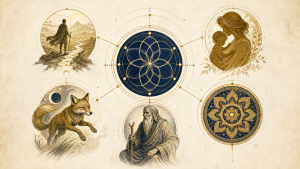
Archetype
An archetype is an inherited organizing pattern in Jung’s theory that can shape recurring forms of imagery, emotion, perception, and behavior without prescribing one fixed image.

Transcendent Function
The transcendent function is the new psychological attitude or symbolic possibility that can emerge when conscious and unconscious positions are held in genuine dialogue.

Psychological Inflation
Psychological inflation is an expanded or diminished self-estimate caused by identifying the ego with an archetype, role, group, insight, or unconscious content.

Mandala
A mandala is a centered, often circular symbolic form that Jung associated with psychic order, wholeness, containment, and the Self.
Related Archetypes

Wise Old Person
The Wise Old Person is an archetypal guide figure associated with meaning, counsel, insight, and the danger of identifying with borrowed authority.

Great Mother
The Great Mother is an archetypal pattern of origin, nourishment, protection, fertility, containment, engulfment, and destructive power.

Child
The Child archetype represents vulnerable beginnings, unrealized potential, renewal, dependence, abandonment, and a future personality still developing.

Trickster
The Trickster is an archetypal boundary-breaker whose humor, appetite, deception, mistakes, and reversals can expose rigidity while also causing real harm.
Related Practices

Symbol Amplification
Symbol amplification is a Jungian method of comparing an image with mythic, religious, artistic, historical, and cultural parallels while staying anchored to personal context.

Circumambulation
Circumambulation is a Jungian method of staying close to one image while examining it repeatedly from different personal, emotional, symbolic, and practical viewpoints.
Related Books

Man and His Symbols
Man and His Symbols is an illustrated introduction to dreams, symbols, archetypes, and individuation written by Carl Jung and four close collaborators for general readers.

The Archetypes and the Collective Unconscious
The Archetypes and the Collective Unconscious collects major essays in which Carl Jung develops his accounts of archetypes, collective psychic patterns, rebirth, the mother, the child, and individuation.
Related Tools

Personal Association Worksheet
A private worksheet for gathering memories, emotions, phrases, bodily responses, and lived meanings connected to one dream image before amplification.

Mandala Reflection Worksheet
A private worksheet for exploring centered, circular, square, or fourfold imagery without assuming that symmetry proves wholeness or spiritual attainment.

Dream Series Comparison Worksheet
A private worksheet for comparing several dreams over time to identify repetition, change, contrast, and sequence without forcing a single symbolic interpretation.

Symbolic Interpretation Comparison Worksheet
A private browser worksheet for comparing three interpretations while preserving literal observation, context, counterevidence, reality, and ethical boundaries.

Dream Interpretation Evidence Worksheet
A private browser worksheet for auditing a dream interpretation against the complete dream, personal context, supporting and contradictory evidence, alternatives, and reality boundaries.