
Interactive Tool
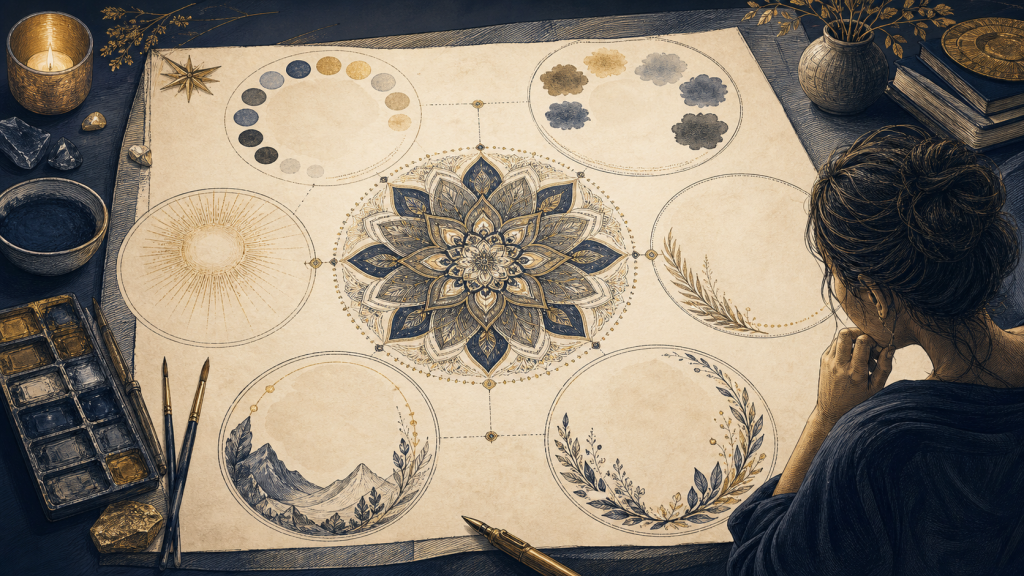
Mandala Reflection Worksheet
A private worksheet for exploring centered, circular, square, or fourfold imagery without assuming that symmetry proves wholeness or spiritual attainment.
Purpose
To explore the structure, center, boundary, asymmetry, personal associations, and cultural context of a mandala-like image.
Instructions
Copy the prompts into a private notebook. Describe the image, locate its context, gather personal associations, research cultural meaning, and return to the center without forcing a conclusion.
Complete the worksheet after drawing, encountering, or repeatedly noticing a mandala-like image. Describe observable features first: center, boundary, symmetry, color, movement, and emotional tone. Only then write possible personal associations.
Revisit the record later and note what changed in your response. A circular image does not automatically represent the Jungian Self, wholeness, healing, or spiritual attainment. Context, repetition, and the dreamer’s own associations matter more than a universal label.
Privacy
This page does not collect, transmit, or store responses.
Important Disclaimer
Educational only. A centered image does not diagnose psychological integration or establish spiritual attainment, prophecy, or supernatural authority.
Private reflection worksheet
Reflect on a centered or fourfold image
Describe its structure, personal context, and cultural limits before forming tentative interpretations.
A centered or symmetrical image does not prove integration, enlightenment, or a message from the Self. Treat every interpretation as a revisable hypothesis.
Reflect Without Forcing a Meaning
This worksheet helps you examine a centered, circular, square, or fourfold image through careful description, personal association, cultural context, and competing hypotheses.
Keep the Context Intact
Whether the image arose in a dream, drawing, artwork, ritual, or deliberate exercise matters. Symmetry alone does not prove psychological integration or spiritual significance.
Privacy
The interactive worksheet runs entirely in your browser. Nothing you enter is transmitted to or stored by Individuationing. You may download or print your own copy when finished.
Compare Mandalas Over Time
One drawing should not be scored as integrated, fragmented, healthy, or spiritual. If you repeat the exercise, compare changes in center, boundary, symmetry, color, empty space, and emotional tone alongside waking circumstances. Preserve irregular or unfinished forms rather than correcting them for appearance. A series can support reflection, but it remains artwork and personal material—not a diagnostic test.
Continue your study
Recommended Reading
Books selected because they directly develop ideas discussed on this page.
The Red Book: Liber Novus
The Red Book: Liber Novus records and artistically develops Carl Jung's confrontation with inner figures and images during a formative period of his psychology.
The Archetypes and the Collective Unconscious
The Archetypes and the Collective Unconscious collects major essays in which Carl Jung develops his accounts of archetypes, collective psychic patterns, rebirth, the mother, the child,…
Paid links. As an Amazon Associate I earn from qualifying purchases.
Related Concepts

Individuation
Individuation is Jung’s term for the lifelong process of becoming a more differentiated and integrated psychological whole.

Self
The Self is Jung’s concept of the whole psyche—conscious and unconscious—and the archetypal principle of its organization, development, and potential integration.
Archetype
An archetype is an inherited organizing pattern in Jung’s theory that can shape recurring forms of imagery, emotion, perception, and behavior without prescribing one fixed image.

Transcendent Function
The transcendent function is the new psychological attitude or symbolic possibility that can emerge when conscious and unconscious positions are held in genuine dialogue.

Psychological Inflation
Psychological inflation is an expanded or diminished self-estimate caused by identifying the ego with an archetype, role, group, insight, or unconscious content.
Mandala
A mandala is a centered, often circular symbolic form that Jung associated with psychic order, wholeness, containment, and the Self.
Related Archetypes

Wise Old Person
The Wise Old Person is an archetypal guide figure associated with meaning, counsel, insight, and the danger of identifying with borrowed authority.
Great Mother
The Great Mother is an archetypal pattern of origin, nourishment, protection, fertility, containment, engulfment, and destructive power.

Child
The Child archetype represents vulnerable beginnings, unrealized potential, renewal, dependence, abandonment, and a future personality still developing.

Trickster
The Trickster is an archetypal boundary-breaker whose humor, appetite, deception, mistakes, and reversals can expose rigidity while also causing real harm.
Related Dream Symbols

House
A house in a dream may represent the dreamer, a structure of personality, family life, memory, safety, or a psychological situation, depending on context.

Water
Water in a dream may relate to emotion, bodily life, the unconscious, renewal, danger, depth, or overwhelming experience, depending on its form and context.

Forest
A forest in a dream may suggest an unfamiliar psychological territory, instinctive life, concealment, danger, refuge, disorientation, or a path of discovery.

Door
A door in a dream may suggest access, exclusion, transition, opportunity, secrecy, protection, choice, or a boundary between psychological situations.
Related Practices

Symbol Amplification
Symbol amplification is a Jungian method of comparing an image with mythic, religious, artistic, historical, and cultural parallels while staying anchored to personal context.
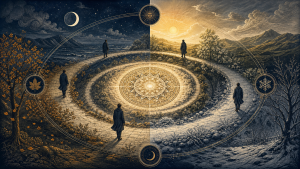
Circumambulation
Circumambulation is a Jungian method of staying close to one image while examining it repeatedly from different personal, emotional, symbolic, and practical viewpoints.
Related Books
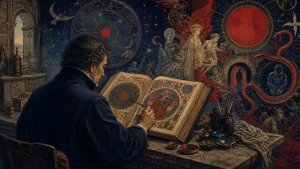
The Red Book: Liber Novus
The Red Book: Liber Novus records and artistically develops Carl Jung's confrontation with inner figures and images during a formative period of his psychology.

The Archetypes and the Collective Unconscious
The Archetypes and the Collective Unconscious collects major essays in which Carl Jung develops his accounts of archetypes, collective psychic patterns, rebirth, the mother, the child, and individuation.
Related Assessments

Dream Context Self-Check
A non-diagnostic checklist for testing whether a dream interpretation accounts for personal associations, waking context, emotion, sequence, and external relationships.
Archetypal Image Context Check
A non-diagnostic checklist for deciding whether an image deserves archetypal amplification without ignoring personal history, culture, external reality, or uncertainty.

Projection Boundary Self-Check
A non-diagnostic reflection checklist for separating observable behavior, personal interpretation, emotional activation, and possible projection in a relationship.

Active Imagination Readiness & Safety Check
A private, non-diagnostic checklist for identifying preparation gaps in grounding, containment, support, interpretation, and action before active imagination.