Concept
Archetypal Possession
Archetypal possession describes a state in which an impersonal pattern overwhelms ordinary perspective and is experienced as if it defines the whole person or situation.
Individuationing Library
Explore the central ideas of Jungian and analytical psychology.
Archetypal possession describes a state in which an impersonal pattern overwhelms ordinary perspective and is experienced as if it defines the whole person or situation.
A symbolic attitude is the willingness to hold an image, event, or conflict as potentially meaningful without forcing it into a literal or fixed explanation.

The shadow, persona, anima or animus, and Self are often taught as four major Jungian archetypes, though Jung’s wider theory is not limited to four.
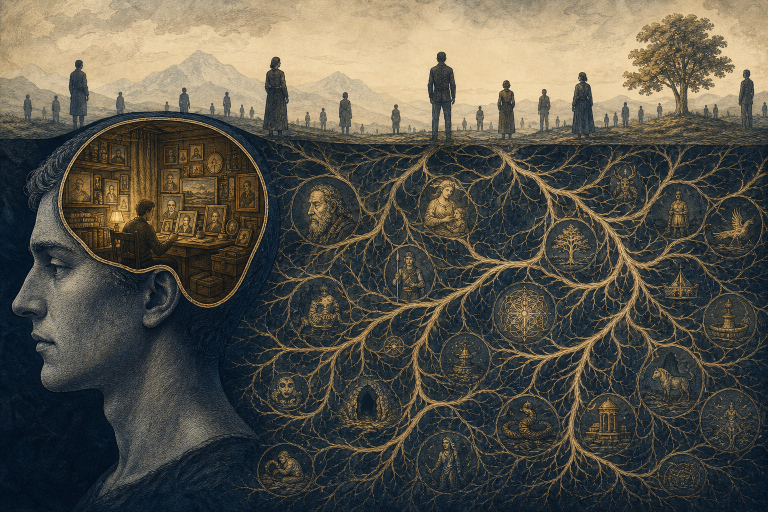
The personal unconscious contains forgotten or repressed individual material, while the collective unconscious names inherited archetypal patterns shared across human life.
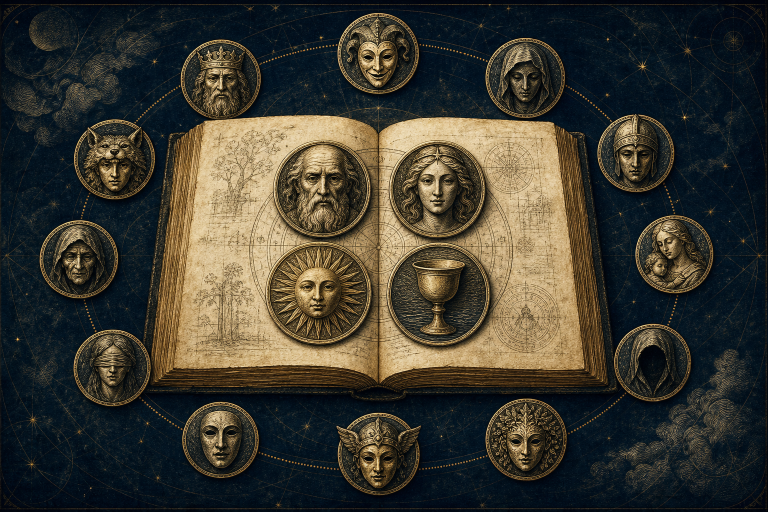
Carl Jung did not establish a canonical list of twelve personality archetypes; the popular twelve-archetype model is a later simplification.

Carl Jung approached religion as a psychological and symbolic phenomenon whose images can organize experience, while avoiding a clinical proof of theological claims.

Carl Jung and Sigmund Freud shared an early psychoanalytic alliance but diverged over libido, religion, symbols, the unconscious, and the aims of psychological development.

Carl Jung discussed astrology as a historical symbolic system and explored astrological data in relation to synchronicity, without establishing astrology as validated causal science.

Carl Jung interpreted alchemical images as historical parallels to unconscious psychological processes, especially projection, transformation, opposites, and individuation.

Carl Jung used drawing, painting, mandalas, sculpture, and symbolic image-making as means of engaging psychic material, while distinguishing this work from aesthetic criticism.
Search the knowledge base
Search concepts, archetypes, dream symbols, practices, people, books, self-checks, and worksheets.