
Book
The Psyche in Antiquity, Book One
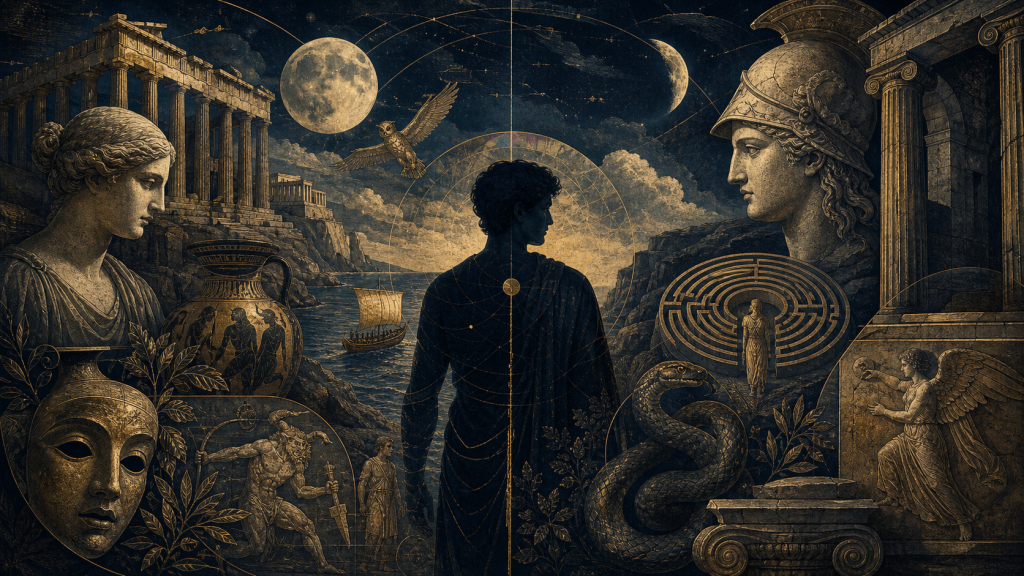
The Psyche in Antiquity, Book One is Edinger’s psychological tour of early Greek philosophy from the Milesians through Plotinus.
Summary
Edinger follows the psyche as he sees it expressed in ideas that gripped early Greek thinkers. The volume moves through the Milesians, Pythagoras, Heraclitus, Parmenides, Empedocles, Socrates, Plato, Aristotle, Zeno, Philo, and Plotinus.
Key Topics
- Early Greek philosophy
- Archetypal ideas
- Logos and opposites
- Number and order
- Soul and cosmos
- Modern psychological parallels
Reader Guidance
Advanced. This is a modern Jungian interpretation, not a comprehensive history of Greek philosophy. Pair it with primary texts, classics, philosophy, archaeology, and scholarship attentive to anachronism.
What Is The Psyche in Antiquity, Book One?
The Psyche in Antiquity, Book One: Early Greek Philosophy follows Edward F. Edinger’s psychological reading of ideas that shaped early Greek thought. His purpose is not to survey philosophy neutrally but to relate powerful ancient ideas to modern psychological experience.
Thinkers Covered
The volume addresses the Milesian philosophers, Pythagoras, Heraclitus, Parmenides, Anaxagoras, Empedocles, Socrates, Plato, Aristotle, Zeno of Citium, Philo, and Plotinus.
Ideas as Psychic Events
Edinger treats influential ideas as more than abstract propositions. A new image of matter, number, change, being, reason, or soul can reorganize how a culture and individual consciousness understand reality.
Opposites and Change
Heraclitus and other early thinkers provide material for considering conflict and psychological opposites. A modern psychological parallel can clarify why an idea remains compelling, but it cannot replace philosophical argument.
Number, Order, and Totality
Pythagorean themes may be compared with symbolic order and the psyche’s tendency to seek patterns. Pattern recognition must remain open to correction; meaningful form is not evidence that every coincidence carries a hidden message.
The Risk of Anachronism
Applying modern concepts such as unconscious, ego, and Self to ancient thought risks making the past resemble the present. Edinger’s approach is most useful when that risk is stated rather than ignored.
How to Read It Critically
- Read translations of the surviving fragments and primary texts.
- Compare Jungian interpretations with histories of philosophy.
- Distinguish ancient argument from modern psychological amplification.
- Notice missing social, political, material, and intercultural contexts.
- Avoid claiming that one archetypal scheme explains Greek thought.
Who Should Read It?
The volume is suited to advanced readers interested in analytical psychology, intellectual history, archetypal ideas, and the relation between philosophy and psyche.
Edition and Availability
Inner City Books lists Title 85 as an illustrated 128-page volume published in 1999 with ISBN 9780919123861.
Check this verified edition on Amazon
Sources
Related Concepts

Individuation
Individuation is Jung’s term for the lifelong process of becoming a more differentiated and integrated psychological whole.

Collective Unconscious
In Jungian psychology, the collective unconscious is a proposed inherited layer of the psyche expressed through universal patterns called archetypes.

Personal Unconscious
In Jungian psychology, the personal unconscious contains experiences, perceptions, and emotionally charged material outside an individual’s present awareness.

Ego
In Jungian psychology, the ego is the central complex of consciousness: the organizing “I” that experiences identity, makes choices, and adapts to inner and outer life.

Self
The Self is Jung’s concept of the whole psyche—conscious and unconscious—and the archetypal principle of its organization, development, and potential integration.

Archetype
An archetype is an inherited organizing pattern in Jung’s theory that can shape recurring forms of imagery, emotion, perception, and behavior without prescribing one fixed image.
Synchronicity
Synchronicity is Jung’s term for a meaningful coincidence between an inner psychological state and an external event when no adequate causal connection is apparent.

Transcendent Function
The transcendent function is the new psychological attitude or symbolic possibility that can emerge when conscious and unconscious positions are held in genuine dialogue.

Psychological Opposites
Psychological opposites are conflicting conscious and unconscious positions whose tension can reveal one-sidedness and support development.

Psychological Inflation
Psychological inflation is an expanded or diminished self-estimate caused by identifying the ego with an archetype, role, group, insight, or unconscious content.
Related Practices

Active Imagination
Active imagination is Jung’s method of consciously engaging emerging images, emotions, or figures through sustained attention and expression while preserving awareness and judgment.

Symbol Amplification
Symbol amplification is a Jungian method of comparing an image with mythic, religious, artistic, historical, and cultural parallels while staying anchored to personal context.

Circumambulation
Circumambulation is a Jungian method of staying close to one image while examining it repeatedly from different personal, emotional, symbolic, and practical viewpoints.
Related Psychologists

Carl Jung
Carl Gustav Jung was a Swiss psychiatrist who founded analytical psychology and developed influential ideas about complexes, archetypes, the collective unconscious, psychological types, and individuation.

Edward F. Edinger
Edward F. Edinger was an American psychiatrist, Jungian analyst, lecturer, and author who became a prominent interpreter of Jung’s work on the ego, Self, individuation, alchemy, and religious symbolism.