Book
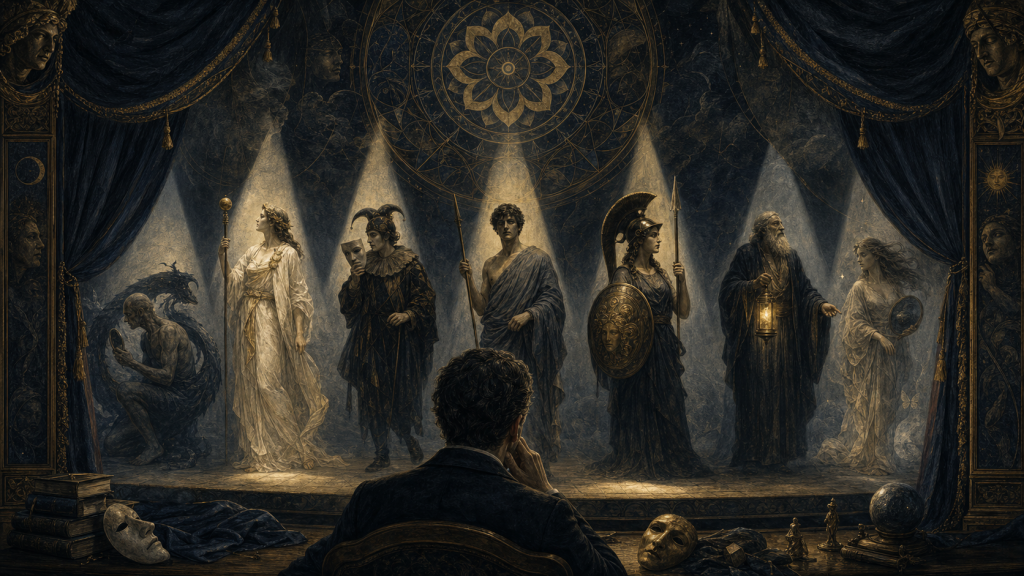
The Psyche on Stage
The Psyche on Stage is Edinger’s Jungian study of Measure for Measure, Romeo and Juliet, Oedipus the King, and Oedipus at Colonus.
Summary
Edinger traces changing images of Self and ego through Shakespeare’s Measure for Measure and Romeo and Juliet and Sophocles’ Oedipus the King and Oedipus at Colonus. The book focuses on the tragic hero, sacred marriage, and the search for wholeness.
Key Topics
- Shakespeare
- Sophocles
- Tragic hero
- Sacred marriage
- Ego and Self
- Individuation in drama
- Literary interpretation
Reader Guidance
Intermediate to advanced. Read the plays directly and pair Edinger with literary, theatrical, historical, classical, gender, and political scholarship. Jungian motifs are one interpretive layer.
What Is The Psyche on Stage?
The Psyche on Stage is Edward F. Edinger’s Jungian interpretation of four plays: Shakespeare’s Measure for Measure and Romeo and Juliet, and Sophocles’ Oedipus the King and Oedipus at Colonus.
Drama as Psychological Image
A play places conflict into speech, action, relationship, and consequence. Edinger uses dramatic structure to examine changing relations between ego and Self, but the characters remain literary creations rather than clinical cases.
Measure for Measure
Edinger reads the play through problems of law, desire, hypocrisy, judgment, and a lost or recovered relation to wholeness. Psychological language should not obscure institutional power, coercion, and sexual ethics.
Romeo and Juliet
The lovers may evoke the coniunctio or sacred marriage, but the drama also concerns family conflict, youth, violence, secrecy, haste, and death. Archetypal intensity does not make a relationship safe or sustainable.
Oedipus as Tragic Hero
Oedipus the King confronts knowledge, blindness, responsibility, fate, and unbearable discovery. A Jungian reading can amplify these themes without reducing the tragedy to an individual diagnosis.
Oedipus at Colonus
The later play shifts toward age, exile, death, authority, and transformation. Edinger uses this movement to consider changes in the ego–Self relationship and the meaning of the tragic hero.
Responsible Literary Psychology
- Begin with the language and dramatic action.
- Distinguish character, author, audience, and interpreter.
- Preserve historical and theatrical context.
- Do not romanticize coercion, violence, or death as individuation.
- Compare Jungian claims with other critical traditions.
Who Should Read It?
This concise book suits readers of Shakespeare, Sophocles, tragedy, archetypes, and individuation. It is especially useful as a model to examine—and critically test—psychological literary interpretation.
Edition and Availability
Inner City Books lists Title 93 as an illustrated 96-page volume published in 2001 with ISBN 9780919123946.
View the verified paperback edition on Amazon
Sources
Related Concepts
Shadow
In Jungian psychology, the shadow is the part of the personality containing qualities, impulses, and capacities that the conscious ego does not recognize or accept as its own.

Individuation
Individuation is Jung’s term for the lifelong process of becoming a more differentiated and integrated psychological whole.

Collective Unconscious
In Jungian psychology, the collective unconscious is a proposed inherited layer of the psyche expressed through universal patterns called archetypes.
Ego
In Jungian psychology, the ego is the central complex of consciousness: the organizing “I” that experiences identity, makes choices, and adapts to inner and outer life.

Self
The Self is Jung’s concept of the whole psyche—conscious and unconscious—and the archetypal principle of its organization, development, and potential integration.

Archetype
An archetype is an inherited organizing pattern in Jung’s theory that can shape recurring forms of imagery, emotion, perception, and behavior without prescribing one fixed image.

Projection
Projection is the largely unconscious process of experiencing one’s own psychological content as if it belonged primarily or entirely to another person, group, or object.

Anima
Anima is Jung’s historical term for an inner feminine archetypal figure in a man, associated with feeling, relationship, imagery, and mediation between consciousness and the unconscious.

Animus
Animus is Jung’s historical term for an inner masculine archetypal figure in a woman, associated with opinion, agency, meaning, and mediation between consciousness and the unconscious.

Transcendent Function
The transcendent function is the new psychological attitude or symbolic possibility that can emerge when conscious and unconscious positions are held in genuine dialogue.

Psychological Opposites
Psychological opposites are conflicting conscious and unconscious positions whose tension can reveal one-sidedness and support development.

Psychological Inflation
Psychological inflation is an expanded or diminished self-estimate caused by identifying the ego with an archetype, role, group, insight, or unconscious content.
Related Practices

Active Imagination
Active imagination is Jung’s method of consciously engaging emerging images, emotions, or figures through sustained attention and expression while preserving awareness and judgment.

Jungian Dream Analysis
Jungian dream analysis explores a dream’s personal associations, structure, emotional context, and possible compensatory relationship to conscious life without using fixed symbol definitions.

Symbol Amplification
Symbol amplification is a Jungian method of comparing an image with mythic, religious, artistic, historical, and cultural parallels while staying anchored to personal context.
Related Psychologists

Carl Jung
Carl Gustav Jung was a Swiss psychiatrist who founded analytical psychology and developed influential ideas about complexes, archetypes, the collective unconscious, psychological types, and individuation.

Edward F. Edinger
Edward F. Edinger was an American psychiatrist, Jungian analyst, lecturer, and author who became a prominent interpreter of Jung’s work on the ego, Self, individuation, alchemy, and religious symbolism.