Jungian Concept
Carl Jung and Astrology
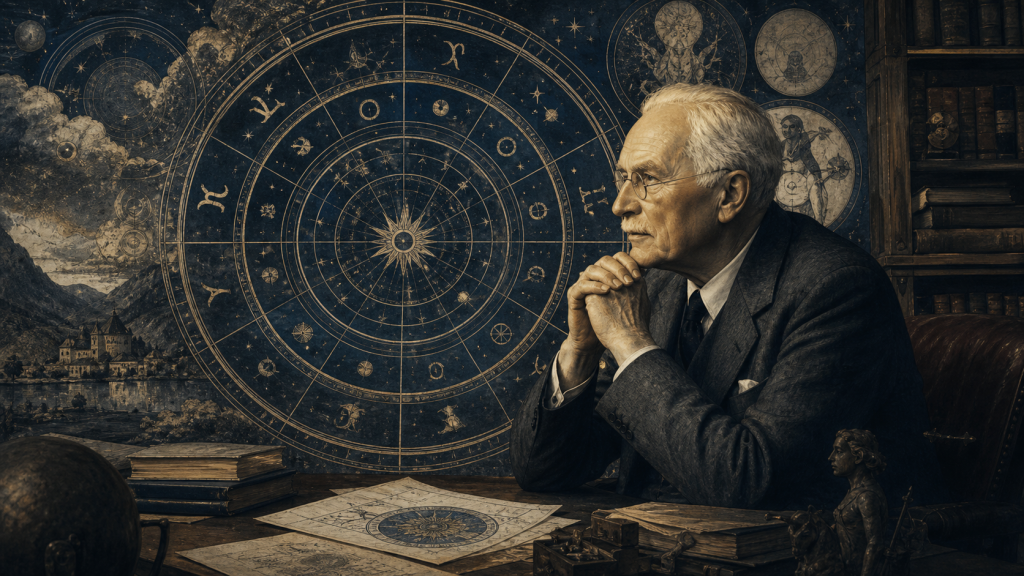
Carl Jung discussed astrology as a historical symbolic system and explored astrological data in relation to synchronicity, without establishing astrology as validated causal science.
Definition
Jung treated astrology primarily as a symbolic and historical system that could reflect psychological patterns, and he discussed it in connection with synchronicity and acausal correspondence.
Symbolic system or causal science?
Jung’s interest does not fit neatly into either dismissal or blanket endorsement. He regarded astrology as an old symbolic system containing projected psychological patterns, while also asking whether meaningful correspondences might occur without ordinary causation.
The marriage experiment
In his work on synchronicity, Jung examined traditional astrological aspects in a collection of married couples. He did not present the exercise as decisive proof. His discussion includes selection effects, expectations, and the difficulty of separating observer involvement from the result.
Responsible interpretation
Astrological symbolism may prompt reflection, but it should not be presented as diagnosis, guaranteed prediction, or a substitute for evidence-based medical, legal, financial, or relationship decisions.
Did Carl Jung believe in astrology?
Carl Jung studied astrology as a historical symbolic system and sometimes used horoscopes as material for psychological reflection. He was interested in the way astrological images persisted across cultures and in whether meaningful correspondences might relate to his idea of synchronicity.
That interest is often exaggerated into a simple endorsement. Jung’s writings include exploratory claims, symbolic interpretations, correspondence with practitioners, and an astrological marriage experiment whose results he discussed cautiously. These do not amount to modern scientific validation of natal astrology.
Astrology as symbolic vocabulary
Astrological figures provided Jung with a long-developed language of planets, elements, oppositions, and transformations. He compared this material with mythology, alchemy, religion, and dreams. Psychologically, the value of an image depended on how it functioned in context, not merely on a rule attached to a birth chart.
The marriage experiment and synchronicity
Jung examined horoscope pairings from married couples while exploring meaningful coincidence. The study involved methodological complications, multiple comparisons, and interpretive choices. It is better read as part of the development of his synchronicity hypothesis than as decisive statistical proof.
What responsible readers should distinguish
- Historical study of astrological symbolism
- Clinical use of an image as conversational material
- Personal metaphysical belief
- Empirical claims about prediction or causation
Those are different questions and require different evidence. Jung’s curiosity can be studied without treating astrology as diagnosis, certainty, or a substitute for practical decision-making.
Why Jung’s astrology comments are frequently misquoted
Short quotations circulate without the paragraphs that qualify them, and exploratory correspondence is sometimes presented as a final scientific conclusion. Other summaries combine Jung’s words with later astrological theories. Verify the original work, publication context, and translation before attributing a strong claim to him.
Astrology, causation, and meaning are different questions
A symbol may feel meaningful without demonstrating physical causation. A statistical pattern, if reliably established, would require methodological explanation. A personal coincidence may prompt reflection without predicting the future. Keeping these categories separate prevents psychological meaning from being used as automatic scientific proof.
A responsible use of astrological material
If astrology is discussed in a Jungian context, treat it as symbolic and historical material rather than medical, financial, or legal guidance. Ask what associations the image evokes, what alternatives fit the situation, and what evidence would change the interpretation. Important decisions still require ordinary facts, relevant expertise, and accountability.
Origin and Development
Jung referred to astrology in correspondence and writings, and included an astrological marriage experiment in his discussion of synchronicity. He presented the results cautiously and considered possible distortions in the data.
Examples
- Astrological motifs considered as archetypal images
- The horoscope treated as a symbolic map rather than a mechanical cause
- The marriage experiment discussed in Synchronicity
- Astrology placed within the history of projection and symbolic thought
Common Misconceptions
- Jung did not scientifically prove astrology.
- A quotation attributed to Jung does not establish endorsement of every astrological claim.
- Synchronicity is not a license to ignore probability or contrary evidence.
- Psychological usefulness and empirical prediction are different questions.
Continue your study
Recommended Reading
Books selected because they directly develop ideas discussed on this page.
Aion: Researches into the Phenomenology of the Self
Aion is Jung’s advanced study of the Self, the shadow, opposites, and the religious, astrological, Gnostic, and alchemical symbols of psychological totality.
The Archetypes and the Collective Unconscious
The Archetypes and the Collective Unconscious collects major essays in which Carl Jung develops his accounts of archetypes, collective psychic patterns, rebirth, the mother, the child,…
Man and His Symbols
Man and His Symbols is an illustrated introduction to dreams, symbols, archetypes, and individuation written by Carl Jung and four close collaborators for general readers.
Paid links. As an Amazon Associate I earn from qualifying purchases.
Related Concepts
Synchronicity
Synchronicity is Jung’s term for a meaningful coincidence between an inner psychological state and an external event when no adequate causal connection is apparent.
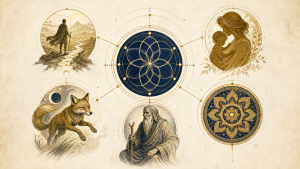
Archetype
An archetype is an inherited organizing pattern in Jung’s theory that can shape recurring forms of imagery, emotion, perception, and behavior without prescribing one fixed image.
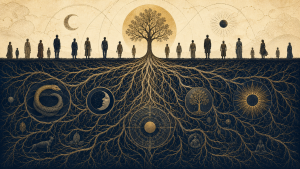
Collective Unconscious
In Jungian psychology, the collective unconscious is a proposed inherited layer of the psyche expressed through universal patterns called archetypes.
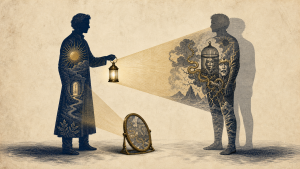
Projection
Projection is the largely unconscious process of experiencing one’s own psychological content as if it belonged primarily or entirely to another person, group, or object.
Related Books
Aion: Researches into the Phenomenology of the Self
Aion is Jung’s advanced study of the Self, the shadow, opposites, and the religious, astrological, Gnostic, and alchemical symbols of psychological totality.
The Archetypes and the Collective Unconscious
The Archetypes and the Collective Unconscious collects major essays in which Carl Jung develops his accounts of archetypes, collective psychic patterns, rebirth, the mother, the child, and individuation.

Man and His Symbols
Man and His Symbols is an illustrated introduction to dreams, symbols, archetypes, and individuation written by Carl Jung and four close collaborators for general readers.

Synchronicity: An Acausal Connecting Principle
Carl Jung’s principal essay proposing synchronicity as a framework for meaningful coincidence not adequately described by ordinary causal explanation.

Psychology and Alchemy
Carl Jung’s major study connecting dream series, Christian symbolism, and Western alchemy with projection and the psychological process of individuation.

Memories, Dreams, Reflections
Memories, Dreams, Reflections is a semi-autobiographical account assembled from Carl Jung's recollections, manuscripts, and conversations with editor Aniela Jaffé.