
Jungian Concept
Introversion
Introversion is a Jungian attitude in which conscious energy and motivation give greater priority to the subject’s inner impressions, ideas, and standpoint.

Definition
Introversion is a mode of orientation in which the subjective factor carries greater motivational weight than the external object. It is a preference within a dynamic system, not a total identity.
What Is Introversion?
In Jungian psychology, introversion is an attitude in which greater psychological weight is given to the subject—the person’s inner impressions, ideas, images, and standpoint. It describes the direction of conscious orientation, not simply social behavior.
An introverted person may be talkative, confident, or socially skilled when engaged by a meaningful interest. The key question is what primarily organizes judgment and action: inner necessity or external conditions.
Introversion Is Not Shyness
Shyness involves discomfort or inhibition in social situations. Social anxiety involves clinically significant fear and impairment. Introversion, in Jung’s theory, is neither. A person may be introverted without fearing people, or extraverted while experiencing social anxiety.
Strengths of the Introverted Attitude
Introversion can support reflection, concentration, independence from group pressure, sustained inner development, and work guided by personal conviction. It can preserve a necessary subjective standpoint when the environment demands conformity.
One-Sided Introversion
When extreme, the introverted attitude may undervalue external facts and other people’s independent reality. The outer world can then feel intrusive, overwhelming, or strangely powerful because its importance has been pushed out of consciousness.
Jung understood this as compensation: the neglected opposite attitude gathers unconscious force. Development involves a better relationship with external reality, not conversion into an extravert.
Introverted Functions
Jung described introverted forms of thinking, feeling, sensation, and intuition. Two people can both be introverted while differing greatly because their dominant functions organize experience in different ways.
Introversion in Everyday Language
Modern usage often defines introverts by needing solitude to “recharge.” That can be a useful personal description, but it is narrower than Jung’s theory. Jung focused on the relative priority of subjective and objective factors.
Subjective Orientation and Reality Testing
Giving weight to inner impressions does not make every impression accurate. Mature introversion compares its internal standpoint with consequences, evidence, and the independent responses of other people. The task is not to surrender inward judgment, but to prevent private certainty from becoming insulated. Writing an interpretation down, stating what could disconfirm it, and asking for specific feedback can preserve depth while strengthening contact with external reality.
Sources and Further Reading
Origin and Development
Jung’s use developed during his early disputes with psychoanalysis and was systematized in Psychological Types (1921). The word existed earlier, but Jung gave it a central technical role in personality theory.
Examples
An introverted decision-maker may understand the available external advice but choose according to an internally developed principle. The same behavior—declining an invitation—could instead arise from fatigue, anxiety, disinterest, or practical necessity, so behavior alone does not determine type.
Common Misconceptions
- Introversion is not the same as shyness or social anxiety.
- Introverts are not necessarily quiet or antisocial.
- Introversion does not guarantee depth, creativity, or intelligence.
- Everyone uses extraversion as well.
- A preference is not a fixed limitation.
Continue your study
Recommended Reading
Books selected because they directly develop ideas discussed on this page.
Man and His Symbols
Man and His Symbols is an illustrated introduction to dreams, symbols, archetypes, and individuation written by Carl Jung and four close collaborators for general readers.
Psychological Types
Carl Jung’s foundational study of introversion, extraversion, and the psychological functions of thinking, feeling, sensation, and intuition.
Paid links. As an Amazon Associate I earn from qualifying purchases.
Related Concepts

Persona
In Jungian psychology, the persona is the social identity or “mask” through which a person adapts to roles, expectations, and relationships.

Individuation
Individuation is Jung’s term for the lifelong process of becoming a more differentiated and integrated psychological whole.

Personal Unconscious
In Jungian psychology, the personal unconscious contains experiences, perceptions, and emotionally charged material outside an individual’s present awareness.

Ego
In Jungian psychology, the ego is the central complex of consciousness: the organizing “I” that experiences identity, makes choices, and adapts to inner and outer life.

Self
The Self is Jung’s concept of the whole psyche—conscious and unconscious—and the archetypal principle of its organization, development, and potential integration.
Psychological Types
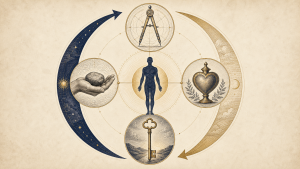
Jung’s psychological types combine two attitudes—introversion and extraversion—with four functions: thinking, feeling, sensation, and intuition.

Extraversion
Extraversion is a Jungian attitude in which conscious energy and motivation give greater priority to external people, events, objects, and shared conditions.

Thinking
Thinking is the Jungian function that evaluates experience through concepts, logical relationships, and judgments about what something means.

Feeling
Feeling is the Jungian function that evaluates experience by assigning value: acceptable or unacceptable, important or unimportant, welcomed or rejected.

Sensation
Sensation is the Jungian function that perceives immediate concrete reality through the physical senses and awareness of bodily states.

Intuition
Intuition is the Jungian function that perceives possibilities, patterns, and implications through unconscious processes rather than direct sensory evidence.

Participation Mystique
Participation mystique is a Jungian term for an unconscious state of identity in which the boundary between subject and object, self and other, is insufficiently differentiated.

Carl Jung’s Theory of Personality
Carl Jung’s personality theory combines psychological attitudes and functions with a broader model of ego, persona, shadow, unconscious life, and individuation.

Carl Jung and MBTI
The Myers-Briggs Type Indicator was inspired by Carl Jung’s psychological types, but its four-letter system and assessment method were developed by Katharine Cook Briggs and Isabel Briggs Myers.
Related Books

Man and His Symbols
Man and His Symbols is an illustrated introduction to dreams, symbols, archetypes, and individuation written by Carl Jung and four close collaborators for general readers.

Psychological Types
Carl Jung’s foundational study of introversion, extraversion, and the psychological functions of thinking, feeling, sensation, and intuition.
Related Psychologists

Carl Jung
Carl Gustav Jung was a Swiss psychiatrist who founded analytical psychology and developed influential ideas about complexes, archetypes, the collective unconscious, psychological types, and individuation.

Toni Wolff
Toni Wolff was a Swiss analyst, scholar, institutional leader, and close collaborator of Carl Jung who developed four structural forms of the feminine psyche.