
Psychologist
Toni Wolff
Toni Wolff was a Swiss analyst, scholar, institutional leader, and close collaborator of Carl Jung who developed four structural forms of the feminine psyche.

Known For
Four structural forms of the feminine psyche—Mother, Hetaira, Amazon, and Medial Woman; leadership of the Psychology Club Zürich; analytic practice; and collaboration in early analytical psychology.
Biography
Born in Zürich in 1888, Wolff entered analysis with Jung in the early 1910s and became an analyst, lecturer, writer, close collaborator, and intimate partner. She served as president of the Psychology Club Zürich for seventeen years and developed an independent fourfold model of relational orientations. She died in Zürich in 1953.
Key Ideas
- Mother: care, development, continuity, and containment
- Hetaira: individual relationship, companionship, and psychological dialogue
- Amazon: autonomy, profession, competence, and collective goals
- Medial Woman: sensitivity to collective, symbolic, and unconscious currents
- Development through relationship among all four forms rather than identification with one
Who Was Toni Wolff?
Antonia “Toni” Wolff (1888–1953) was a Swiss analyst, scholar, teacher, and central figure in the early development of analytical psychology. She was first an analysand and later a close intellectual collaborator and intimate partner of Carl Jung.
Wolff helped build the institutional and interpretive community around Jung’s work, served as president of the Psychology Club Zürich for many years, and developed her own model of four structural forms of the feminine psyche. Her contribution was long overshadowed by attention to her relationship with Jung.
Early Life and Entry Into Analysis
Wolff was born in Zürich on September 18, 1888, into a prosperous Swiss family. Although intellectually ambitious, she did not receive the university education she wanted. After her father’s death and a period of depression, she entered analysis with Jung in the early 1910s.
She became part of the emerging circle that studied dreams, mythology, symbolic images, and unconscious processes. Her role developed beyond that of patient: she became an analyst, lecturer, writer, organizational leader, and an important reader of Jung’s ideas during a formative period.
Collaboration With Jung
Wolff’s collaboration with Jung included sustained discussion of symbolic material and analytical concepts. Historical accounts also describe a long intimate relationship that existed alongside Jung’s marriage to Emma Jung. The arrangement caused pain and tension and should not be romanticized as proof of psychological enlightenment.
Older histories often frame Wolff mainly through what she provided Jung. A more balanced account recognizes her own analytic practice, institutional labor, writing, and theoretical contribution while still acknowledging unequal professional visibility and the complicated relationships involved.
The Psychology Club Zürich
Wolff was deeply involved in the Psychology Club Zürich, founded in 1916 as a meeting place for people working with analytical psychology. She served as its president for a total of seventeen years.
The club provided lectures, discussion, and community outside formal university psychology. Wolff’s leadership helped sustain this early network, although access to such circles was shaped by the social class, gender expectations, and European intellectual setting of the period.
Four Structural Forms of the Feminine Psyche
Wolff’s best-known theoretical work proposes four structural forms: Mother, Hetaira, Amazon, and Medial Woman. She presented an early version to the Psychology Club in 1934 and an expanded version at the C. G. Jung Institute in 1948. An English translation was privately printed in 1956.
The model concerns orientations of relationship and activity rather than four occupations or social roles. Wolff argued that one form may be dominant while others remain less developed. The forms should not be treated as a modern personality quiz or four boxes into which every woman must fit.
Mother
The Mother orientation emphasizes care, protection, development, continuity, and responsiveness to what another person or living process needs. Constructively it can support growth and belonging. Its shadow may include engulfment, overprotection, control through care, or loss of one’s own differentiated aims.
Hetaira
Hetaira is a historically loaded Greek term often translated as companion. Wolff used it for an orientation toward the individual qualities and psychological development of another person, especially in intimate partnership. Constructively it values dialogue and personal recognition; its shadow may include dependence on relational intensity, rivalry, or organizing identity around another person’s development.
Amazon
The Amazon orientation emphasizes independent competence, objective achievement, collective work, profession, and engagement with the impersonal world. Constructively it supports autonomy and effective action. Its shadow may include overidentification with performance, dismissal of dependency, or adaptation to standards that devalue relationship and embodiment.
Medial Woman
The Medial orientation describes sensitivity to collective, symbolic, cultural, spiritual, or unconscious currents. Constructively it can mediate emerging images and values into language, art, healing, or research. Its risks include inflation, weak discrimination, loss of grounding, or confusing subjective imagery with external fact.
How the Four Forms Relate
Wolff arranged the forms in a quaternity, with adjacent and opposing relationships. The model suggests that development involves tension among several orientations rather than perfecting one identity.
This makes the framework more useful as a map of neglected capacities than as a label. A person might ask which form is overused, which is idealized, which is projected onto others, and which form a particular situation actually requires.
Gender Limitations and Contemporary Use
Wolff wrote explicitly about women within the gender assumptions and social restrictions of early twentieth-century Europe. Her categories can reproduce essentialism if treated as timeless definitions of femininity.
Contemporary interpreters often explore the four orientations in people of any sex, gender identity, or sexual orientation. That adaptation may make the model more flexible, but it should be identified as a reinterpretation rather than silently attributed to Wolff.
The framework must also be tested across cultures and social conditions. Care, profession, intimacy, spiritual mediation, and independence take different forms depending on family systems, disability, race, class, religion, sexuality, economics, and historical setting.
Wolff and Psychological Types
Wolff presented her structural forms as complementary to Jung’s psychological types, including introversion, extraversion, and the functions of thinking, feeling, sensation, and intuition. The systems answer different questions: Jung’s typology concerns habitual orientation and functions of consciousness, while Wolff’s model concerns characteristic directions of relationship and activity.
Neither system should be used to explain an entire person. Typological language becomes most useful when it reveals one-sidedness and invites development.
Major Writings
- Structural Forms of the Feminine Psyche
- Essays collected in Studies in Jungian Psychology
- Lectures and papers on feminine psychology, Christianity, symbolism, and analytical practice
Wolff published relatively little, and much of her influence occurred through analysis, teaching, discussion, and organizational work—forms of intellectual labor that historical records often preserve unevenly.
Criticisms and Responsible Reading
- Gender essentialism: the four forms should not define what women naturally are or ought to be.
- Historical restriction: the model reflects a privileged European social world and its available roles.
- Relational framing: some descriptions remain organized around women’s relationships to men.
- Typological misuse: the forms are not validated measurements or diagnostic categories.
- Biographical reduction: Wolff should neither be erased from Jung’s history nor reduced to their intimate relationship.
Legacy
Wolff died in Zürich on March 21, 1953. Her legacy includes institution-building, analytic practice, interpretive collaboration, and a compact model that continues to provoke debate about gender, relational orientation, and psychological development.
Reading Wolff today requires two movements at once: recovering a woman thinker whose work was frequently subordinated to Jung’s story, and critically revising the gender assumptions within her own theory.
Structural Forms and Historical Limits
Wolff’s structural forms of the feminine are historically influential within Jungian thought, but they should not be treated as exhaustive roles for women or as biological destiny. Contemporary readers can examine the relational patterns she described while questioning binary gender assumptions, social privilege, and omitted ways of living. The model is a historical interpretive framework, not a validated personality test.
Sources and Further Reading
- University of Florida Digital Collections: Structural Forms of the Feminine Psyche.
- Psychological Perspectives: “Structural Forms of the Feminine Psyche”.
- C. G. Jung.net: Toni Wolff’s Structural Forms.
- Pacifica Graduate Institute: interdisciplinary study of Wolff’s model.
Related People in the Early Jungian Movement
Wolff’s life and work are clearer when read alongside Emma Jung, Jolande Jacobi, and Aniela Jaffé. Each contributed differently to the development, teaching, editing, and interpretation of analytical psychology.
Continue your study
Recommended Reading
Books selected because they directly develop ideas discussed on this page.
Memories, Dreams, Reflections
Memories, Dreams, Reflections is a semi-autobiographical account assembled from Carl Jung's recollections, manuscripts, and conversations with editor Aniela Jaffé.
The Red Book: Liber Novus
The Red Book: Liber Novus records and artistically develops Carl Jung's confrontation with inner figures and images during a formative period of his psychology.
The Archetypes and the Collective Unconscious
The Archetypes and the Collective Unconscious collects major essays in which Carl Jung develops his accounts of archetypes, collective psychic patterns, rebirth, the mother, the child,…
Paid links. As an Amazon Associate I earn from qualifying purchases.
Related Concepts

Individuation
Individuation is Jung’s term for the lifelong process of becoming a more differentiated and integrated psychological whole.

Archetype
An archetype is an inherited organizing pattern in Jung’s theory that can shape recurring forms of imagery, emotion, perception, and behavior without prescribing one fixed image.

Anima
Anima is Jung’s historical term for an inner feminine archetypal figure in a man, associated with feeling, relationship, imagery, and mediation between consciousness and the unconscious.

Animus
Animus is Jung’s historical term for an inner masculine archetypal figure in a woman, associated with opinion, agency, meaning, and mediation between consciousness and the unconscious.
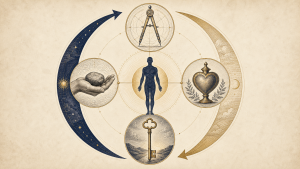
Psychological Types
Jung’s psychological types combine two attitudes—introversion and extraversion—with four functions: thinking, feeling, sensation, and intuition.

Introversion
Introversion is a Jungian attitude in which conscious energy and motivation give greater priority to the subject’s inner impressions, ideas, and standpoint.

Extraversion
Extraversion is a Jungian attitude in which conscious energy and motivation give greater priority to external people, events, objects, and shared conditions.

Thinking
Thinking is the Jungian function that evaluates experience through concepts, logical relationships, and judgments about what something means.

Feeling
Feeling is the Jungian function that evaluates experience by assigning value: acceptable or unacceptable, important or unimportant, welcomed or rejected.

Sensation
Sensation is the Jungian function that perceives immediate concrete reality through the physical senses and awareness of bodily states.

Intuition
Intuition is the Jungian function that perceives possibilities, patterns, and implications through unconscious processes rather than direct sensory evidence.
Related Books

Memories, Dreams, Reflections
Memories, Dreams, Reflections is a semi-autobiographical account assembled from Carl Jung's recollections, manuscripts, and conversations with editor Aniela Jaffé.

The Red Book: Liber Novus
The Red Book: Liber Novus records and artistically develops Carl Jung's confrontation with inner figures and images during a formative period of his psychology.

The Archetypes and the Collective Unconscious
The Archetypes and the Collective Unconscious collects major essays in which Carl Jung develops his accounts of archetypes, collective psychic patterns, rebirth, the mother, the child, and individuation.
Related Practices

Active Imagination
Active imagination is Jung’s method of consciously engaging emerging images, emotions, or figures through sustained attention and expression while preserving awareness and judgment.

Jungian Dream Analysis
Jungian dream analysis explores a dream’s personal associations, structure, emotional context, and possible compensatory relationship to conscious life without using fixed symbol definitions.

Symbol Amplification
Symbol amplification is a Jungian method of comparing an image with mythic, religious, artistic, historical, and cultural parallels while staying anchored to personal context.