Book
The Aion Lectures
The Aion Lectures is Edinger’s edited lecture companion to C. G. Jung’s Aion, originally delivered in Los Angeles in 1988–89.
Summary
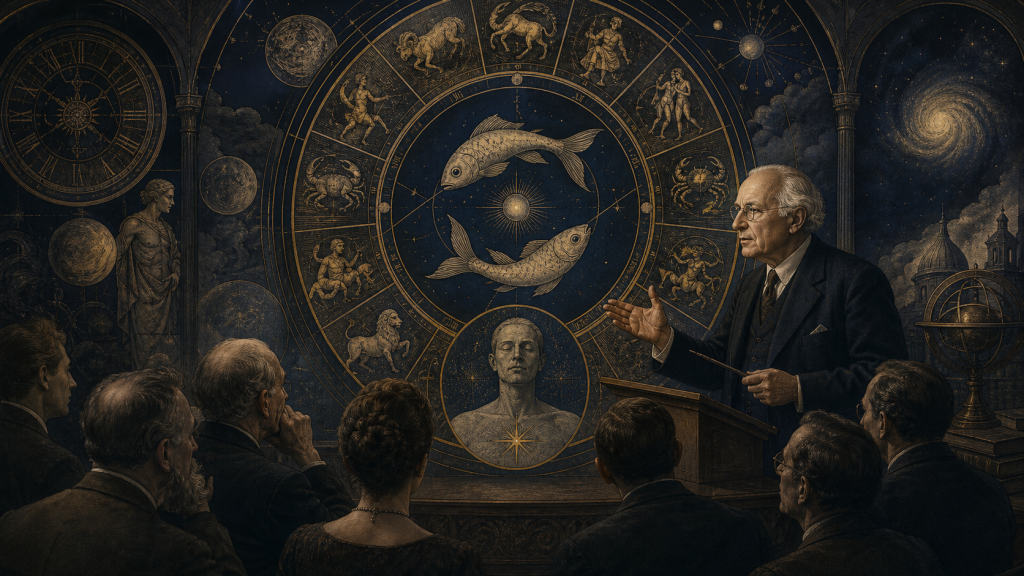
Based on lectures delivered at the C. G. Jung Institute of Los Angeles in 1988–89, the book explains difficult references in Aion, expands Jung’s source material, and supplies background and examples for understanding its symbolic images.
Key Topics
- Jung’s Aion
- Self and Shadow
- Christ as symbol
- Fish symbolism
- Gnosticism
- Alchemy
- Historical God-image
Reader Guidance
Advanced. Use as a companion to Jung’s Aion, not a replacement. Its psychological history of religious symbols should be balanced with theology, late-antique studies, Jewish history, early Christianity, Gnostic studies, and critical historiography.
What Is The Aion Lectures?
The Aion Lectures is Edward F. Edinger’s chapter-by-chapter companion to C. G. Jung’s Aion. It is based on lectures delivered at the C. G. Jung Institute of Los Angeles in 1988–89.
Why Aion Needs a Guide
Jung moves among clinical psychology, Christian symbolism, astrology, Gnosticism, alchemy, history, and the structure of the Self. Edinger explains references, extends quotations, supplies background, and offers examples.
The Self and Shadow
Aion develops two foundational concepts: the Self and the Shadow. Edinger helps readers follow how individual psychology becomes entangled with collective religious imagery.
Christ as a Symbol of the Self
Jung analyzes Christ as a major Western symbol of psychic totality while arguing that historical symbols can express only part of the Self’s opposites. This is a psychological interpretation, not a statement of Christian doctrine.
Fish, Gnosticism, and Historical Images
Fish symbolism and Gnostic material occupy substantial space. These sources require specialist historical study; similarities do not prove direct influence or one universal meaning.
The Risk of Inflation
Study of the Self can become identification with the Self. Edinger’s guide is most valuable when paired with the site’s discussion of psychological inflation, ethical responsibility, and ordinary reality.
How to Read the Two Books Together
- Read one chapter of Jung’s Aion.
- Note unfamiliar sources and central claims.
- Read Edinger’s corresponding lecture.
- Check historical references independently.
- Return to Jung and distinguish explanation from interpretation.
Who Should Read It?
This is an advanced resource for readers seriously studying Jung’s account of Self, Shadow, religion, and collective symbolism. It is more accessible than Aion alone but still assumes familiarity with analytical psychology.
Edition and Availability
Inner City Books lists Title 71 as a 208-page volume published in 1996 with 30 illustrations and ISBN 9780919123724.
Check the verified paperback edition on Amazon
Sources
Related Concepts
Shadow
In Jungian psychology, the shadow is the part of the personality containing qualities, impulses, and capacities that the conscious ego does not recognize or accept as its own.

Individuation
Individuation is Jung’s term for the lifelong process of becoming a more differentiated and integrated psychological whole.

Collective Unconscious
In Jungian psychology, the collective unconscious is a proposed inherited layer of the psyche expressed through universal patterns called archetypes.

Personal Unconscious
In Jungian psychology, the personal unconscious contains experiences, perceptions, and emotionally charged material outside an individual’s present awareness.
Ego
In Jungian psychology, the ego is the central complex of consciousness: the organizing “I” that experiences identity, makes choices, and adapts to inner and outer life.

Self
The Self is Jung’s concept of the whole psyche—conscious and unconscious—and the archetypal principle of its organization, development, and potential integration.
Archetype
An archetype is an inherited organizing pattern in Jung’s theory that can shape recurring forms of imagery, emotion, perception, and behavior without prescribing one fixed image.

Anima
Anima is Jung’s historical term for an inner feminine archetypal figure in a man, associated with feeling, relationship, imagery, and mediation between consciousness and the unconscious.

Animus
Animus is Jung’s historical term for an inner masculine archetypal figure in a woman, associated with opinion, agency, meaning, and mediation between consciousness and the unconscious.

Transcendent Function
The transcendent function is the new psychological attitude or symbolic possibility that can emerge when conscious and unconscious positions are held in genuine dialogue.

Psychological Opposites
Psychological opposites are conflicting conscious and unconscious positions whose tension can reveal one-sidedness and support development.

Psychological Inflation
Psychological inflation is an expanded or diminished self-estimate caused by identifying the ego with an archetype, role, group, insight, or unconscious content.
Related Practices

Shadow Work
Shadow work is a modern term for reflective practices that explore qualities, emotions, and patterns a person habitually rejects, hides, or fails to recognize in themselves.

Active Imagination
Active imagination is Jung’s method of consciously engaging emerging images, emotions, or figures through sustained attention and expression while preserving awareness and judgment.

Jungian Dream Analysis
Jungian dream analysis explores a dream’s personal associations, structure, emotional context, and possible compensatory relationship to conscious life without using fixed symbol definitions.

Symbol Amplification
Symbol amplification is a Jungian method of comparing an image with mythic, religious, artistic, historical, and cultural parallels while staying anchored to personal context.

Circumambulation
Circumambulation is a Jungian method of staying close to one image while examining it repeatedly from different personal, emotional, symbolic, and practical viewpoints.
Related Psychologists

Carl Jung
Carl Gustav Jung was a Swiss psychiatrist who founded analytical psychology and developed influential ideas about complexes, archetypes, the collective unconscious, psychological types, and individuation.

Edward F. Edinger
Edward F. Edinger was an American psychiatrist, Jungian analyst, lecturer, and author who became a prominent interpreter of Jung’s work on the ego, Self, individuation, alchemy, and religious symbolism.