Practice
Sandplay Therapy
Sandplay therapy is a clinical, expressive method in which a client creates scenes with sand, water, and miniatures within a protected therapeutic relationship.

Purpose
To provide a contained clinical setting in which nonverbal and symbolic material can take visible form and be held within a trained therapeutic relationship.
Instructions
This is a clinical overview, not a do-it-yourself protocol. Authentic therapeutic sandplay should be conducted with an appropriately trained professional who can establish safety, consent, boundaries, and follow-up.
Reflection Questions
- What makes a space genuinely free and protected?
- Why might premature interpretation interfere?
- How does a series differ from one isolated scene?
- Which cultural meanings belong to the client rather than the therapist?
Cautions and Boundaries
Do not use this page to conduct therapy, process trauma without support, diagnose from miniature choices, or claim that a symbol has one fixed meaning.
What Is Sandplay Therapy?
Sandplay therapy is a hands-on psychotherapeutic method associated with Dora Kalff. In a tray of prescribed proportions, a client uses sand, water, and miniature figures to form a scene without needing to explain it immediately.
The Free and Protected Space
Kalff emphasized a “free and protected space” created by the physical tray and the therapeutic relationship. The scene can give concrete form to feelings, memories, conflicts, and symbolic images that may be difficult to express verbally.
How a Session Works
The client chooses whether and how to arrange miniatures. A trained therapist observes the process and safeguards the setting. Classical Kalffian practice does not rush to interpret individual objects; meaning is considered across the scene, the client’s associations, the relationship, and changes over a series of trays.
Sandplay Is Not a Symbol Dictionary
A snake, house, child, or circle cannot be assigned a fixed meaning. Personal history and cultural context come first. Archetypal parallels may enrich understanding, but they do not override the person who made the scene.
Clinical Boundary
Sandplay therapy is not the same as arranging objects alone for entertainment or using an online prompt. Trauma, dissociation, psychosis, and overwhelming emotion require qualified clinical judgment. This page is educational and does not teach readers to practice psychotherapy.
Related Methods
Sandplay may be discussed alongside active imagination, dream work, art therapy, and symbolic play, but each has distinct training, boundaries, and evidence.
A Series Matters More Than One Tray
Classical sandplay attends to movement across multiple trays. Repeated figures, changing distances, new boundaries, destruction, repair, and the gradual appearance of order may become meaningful in relation to the client’s life and therapeutic process. A single scene can be powerful, but it rarely supports a confident conclusion by itself. The client’s associations and the therapist’s longitudinal knowledge remain more important than an outsider’s visual guess.
Continue your study
Recommended Reading
Books selected because they directly develop ideas discussed on this page.
Man and His Symbols
Man and His Symbols is an illustrated introduction to dreams, symbols, archetypes, and individuation written by Carl Jung and four close collaborators for general readers.
Memories, Dreams, Reflections
Memories, Dreams, Reflections is a semi-autobiographical account assembled from Carl Jung's recollections, manuscripts, and conversations with editor Aniela Jaffé.
The Red Book: Liber Novus
The Red Book: Liber Novus records and artistically develops Carl Jung's confrontation with inner figures and images during a formative period of his psychology.
Paid links. As an Amazon Associate I earn from qualifying purchases.
Related Concepts
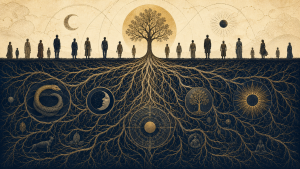
Collective Unconscious
In Jungian psychology, the collective unconscious is a proposed inherited layer of the psyche expressed through universal patterns called archetypes.

Personal Unconscious
In Jungian psychology, the personal unconscious contains experiences, perceptions, and emotionally charged material outside an individual’s present awareness.
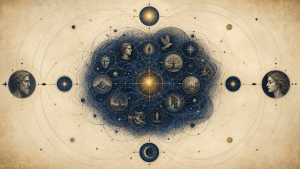
Complex
In Jungian psychology, a complex is an emotionally charged network of associations that can temporarily influence perception, emotion, and behavior.

Self
The Self is Jung’s concept of the whole psyche—conscious and unconscious—and the archetypal principle of its organization, development, and potential integration.
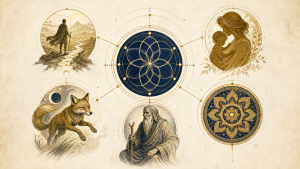
Archetype
An archetype is an inherited organizing pattern in Jung’s theory that can shape recurring forms of imagery, emotion, perception, and behavior without prescribing one fixed image.
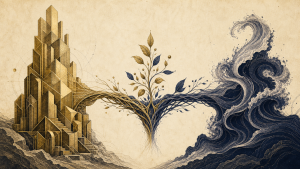
Transcendent Function
The transcendent function is the new psychological attitude or symbolic possibility that can emerge when conscious and unconscious positions are held in genuine dialogue.
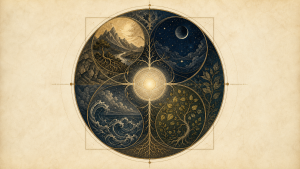
Mandala
A mandala is a centered, often circular symbolic form that Jung associated with psychic order, wholeness, containment, and the Self.

Participation Mystique
Participation mystique is a Jungian term for an unconscious state of identity in which the boundary between subject and object, self and other, is insufficiently differentiated.
Related Archetypes

Wise Old Person
The Wise Old Person is an archetypal guide figure associated with meaning, counsel, insight, and the danger of identifying with borrowed authority.
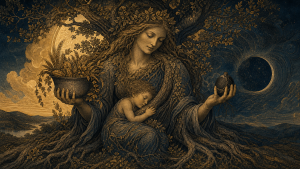
Great Mother
The Great Mother is an archetypal pattern of origin, nourishment, protection, fertility, containment, engulfment, and destructive power.

Child
The Child archetype represents vulnerable beginnings, unrealized potential, renewal, dependence, abandonment, and a future personality still developing.

Trickster
The Trickster is an archetypal boundary-breaker whose humor, appetite, deception, mistakes, and reversals can expose rigidity while also causing real harm.

Wounded Healer
The Wounded Healer archetype holds vulnerability and the capacity to help in tension while requiring self-knowledge, competence, accountability, and clear boundaries.
Related Dream Symbols
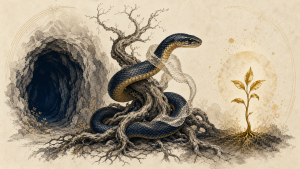
Snake
A snake in a dream can evoke danger, instinct, transformation, healing, sexuality, wisdom, or something unfamiliar—but its meaning depends on the dream’s details and the dreamer’s associations.

House
A house in a dream may represent the dreamer, a structure of personality, family life, memory, safety, or a psychological situation, depending on context.

Water
Water in a dream may relate to emotion, bodily life, the unconscious, renewal, danger, depth, or overwhelming experience, depending on its form and context.

Forest
A forest in a dream may suggest an unfamiliar psychological territory, instinctive life, concealment, danger, refuge, disorientation, or a path of discovery.

Door
A door in a dream may suggest access, exclusion, transition, opportunity, secrecy, protection, choice, or a boundary between psychological situations.

Mirror
A mirror in a dream may concern self-recognition, appearance, identity, reversal, duplication, self-judgment, projection, or the unsettling failure to recognize oneself.
Related Books

Man and His Symbols
Man and His Symbols is an illustrated introduction to dreams, symbols, archetypes, and individuation written by Carl Jung and four close collaborators for general readers.

Memories, Dreams, Reflections
Memories, Dreams, Reflections is a semi-autobiographical account assembled from Carl Jung's recollections, manuscripts, and conversations with editor Aniela Jaffé.

The Red Book: Liber Novus
The Red Book: Liber Novus records and artistically develops Carl Jung's confrontation with inner figures and images during a formative period of his psychology.

The Archetypes and the Collective Unconscious
The Archetypes and the Collective Unconscious collects major essays in which Carl Jung develops his accounts of archetypes, collective psychic patterns, rebirth, the mother, the child, and individuation.