Dream Symbol
Forest
A forest in a dream may suggest an unfamiliar psychological territory, instinctive life, concealment, danger, refuge, disorientation, or a path of discovery.
Symbol Overview
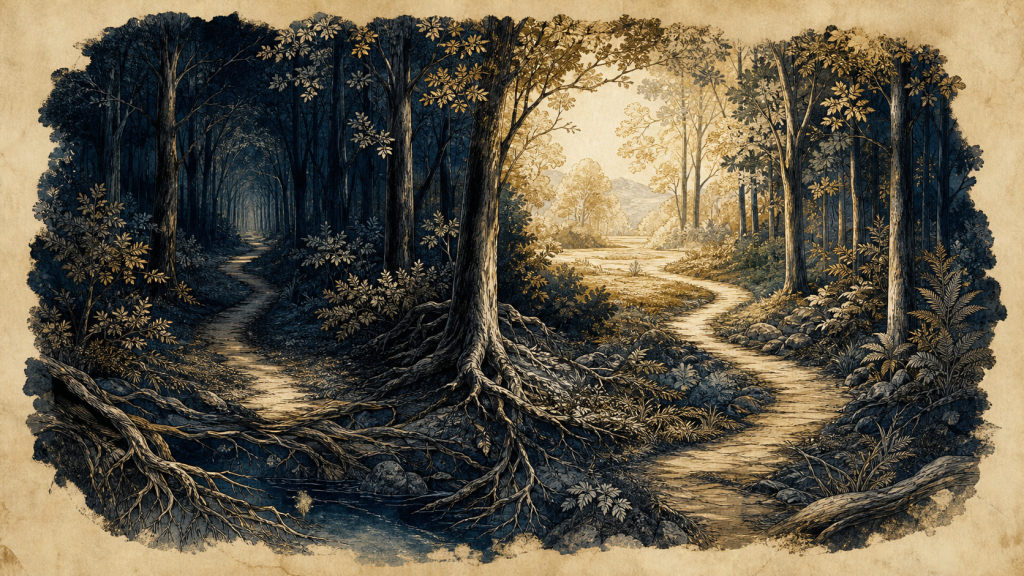
A forest in a dream may suggest an unfamiliar psychological territory, instinctive life, concealment, danger, refuge, disorientation, or a path of discovery.
Possible Contexts
- Unfamiliar psychological territory
- Instinctive life and nature
- Refuge or concealment
- Danger and disorientation
- A path of exploration or development
- Literal environmental experience
Questions for Reflection
- What was the forest’s condition and atmosphere?
- Were you entering, leaving, hiding, or lost?
- What figures or landmarks appeared?
- What personal and cultural associations arise?
Interpretation Caution
A forest has no fixed meaning. Personal history, cultural context, dream sequence, and waking circumstances must guide interpretation.
What Does a Forest Mean in a Dream?
A forest in a dream often places the dreamer outside familiar orientation. It may represent an unknown psychological territory, instinctive life, refuge, concealment, danger, confusion, or a developing path. No interpretation applies universally.
Details That Change the Meaning
- Dense, open, burned, cultivated, ancient, or newly growing
- Daylight, darkness, fog, season, and weather
- Following a path, becoming lost, hiding, camping, or leaving
- Animals, helpers, pursuers, houses, water, or clearings
Possible Contexts
A threatening forest may reflect anxiety about entering an unfamiliar situation. A living forest can suggest contact with instinct or renewal. A path may provide orientation, while its disappearance may ask the dreamer to tolerate uncertainty. Literal memories of hiking, danger, work, or childhood must be considered first.
Story and Cultural Context
Forests carry different meanings in fairy tales, Indigenous traditions, religion, ecology, and local history. These traditions should not be collapsed into one generic Jungian symbol.
Questions for Reflection
- Did you enter voluntarily?
- What were you seeking or avoiding?
- What provided orientation?
- What personal forest memory has the same atmosphere?
- What unfamiliar area of life feels similar now?
Caution
A forest dream is not a prediction. Use the Personal Association Worksheet before consulting broad symbolic parallels.
Paths, Clearings, and Edges
A forest is structured by transitions as well as trees. A path may represent borrowed guidance, habit, or a practical route; a clearing can offer perspective or exposure; the forest edge marks movement between known and less familiar terrain. Ask whether the dreamer follows, makes, loses, or refuses a path. The answer can clarify agency without turning the landscape into a fixed map of the unconscious.
Continue your study
Recommended Reading
Books selected because they directly develop ideas discussed on this page.
Man and His Symbols
Man and His Symbols is an illustrated introduction to dreams, symbols, archetypes, and individuation written by Carl Jung and four close collaborators for general readers.
Memories, Dreams, Reflections
Memories, Dreams, Reflections is a semi-autobiographical account assembled from Carl Jung's recollections, manuscripts, and conversations with editor Aniela Jaffé.
Paid links. As an Amazon Associate I earn from qualifying purchases.
Related Concepts
Individuation
Individuation is Jung’s term for the lifelong process of becoming a more differentiated and integrated psychological whole.
Collective Unconscious
In Jungian psychology, the collective unconscious is a proposed inherited layer of the psyche expressed through universal patterns called archetypes.

Personal Unconscious
In Jungian psychology, the personal unconscious contains experiences, perceptions, and emotionally charged material outside an individual’s present awareness.
Self
The Self is Jung’s concept of the whole psyche—conscious and unconscious—and the archetypal principle of its organization, development, and potential integration.
Archetype
An archetype is an inherited organizing pattern in Jung’s theory that can shape recurring forms of imagery, emotion, perception, and behavior without prescribing one fixed image.
Transcendent Function
The transcendent function is the new psychological attitude or symbolic possibility that can emerge when conscious and unconscious positions are held in genuine dialogue.
Mandala
A mandala is a centered, often circular symbolic form that Jung associated with psychic order, wholeness, containment, and the Self.
Related Archetypes

Wise Old Person
The Wise Old Person is an archetypal guide figure associated with meaning, counsel, insight, and the danger of identifying with borrowed authority.
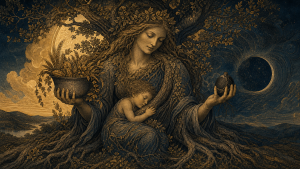
Great Mother
The Great Mother is an archetypal pattern of origin, nourishment, protection, fertility, containment, engulfment, and destructive power.

Child
The Child archetype represents vulnerable beginnings, unrealized potential, renewal, dependence, abandonment, and a future personality still developing.
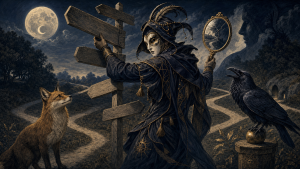
Trickster
The Trickster is an archetypal boundary-breaker whose humor, appetite, deception, mistakes, and reversals can expose rigidity while also causing real harm.

Maiden (Kore)
The Maiden, or Kore, is an archetypal image of youth, potential, vulnerability, separation, descent, renewal, and an identity not yet fully differentiated.
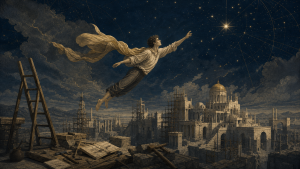
Puer Aeternus
Puer aeternus, the eternal-youth archetype, carries possibility, freedom, renewal, and imagination but becomes one-sided when potential repeatedly replaces commitment and lived experience.

Senex
The Senex archetype carries time, structure, discipline, memory, authority, limit, and responsibility; one-sided, it may harden into rigidity, control, sterility, or punitive order.
Related Practices

Jungian Dream Analysis
Jungian dream analysis explores a dream’s personal associations, structure, emotional context, and possible compensatory relationship to conscious life without using fixed symbol definitions.

Dream Journaling
Dream journaling is the practice of recording dreams promptly and preserving their sequence, atmosphere, images, emotions, and personal associations.

Symbol Amplification
Symbol amplification is a Jungian method of comparing an image with mythic, religious, artistic, historical, and cultural parallels while staying anchored to personal context.
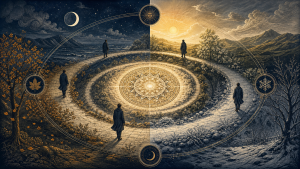
Circumambulation
Circumambulation is a Jungian method of staying close to one image while examining it repeatedly from different personal, emotional, symbolic, and practical viewpoints.

Sandplay Therapy
Sandplay therapy is a clinical, expressive method in which a client creates scenes with sand, water, and miniatures within a protected therapeutic relationship.
Personal Association in Dream Work
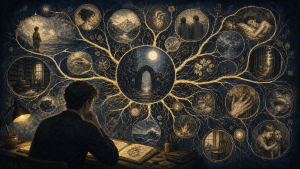
Personal association explores the dreamer’s own memories, feelings, language, culture, sensory responses, and current circumstances around a specific dream image.
Related Books

Man and His Symbols
Man and His Symbols is an illustrated introduction to dreams, symbols, archetypes, and individuation written by Carl Jung and four close collaborators for general readers.

Memories, Dreams, Reflections
Memories, Dreams, Reflections is a semi-autobiographical account assembled from Carl Jung's recollections, manuscripts, and conversations with editor Aniela Jaffé.