Interactive Tool
Dream Recall Worksheet
A private, reusable worksheet for recording a dream accurately before interpretation changes its sequence, images, atmosphere, and emotional details.
Purpose
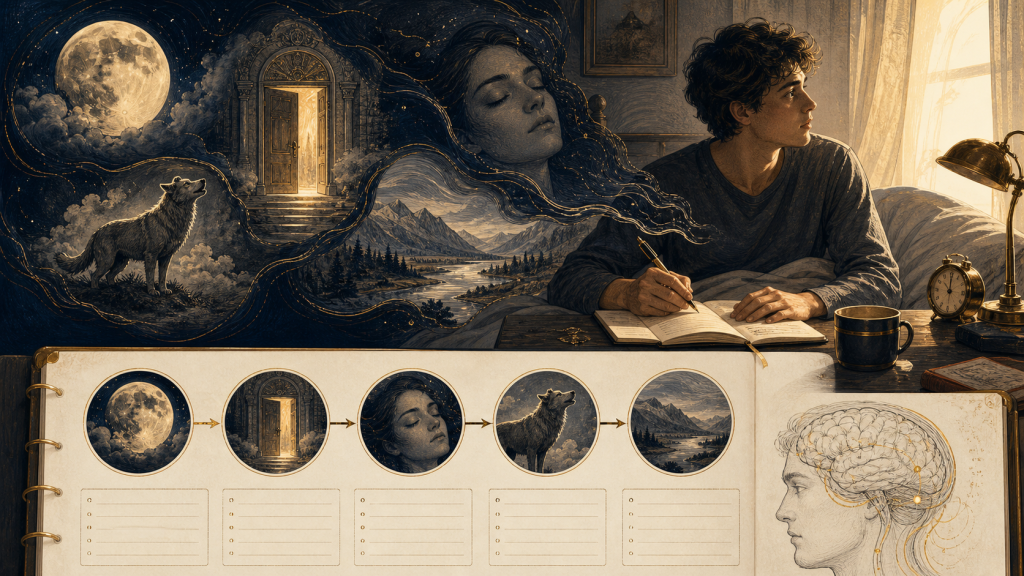
To preserve dream sequence, setting, figures, symbols, emotions, associations, and waking context before interpretation.
Instructions
Use the worksheet immediately after waking or while reviewing a dream journal entry. Complete recall sections before developing interpretations.
Privacy
No information is entered, transmitted, or stored by this page. Copy the headings into a private notebook or document under your control.
Important Disclaimer
Educational only. Dreams do not provide diagnosis, prophecy, or commands. Seek qualified help for distressing nightmares, trauma symptoms, severe sleep problems, or impaired reality testing.
Private working worksheet
Record the dream before interpreting it
Everything you type remains only in this tab unless you choose to download or print your own copy.
Dreams are not diagnoses, commands, or predictions. Recurrent nightmares, trauma symptoms, severe sleep disruption, or loss of contact with reality deserve qualified professional support.
Capture First, Interpret Later
The interactive Dream Recall Worksheet helps preserve sequence, setting, figures, symbols, emotions, and waking context before interpretation changes the memory. It works alongside Dream Journaling and Jungian Dream Analysis.
Using Your Private Copy
Download a plain-text copy for your own records or print the completed worksheet. The site does not receive your entries. Closing or refreshing the tab removes anything that has not been downloaded or printed.
Interpretive Boundaries
Keep multiple hypotheses open. A house, water, or snake must be considered through the particular dream, the dreamer’s associations, and waking-life context—not a fixed dictionary definition.
Preserve Uncertainty
Use brackets or question marks for uncertain dialogue, sequence, identity, and location instead of silently completing the dream. Distinguish what was present on waking from details remembered later. These gaps are part of the record. Accurate uncertainty makes later comparison more reliable and reduces the temptation to reshape a dream around an interpretation.
Continue your study
Recommended Reading
Books selected because they directly develop ideas discussed on this page.
Man and His Symbols
Man and His Symbols is an illustrated introduction to dreams, symbols, archetypes, and individuation written by Carl Jung and four close collaborators for general readers.
Memories, Dreams, Reflections
Memories, Dreams, Reflections is a semi-autobiographical account assembled from Carl Jung's recollections, manuscripts, and conversations with editor Aniela Jaffé.
Paid links. As an Amazon Associate I earn from qualifying purchases.
Related Concepts

Individuation
Individuation is Jung’s term for the lifelong process of becoming a more differentiated and integrated psychological whole.
Collective Unconscious
In Jungian psychology, the collective unconscious is a proposed inherited layer of the psyche expressed through universal patterns called archetypes.
Personal Unconscious
In Jungian psychology, the personal unconscious contains experiences, perceptions, and emotionally charged material outside an individual’s present awareness.
Complex
In Jungian psychology, a complex is an emotionally charged network of associations that can temporarily influence perception, emotion, and behavior.
Self
The Self is Jung’s concept of the whole psyche—conscious and unconscious—and the archetypal principle of its organization, development, and potential integration.
Archetype
An archetype is an inherited organizing pattern in Jung’s theory that can shape recurring forms of imagery, emotion, perception, and behavior without prescribing one fixed image.
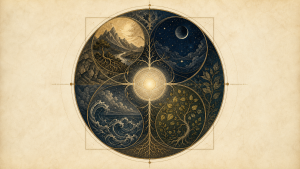
Mandala
A mandala is a centered, often circular symbolic form that Jung associated with psychic order, wholeness, containment, and the Self.
Related Archetypes

Wise Old Person
The Wise Old Person is an archetypal guide figure associated with meaning, counsel, insight, and the danger of identifying with borrowed authority.
Great Mother
The Great Mother is an archetypal pattern of origin, nourishment, protection, fertility, containment, engulfment, and destructive power.

Child
The Child archetype represents vulnerable beginnings, unrealized potential, renewal, dependence, abandonment, and a future personality still developing.

Trickster
The Trickster is an archetypal boundary-breaker whose humor, appetite, deception, mistakes, and reversals can expose rigidity while also causing real harm.
Related Dream Symbols
Snake
A snake in a dream can evoke danger, instinct, transformation, healing, sexuality, wisdom, or something unfamiliar—but its meaning depends on the dream’s details and the dreamer’s associations.

House
A house in a dream may represent the dreamer, a structure of personality, family life, memory, safety, or a psychological situation, depending on context.

Water
Water in a dream may relate to emotion, bodily life, the unconscious, renewal, danger, depth, or overwhelming experience, depending on its form and context.
Related Practices

Jungian Dream Analysis
Jungian dream analysis explores a dream’s personal associations, structure, emotional context, and possible compensatory relationship to conscious life without using fixed symbol definitions.

Dream Journaling
Dream journaling is the practice of recording dreams promptly and preserving their sequence, atmosphere, images, emotions, and personal associations.
Related Books

Man and His Symbols
Man and His Symbols is an illustrated introduction to dreams, symbols, archetypes, and individuation written by Carl Jung and four close collaborators for general readers.

Memories, Dreams, Reflections
Memories, Dreams, Reflections is a semi-autobiographical account assembled from Carl Jung's recollections, manuscripts, and conversations with editor Aniela Jaffé.
Related Assessments
Jungian Functions Self-Reflection
A free educational self-reflection that helps you notice how you currently use thinking, feeling, sensation, and intuition.

Shadow Pattern Self-Reflection
A careful, non-diagnostic self-reflection for noticing recurring projections, disproportionate reactions, hidden strengths, and disowned qualities.

Dream Context Self-Check
A non-diagnostic checklist for testing whether a dream interpretation accounts for personal associations, waking context, emotion, sequence, and external relationships.

Active Imagination Readiness & Safety Check
A private, non-diagnostic checklist for identifying preparation gaps in grounding, containment, support, interpretation, and action before active imagination.

Symbolic Interpretation Grounding Check
A private educational check for testing whether a symbolic interpretation is grounded in observation, alternatives, context, reality, ethics, and revisability.

Dream Interpretation Bias Check
A private educational check for common dream-interpretation biases involving selective evidence, first impressions, fixed meanings, missing context, and reality boundaries.