
Book
The Creation of Consciousness
The Creation of Consciousness is Edward F. Edinger’s concise proposal for a modern Jungian worldview joining the scientific pursuit of knowledge with the religious search for meaning.

Summary
Edinger argues for a worldview in which the growth of individual consciousness has transpersonal significance. He attempts to hold scientific knowledge and the religious need for meaning in creative relation without simply making them identical.
Key Topics
- Creation of consciousness
- Ego and Self
- Individuation
- Science and religious meaning
- Modern worldview
- Ethical responsibility
- Psychological inflation
Reader Guidance
Intermediate to advanced. Read as Edinger’s Jungian philosophical proposal, not a scientific theory of cosmology or brain development, a universal religion, empirical proof of purpose, or a license for grandiosity.
What Is The Creation of Consciousness?
The Creation of Consciousness: Jung’s Myth for Modern Man is Edward F. Edinger’s concise proposal for a modern Jungian worldview. He asks how scientific knowledge and the human need for religious meaning might be held in a creative relationship.
Why Consciousness Matters
Edinger gives individual consciousness a significance greater than personal efficiency or self-improvement. Becoming more conscious means recognizing projections, differentiating conflicting positions, assuming responsibility, and developing a more adequate relationship with unconscious life.
The Ego–Self Relationship
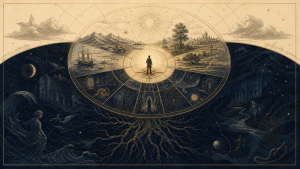
The conscious ego is limited, but it is not disposable. It supplies reflection, choice, reality testing, and responsibility. The Self represents a wider psychic totality that cannot be fully controlled by the ego.
Edinger’s central tension is collaboration without identification. The ego may serve consciousness without imagining that it has become the Self.
Individuation as Responsibility
Individuation is not presented as private perfection. Increased awareness creates obligations: to examine projection, tolerate complexity, recognize one’s Shadow, and act with greater accountability.
Symbolic insight matters only when it can be related to behavior, evidence, relationships, and ordinary life.
Science and Religious Meaning
Edinger tries to avoid a simple choice between scientific knowledge and religious meaning. His proposed collaboration does not make psychology a natural science of ultimate purpose, nor does it permit religious symbolism to override evidence.
The book is best read as a philosophical and psychological argument rather than a tested cosmological model.
The Risk of Inflation
A belief that one is helping create cosmic consciousness can easily become grandiose. The site’s guide to psychological inflation is therefore essential companion reading.
- Meaning does not establish superiority.
- Numinous experience does not grant special authority over others.
- Archetypal language does not remove accountability.
- A personal conviction is not automatically universal truth.
Questions for Critical Reading
- Which claims are psychological, philosophical, religious, or scientific?
- What evidence could support or challenge each kind of claim?
- How does the argument define consciousness?
- Where might collective or cultural history complicate an individual account?
- Does the idea increase humility and responsibility, or inflate identity?
Who Should Read It?
The book is useful for readers who understand basic Jungian concepts and want to examine Edinger’s larger worldview. It also provides context for his studies of scripture, alchemy, mythology, and the ego–Self relationship.
Edition Information
Inner City Books lists Title 14 as a 128-page book published in 1984 with 10 illustrations and ISBN 9780919123137. The linked Amazon edition is ASIN 0919123139.
Sources
Related Concepts

Individuation
Individuation is Jung’s term for the lifelong process of becoming a more differentiated and integrated psychological whole.

Collective Unconscious
In Jungian psychology, the collective unconscious is a proposed inherited layer of the psyche expressed through universal patterns called archetypes.

Personal Unconscious
In Jungian psychology, the personal unconscious contains experiences, perceptions, and emotionally charged material outside an individual’s present awareness.
Ego
In Jungian psychology, the ego is the central complex of consciousness: the organizing “I” that experiences identity, makes choices, and adapts to inner and outer life.

Self
The Self is Jung’s concept of the whole psyche—conscious and unconscious—and the archetypal principle of its organization, development, and potential integration.
Archetype
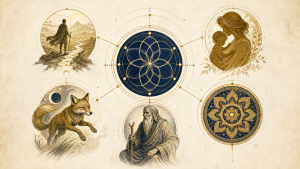
An archetype is an inherited organizing pattern in Jung’s theory that can shape recurring forms of imagery, emotion, perception, and behavior without prescribing one fixed image.

Transcendent Function
The transcendent function is the new psychological attitude or symbolic possibility that can emerge when conscious and unconscious positions are held in genuine dialogue.

Psychological Opposites
Psychological opposites are conflicting conscious and unconscious positions whose tension can reveal one-sidedness and support development.

Psychological Inflation
Psychological inflation is an expanded or diminished self-estimate caused by identifying the ego with an archetype, role, group, insight, or unconscious content.
Related Practices

Shadow Work
Shadow work is a modern term for reflective practices that explore qualities, emotions, and patterns a person habitually rejects, hides, or fails to recognize in themselves.

Active Imagination
Active imagination is Jung’s method of consciously engaging emerging images, emotions, or figures through sustained attention and expression while preserving awareness and judgment.

Jungian Dream Analysis
Jungian dream analysis explores a dream’s personal associations, structure, emotional context, and possible compensatory relationship to conscious life without using fixed symbol definitions.

Symbol Amplification
Symbol amplification is a Jungian method of comparing an image with mythic, religious, artistic, historical, and cultural parallels while staying anchored to personal context.

Circumambulation
Circumambulation is a Jungian method of staying close to one image while examining it repeatedly from different personal, emotional, symbolic, and practical viewpoints.
Related Psychologists

Carl Jung
Carl Gustav Jung was a Swiss psychiatrist who founded analytical psychology and developed influential ideas about complexes, archetypes, the collective unconscious, psychological types, and individuation.

Edward F. Edinger
Edward F. Edinger was an American psychiatrist, Jungian analyst, lecturer, and author who became a prominent interpreter of Jung’s work on the ego, Self, individuation, alchemy, and religious symbolism.