
Dream Symbol
Flying Dream Meaning
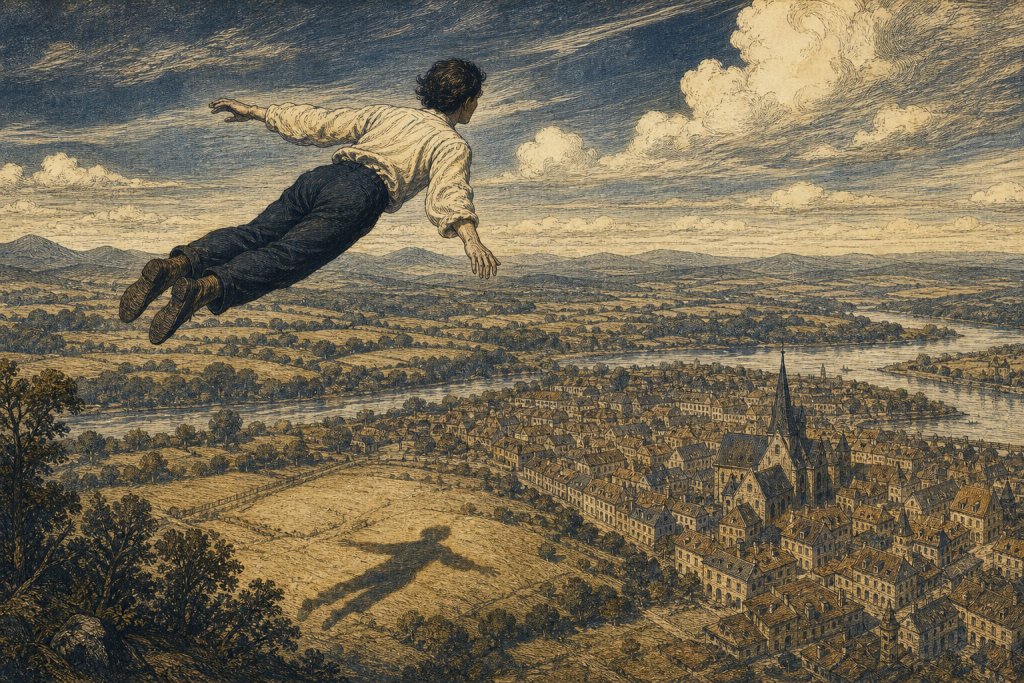
Flying dreams may involve freedom, perspective, confidence, escape, inflation, instability, fear of falling, or the sensory qualities of sleep.
Symbol Overview
The key questions are how the dreamer flies, whether flight can be controlled, what lies below, where the dreamer is going, and whether the experience feels liberating or dangerous.
Possible Contexts
- Joyful controlled flight: competence, perspective, release, imagination, or expanded possibility.
- Unable to land: difficulty returning to limits, obligations, the body, or ordinary reality.
- Escaping by flight: adaptive distance, avoidance, fear, or a need for safety.
- Falling after flight: unstable confidence, loss of control, sleep sensation, or sudden correction.
Questions for Reflection
- How did flight begin?
- Could you steer, stop, and land?
- What were you leaving and approaching?
- How did the ground appear from above?
- Where do you currently need perspective—and where do you need contact?
Interpretation Caution
Dream images do not have one universal meaning. Begin with the dream’s sequence, emotion, personal associations, current circumstances, culture, recent media, sleep conditions, and bodily experience. Treat symbolic interpretations as hypotheses, not diagnoses, predictions, recovered memories, or facts about another person.
Freedom and escape are not the same
A flying dream may compensate for restriction by creating space and movement. It may also dramatize avoidance when the dreamer leaves conflict, responsibility, or embodiment below. The destination and emotional aftermath help distinguish these possibilities.
Inflation as one possible reading
Jungian psychology uses inflation for an ego state that identifies with power or significance larger than it can responsibly carry. Effortless superiority over people below may invite that question—but joyful flight alone does not prove inflation.
The value of landing
Landing can symbolize return, limitation, completion, or renewed contact. Ask what changes when the dreamer comes back to ground. A useful interpretation connects enlarged perspective with an ordinary next step.
Altitude and method provide context
Floating a few feet above a room is different from crossing an ocean or rising beyond sight of the ground. Some dreamers swim through air, use a machine, leap, or discover they can move by intention. The method can connect the flight with effort, technology, imagination, confidence, or an unfamiliar capacity.
Look at what remains below
The landscape may contain home, work, danger, loved ones, crowds, or an unfinished task. Distance can create perspective, but it can also reduce other people to abstractions. Ask whether the dreamer returns with something useful, keeps escaping, becomes lost, or discovers a new relationship to ordinary life.
Continue your study
Recommended Reading
Books selected because they directly develop ideas discussed on this page.
Man and His Symbols
Man and His Symbols is an illustrated introduction to dreams, symbols, archetypes, and individuation written by Carl Jung and four close collaborators for general readers.
Memories, Dreams, Reflections
Memories, Dreams, Reflections is a semi-autobiographical account assembled from Carl Jung's recollections, manuscripts, and conversations with editor Aniela Jaffé.
The Archetypes and the Collective Unconscious
The Archetypes and the Collective Unconscious collects major essays in which Carl Jung develops his accounts of archetypes, collective psychic patterns, rebirth, the mother, the child,…
Paid links. As an Amazon Associate I earn from qualifying purchases.
Related Concepts

Psychological Inflation
Psychological inflation is an expanded or diminished self-estimate caused by identifying the ego with an archetype, role, group, insight, or unconscious content.

Compensation
Compensation is the psyche’s tendency to balance or supplement a one-sided conscious attitude through dreams, emotions, fantasies, symptoms, and neglected perspectives.
Ego
In Jungian psychology, the ego is the central complex of consciousness: the organizing “I” that experiences identity, makes choices, and adapts to inner and outer life.

Self
The Self is Jung’s concept of the whole psyche—conscious and unconscious—and the archetypal principle of its organization, development, and potential integration.
Related Practices

Jungian Dream Analysis
Jungian dream analysis explores a dream’s personal associations, structure, emotional context, and possible compensatory relationship to conscious life without using fixed symbol definitions.

Personal Association in Dream Work
Personal association explores the dreamer’s own memories, feelings, language, culture, sensory responses, and current circumstances around a specific dream image.

Dream Journaling
Dream journaling is the practice of recording dreams promptly and preserving their sequence, atmosphere, images, emotions, and personal associations.
Related Books

Man and His Symbols
Man and His Symbols is an illustrated introduction to dreams, symbols, archetypes, and individuation written by Carl Jung and four close collaborators for general readers.

Memories, Dreams, Reflections
Memories, Dreams, Reflections is a semi-autobiographical account assembled from Carl Jung's recollections, manuscripts, and conversations with editor Aniela Jaffé.

The Archetypes and the Collective Unconscious
The Archetypes and the Collective Unconscious collects major essays in which Carl Jung develops his accounts of archetypes, collective psychic patterns, rebirth, the mother, the child, and individuation.