
Jungian Concept
Psychological Types
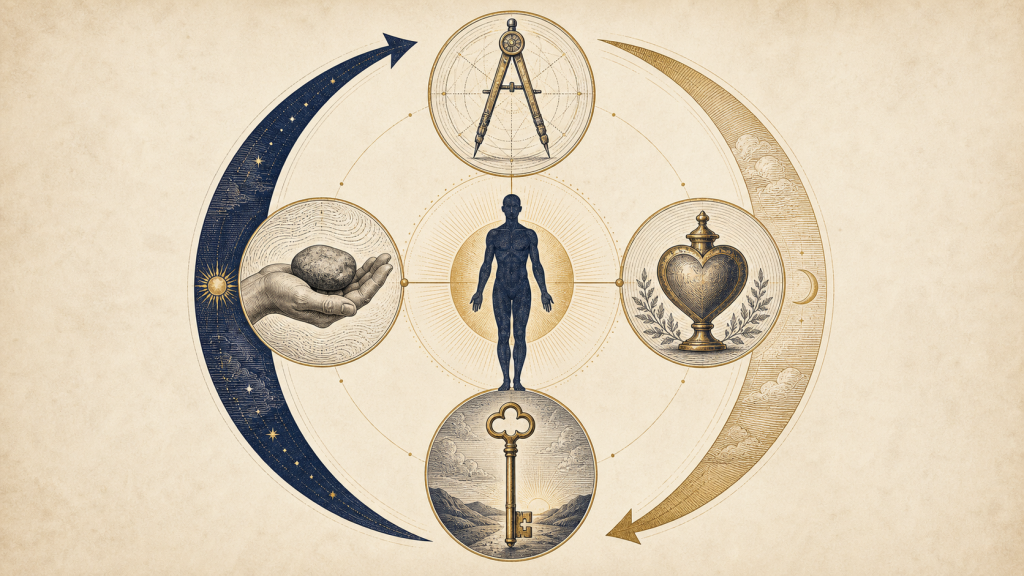
Jung’s psychological types combine two attitudes—introversion and extraversion—with four functions: thinking, feeling, sensation, and intuition.
Definition
Jung’s typology maps two directions of conscious orientation—introversion and extraversion—and four functions of consciousness: thinking, feeling, sensation, and intuition.
What Are Jung’s Psychological Types?
Carl Jung’s theory of psychological types describes recurring differences in how consciousness is oriented and how people perceive and evaluate experience. The model combines two attitudes—introversion and extraversion—with four functions: thinking, feeling, sensation, and intuition.
Jung presented the theory most fully in his 1921 book Psychological Types. He intended typology as a tool for understanding differences and correcting one-sidedness, not as a complete description of personality.
The Two Attitudes
Introversion gives greater weight to the subject: the person’s inner impressions, ideas, and standpoint. Extraversion gives greater weight to the object: external people, conditions, events, and shared reality.
Everyone uses both attitudes. “Type” refers to a habitual preference or dominant conscious orientation, while the less-developed opposite may appear unconsciously or under stress.
The Four Functions
- Sensation registers concrete reality through the senses—what is present.
- Thinking evaluates through concepts and logical connection—what something means.
- Feeling evaluates value—what something is worth or how it is regarded.
- Intuition perceives possibilities, patterns, and where something may lead.
In Jung’s terminology, thinking and feeling are rational functions because they judge. Sensation and intuition are irrational functions because they perceive what is given without first reaching a judgment. “Irrational” here does not mean foolish.
Dominant and Inferior Functions
A dominant function becomes comparatively reliable and differentiated. Its opposite tends to remain less conscious and is called the inferior function. Thinking is paired with feeling; sensation is paired with intuition.
The inferior function is not merely a weakness. It can carry neglected vitality and developmental potential, but it may initially emerge through rigid, emotional, or poorly adapted behavior.
Eight Function-Attitude Types
Each function can operate in an introverted or extraverted attitude, producing eight basic combinations: introverted and extraverted thinking, feeling, sensation, and intuition. Jung’s full descriptions concern the motivation and direction of a function, not a list of surface behaviors.
Jung vs. MBTI
The Myers-Briggs Type Indicator was inspired by Jung but is not identical to his theory. Its four-letter codes, judging/perceiving dimension, scoring system, and assessment claims were developed later. A person’s MBTI result should not be presented as a direct measurement of Jung’s complete model.
Limits of Typology
Type can clarify misunderstanding, but it can also encourage stereotyping and confirmation bias. People change across roles and situations, and no type explains ethics, intelligence, trauma, culture, ability, or destiny. Jung himself emphasized that every individual exceeds the category.
Classification vs. Development
Type language can describe a recurring orientation, but Jung’s larger concern was development. A label becomes counterproductive when it turns current preference into destiny, excuses poor behavior, or discourages neglected capacities. The practical value of typology is comparative: it can reveal why another person’s method is coherent even when it differs from one’s own. It should increase flexibility and communication rather than create a hierarchy of identities.
Sources and Further Reading
Origin and Development
Jung developed the theory through clinical observation and a broad historical comparison of philosophy, religion, literature, aesthetics, and competing schools of psychology. It was published as Psychologische Typen in 1921.
Examples
Two people may reach opposite conclusions from the same situation because one gives primary weight to externally observable conditions while the other gives greater weight to a subjective principle. Typology describes the orientation behind the response, not just whether either person appears sociable.
Common Misconceptions
- Type is not a complete personality.
- Introversion does not equal shyness, and extraversion does not equal confidence.
- Feeling is a form of valuation, not uncontrolled emotion.
- “Irrational function” does not mean unreasonable.
- Jung’s theory and MBTI are related but not identical.
- Type should not determine careers, relationships, or worth.
Continue your study
Recommended Reading
Books selected because they directly develop ideas discussed on this page.
Man and His Symbols
Man and His Symbols is an illustrated introduction to dreams, symbols, archetypes, and individuation written by Carl Jung and four close collaborators for general readers.
Psychological Types
Carl Jung’s foundational study of introversion, extraversion, and the psychological functions of thinking, feeling, sensation, and intuition.
Paid links. As an Amazon Associate I earn from qualifying purchases.
Related Concepts

Persona
In Jungian psychology, the persona is the social identity or “mask” through which a person adapts to roles, expectations, and relationships.

Individuation
Individuation is Jung’s term for the lifelong process of becoming a more differentiated and integrated psychological whole.

Personal Unconscious
In Jungian psychology, the personal unconscious contains experiences, perceptions, and emotionally charged material outside an individual’s present awareness.

Ego
In Jungian psychology, the ego is the central complex of consciousness: the organizing “I” that experiences identity, makes choices, and adapts to inner and outer life.

Self
The Self is Jung’s concept of the whole psyche—conscious and unconscious—and the archetypal principle of its organization, development, and potential integration.

Introversion
Introversion is a Jungian attitude in which conscious energy and motivation give greater priority to the subject’s inner impressions, ideas, and standpoint.

Extraversion
Extraversion is a Jungian attitude in which conscious energy and motivation give greater priority to external people, events, objects, and shared conditions.

Thinking
Thinking is the Jungian function that evaluates experience through concepts, logical relationships, and judgments about what something means.

Feeling
Feeling is the Jungian function that evaluates experience by assigning value: acceptable or unacceptable, important or unimportant, welcomed or rejected.

Sensation
Sensation is the Jungian function that perceives immediate concrete reality through the physical senses and awareness of bodily states.

Intuition
Intuition is the Jungian function that perceives possibilities, patterns, and implications through unconscious processes rather than direct sensory evidence.

Dominant Function
The dominant function is the psychological function a person uses most habitually and has developed most fully under conscious control.

Auxiliary Function
The auxiliary function supports the dominant function by adding a different mode of perception or judgment and helping consciousness adapt more flexibly.

Inferior Function
The inferior function is the least differentiated function in a person's conscious typology and the opposite of the dominant function.

Analytical Psychology
Analytical psychology, often called Jungian psychology, is Carl Jung’s approach to the psyche, unconscious life, symbols, and psychological development.

Carl Jung’s Theory of Personality
Carl Jung’s personality theory combines psychological attitudes and functions with a broader model of ego, persona, shadow, unconscious life, and individuation.

Carl Jung and MBTI
The Myers-Briggs Type Indicator was inspired by Carl Jung’s psychological types, but its four-letter system and assessment method were developed by Katharine Cook Briggs and Isabel Briggs Myers.
Related Books

Man and His Symbols
Man and His Symbols is an illustrated introduction to dreams, symbols, archetypes, and individuation written by Carl Jung and four close collaborators for general readers.

Psychological Types
Carl Jung’s foundational study of introversion, extraversion, and the psychological functions of thinking, feeling, sensation, and intuition.
Related Psychologists

Carl Jung
Carl Gustav Jung was a Swiss psychiatrist who founded analytical psychology and developed influential ideas about complexes, archetypes, the collective unconscious, psychological types, and individuation.

Toni Wolff
Toni Wolff was a Swiss analyst, scholar, institutional leader, and close collaborator of Carl Jung who developed four structural forms of the feminine psyche.