Book
Anatomy of the Psyche
Anatomy of the Psyche is Edward F. Edinger’s Jungian study of Western alchemical images and operations as symbolic parallels for psychological processes and psychotherapy.
Summary
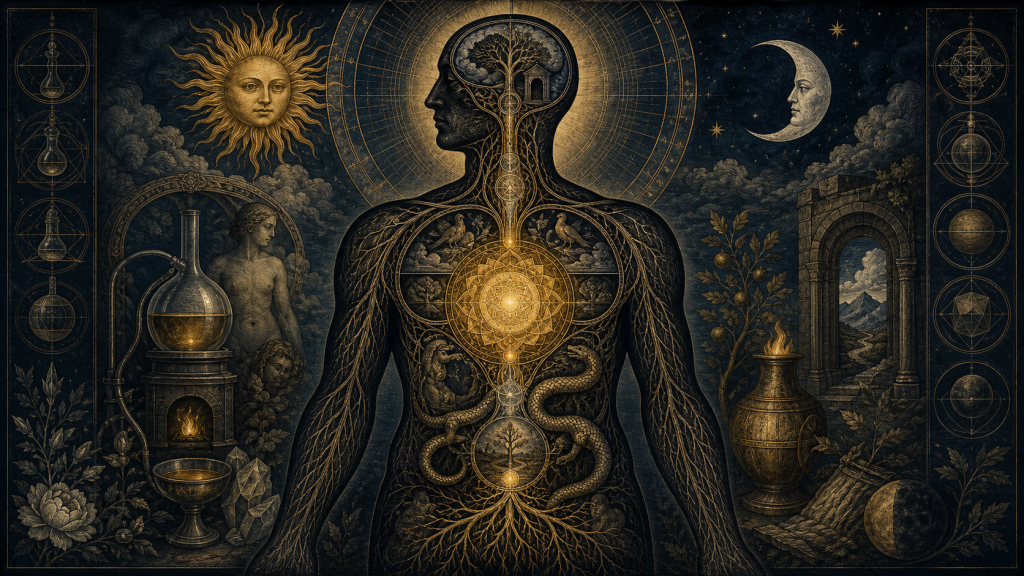
Edinger organizes Western alchemical operations and images as parallels for experiences of separation, dissolution, mortification, conjunction, transformation, and the changing relationship between ego and Self.
Key Topics
- Western alchemy
- Psychological transformation
- Separation and dissolution
- Mortification and conjunction
- Ego and Self
- Individuation
- Alchemy in psychotherapy
Reader Guidance
Advanced. Read as a historically situated Jungian interpretation, not as laboratory chemistry, universal symbolism, medical treatment, diagnostic method, or a replacement for scholarship on alchemical history.
What Is Anatomy of the Psyche?
Anatomy of the Psyche: Alchemical Symbolism in Psychotherapy is Edward F. Edinger’s systematic Jungian reading of Western alchemical images and operations. Published in 1985, it organizes difficult material into recurring symbolic processes that may parallel psychological experience.
The book belongs to the tradition established by C. G. Jung’s studies of alchemy. It is not a history of chemistry and does not represent the full range of current scholarship on alchemical texts, laboratories, medicine, religion, craft, and material culture.
Why Alchemy Appears in Jungian Psychology
Jung argued that alchemical imagery could provide historical parallels for unconscious psychological processes. Edinger develops this claim by grouping images around operations such as separation, dissolution, mortification, conjunction, and transformation.
The value of a parallel depends on context. An image from an alchemical text does not automatically decode a dream, symptom, or life event.
Separation
Separation distinguishes elements that had been mixed together. Psychologically, it may parallel the work of differentiating feelings, assumptions, roles, memories, values, and conflicting positions.
This can support greater consciousness, but division is not always progress. Splitting, isolation, prejudice, and disconnection require different evaluation.
Dissolution
Dissolution loosens a fixed form. Edinger connects it with experiences in which established attitudes soften, certainty weakens, and previously excluded material becomes available.
Loss of structure can also be dangerous. Severe confusion, impaired reality testing, intoxication, medical problems, and acute distress must not be romanticized as symbolic transformation.
Mortification
Mortification imagery includes decay, defeat, darkness, and death. In symbolic work it may accompany the end of an identity, expectation, defense, or inflated position.
It must never be used to glorify self-harm, abuse, deprivation, or untreated illness. Symbolic death is not a command for literal danger.
Conjunction
Conjunction brings differentiated elements into relationship. It can parallel the tension and possible integration of psychological opposites.
Integration does not mean erasing difference or forcing reconciliation. Ethical boundaries, consent, and external reality remain necessary.
Transformation and the Ego–Self Relationship
Across the operations, Edinger examines changes in the relationship between the ego and the Self. The imagery may illuminate aspects of individuation, but it does not establish a universal sequence.
Powerful symbolic experience also creates a risk of psychological inflation. A person may identify with an image of gold, kingship, divine union, or transformation and mistake symbolic intensity for personal authority.
Using the Book with Dreams and Images
- Record the complete image and its emotional context.
- Gather personal associations before consulting alchemical parallels.
- Identify the exact historical source rather than using generic “alchemy” language.
- Compare several possible interpretations.
- Return the parallel to the original dream or situation.
- State uncertainty and preserve ordinary explanations.
The site’s Symbol Amplification guide provides a safer structure for this work.
How to Read It Critically
- Distinguish laboratory, medical, religious, craft, and symbolic dimensions of alchemy.
- Do not assume that every alchemical author meant what modern Jungian psychology finds in the text.
- Avoid treating operations as fixed stages or prescriptions.
- Do not use symbolic language to replace diagnosis, evidence, consent, or safety.
- Consult historians of alchemy alongside psychological interpretations.
Who Should Read It?
This is an advanced resource for readers already familiar with Jungian concepts, especially ego, Self, archetype, dreams, and individuation. It is useful as an organized guide to Edinger’s interpretation, not as a beginner’s introduction or a stand-alone history.
Edition and Purchase Information
The represented Open Court paperback carries ISBN 9780812690095 and Amazon ASIN 0812690095. The exact edition was verified before publication.
Sources
Related Concepts
Shadow
In Jungian psychology, the shadow is the part of the personality containing qualities, impulses, and capacities that the conscious ego does not recognize or accept as its own.

Individuation
Individuation is Jung’s term for the lifelong process of becoming a more differentiated and integrated psychological whole.

Collective Unconscious
In Jungian psychology, the collective unconscious is a proposed inherited layer of the psyche expressed through universal patterns called archetypes.

Personal Unconscious
In Jungian psychology, the personal unconscious contains experiences, perceptions, and emotionally charged material outside an individual’s present awareness.

Complex
In Jungian psychology, a complex is an emotionally charged network of associations that can temporarily influence perception, emotion, and behavior.
Ego
In Jungian psychology, the ego is the central complex of consciousness: the organizing “I” that experiences identity, makes choices, and adapts to inner and outer life.

Self
The Self is Jung’s concept of the whole psyche—conscious and unconscious—and the archetypal principle of its organization, development, and potential integration.
Archetype
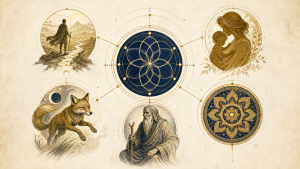
An archetype is an inherited organizing pattern in Jung’s theory that can shape recurring forms of imagery, emotion, perception, and behavior without prescribing one fixed image.

Transcendent Function
The transcendent function is the new psychological attitude or symbolic possibility that can emerge when conscious and unconscious positions are held in genuine dialogue.

Psychological Opposites
Psychological opposites are conflicting conscious and unconscious positions whose tension can reveal one-sidedness and support development.

Psychological Inflation
Psychological inflation is an expanded or diminished self-estimate caused by identifying the ego with an archetype, role, group, insight, or unconscious content.

Coniunctio
Coniunctio is an alchemical image Jung used to explore the psychological union of opposites and the possibility of a new, more inclusive attitude.
Carl Jung, Psychology, and Alchemy
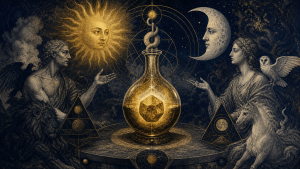
Carl Jung interpreted alchemical images as historical parallels to unconscious psychological processes, especially projection, transformation, opposites, and individuation.
Related Practices

Shadow Work
Shadow work is a modern term for reflective practices that explore qualities, emotions, and patterns a person habitually rejects, hides, or fails to recognize in themselves.

Active Imagination
Active imagination is Jung’s method of consciously engaging emerging images, emotions, or figures through sustained attention and expression while preserving awareness and judgment.

Jungian Dream Analysis
Jungian dream analysis explores a dream’s personal associations, structure, emotional context, and possible compensatory relationship to conscious life without using fixed symbol definitions.

Symbol Amplification
Symbol amplification is a Jungian method of comparing an image with mythic, religious, artistic, historical, and cultural parallels while staying anchored to personal context.

Circumambulation
Circumambulation is a Jungian method of staying close to one image while examining it repeatedly from different personal, emotional, symbolic, and practical viewpoints.
Related Psychologists

Carl Jung
Carl Gustav Jung was a Swiss psychiatrist who founded analytical psychology and developed influential ideas about complexes, archetypes, the collective unconscious, psychological types, and individuation.

Edward F. Edinger
Edward F. Edinger was an American psychiatrist, Jungian analyst, lecturer, and author who became a prominent interpreter of Jung’s work on the ego, Self, individuation, alchemy, and religious symbolism.