
Psychologist
Dora Kalff
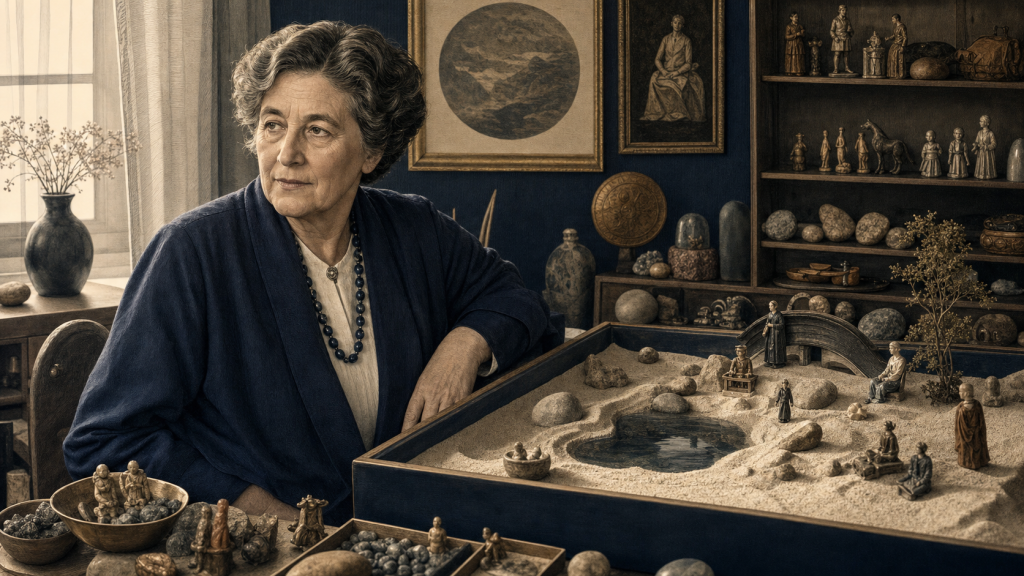
Dora Kalff was a Swiss therapist who developed Jungian sandplay therapy by integrating Margaret Lowenfeld’s World Technique with analytical psychology.
Known For
Founding Jungian sandplay therapy; adapting Margaret Lowenfeld’s World Technique; and articulating the free and protected therapeutic space.
Biography
Kalff studied analytical psychology and adapted Lowenfeld’s expressive sand-tray work into a distinct Jungian clinical method. Her teaching helped establish an international professional sandplay community.
Key Ideas
- Free and protected space
- Symbolic expression through sand and miniatures
- Interpretive restraint
- Development across a series of trays
- Clinical containment and relationship
Who Was Dora Kalff?
Dora Maria Kalff was a Swiss therapist best known as the founder of Jungian sandplay therapy. Her approach developed through contact with C. G. Jung, analytical psychology, Margaret Lowenfeld’s World Technique, and later Buddhist thought.
From the World Technique to Sandplay
Lowenfeld had developed a method in which children constructed worlds using sand and miniature objects. Kalff adapted this expressive medium within a Jungian framework, emphasizing symbolic process, the therapeutic relationship, and the conditions under which psychological development could unfold.
Free and Protected Space
Kalff’s best-known formulation is the “free and protected space.” Freedom means the client is not forced toward a predetermined product or interpretation. Protection refers both to the containing tray and to a reliable therapeutic relationship with clear boundaries.
Interpretive Restraint
Kalff cautioned against treating each miniature as a code. The therapist attends to the whole scene and to development across a series rather than imposing a symbol dictionary. This restraint distinguishes clinical sandplay therapy from casual interpretation.
Legacy
Kalff’s work became an international clinical tradition with professional training organizations and a peer-reviewed literature. Historical claims about efficacy should still be separated from modern outcome research, licensing rules, and individual clinical needs.
Training and Clinical Boundaries
Kalff’s method is more than providing sand and miniatures. Clinical sandplay requires appropriate professional education, supervised training, attention to transference and development, and compliance with local licensing and safeguarding standards. A home sand tray may support creative play or reflection, but it should not be represented as therapy. Interpretive restraint also means referring for medical, trauma-informed, or other specialized care when needed.
Continue your study
Recommended Reading
Books selected because they directly develop ideas discussed on this page.
Man and His Symbols
Man and His Symbols is an illustrated introduction to dreams, symbols, archetypes, and individuation written by Carl Jung and four close collaborators for general readers.
Memories, Dreams, Reflections
Memories, Dreams, Reflections is a semi-autobiographical account assembled from Carl Jung's recollections, manuscripts, and conversations with editor Aniela Jaffé.
The Red Book: Liber Novus
The Red Book: Liber Novus records and artistically develops Carl Jung's confrontation with inner figures and images during a formative period of his psychology.
Paid links. As an Amazon Associate I earn from qualifying purchases.
Related Concepts

Collective Unconscious
In Jungian psychology, the collective unconscious is a proposed inherited layer of the psyche expressed through universal patterns called archetypes.

Complex
In Jungian psychology, a complex is an emotionally charged network of associations that can temporarily influence perception, emotion, and behavior.

Self
The Self is Jung’s concept of the whole psyche—conscious and unconscious—and the archetypal principle of its organization, development, and potential integration.

Archetype
An archetype is an inherited organizing pattern in Jung’s theory that can shape recurring forms of imagery, emotion, perception, and behavior without prescribing one fixed image.

Transcendent Function
The transcendent function is the new psychological attitude or symbolic possibility that can emerge when conscious and unconscious positions are held in genuine dialogue.
Mandala
A mandala is a centered, often circular symbolic form that Jung associated with psychic order, wholeness, containment, and the Self.

Participation Mystique
Participation mystique is a Jungian term for an unconscious state of identity in which the boundary between subject and object, self and other, is insufficiently differentiated.
Related Books

Man and His Symbols
Man and His Symbols is an illustrated introduction to dreams, symbols, archetypes, and individuation written by Carl Jung and four close collaborators for general readers.

Memories, Dreams, Reflections
Memories, Dreams, Reflections is a semi-autobiographical account assembled from Carl Jung's recollections, manuscripts, and conversations with editor Aniela Jaffé.

The Red Book: Liber Novus
The Red Book: Liber Novus records and artistically develops Carl Jung's confrontation with inner figures and images during a formative period of his psychology.

The Archetypes and the Collective Unconscious
The Archetypes and the Collective Unconscious collects major essays in which Carl Jung develops his accounts of archetypes, collective psychic patterns, rebirth, the mother, the child, and individuation.
Related Practices

Active Imagination
Active imagination is Jung’s method of consciously engaging emerging images, emotions, or figures through sustained attention and expression while preserving awareness and judgment.

Jungian Dream Analysis
Jungian dream analysis explores a dream’s personal associations, structure, emotional context, and possible compensatory relationship to conscious life without using fixed symbol definitions.

Dream Journaling
Dream journaling is the practice of recording dreams promptly and preserving their sequence, atmosphere, images, emotions, and personal associations.

Sandplay Therapy
Sandplay therapy is a clinical, expressive method in which a client creates scenes with sand, water, and miniatures within a protected therapeutic relationship.