
Interactive Tool
Edward Edinger Books for Beginners
Choose an accessible Edward Edinger starting point before entering his denser alchemical and religious lectures.

Purpose
Choose an accessible Edward Edinger starting point before entering his denser alchemical and religious lectures.
Instructions
Use the ordering as a flexible pathway. Open each linked book page for edition details, then choose according to your experience and current question.
Privacy
This reading guide does not collect, transmit, or store personal information.
Important Disclaimer
Amazon links may be affiliate links. Recommendations are editorial and are not ordered by commission.
How this guide chooses books
Choose an accessible Edward Edinger starting point before entering his denser alchemical and religious lectures.
Edinger’s diagrams and direct prose can orient new readers, but his books still assume familiarity with Jungian vocabulary and symbolic interpretation.
The order below reflects accessibility, direct relevance, and the role each book can play in a coherent reading path. It does not reflect commission rate. Every linked edition was matched deliberately, but availability, format, seller, and price should be confirmed on Amazon before purchase.
Recommended reading path
1. Ego and Archetype
<p>Edinger presents individuation as a developing relationship between ego-consciousness and the Self, using religious images, myths, dreams, art, and clinical interpretation to discuss separation, alienation, encounter, inflation, and renewed relationship.</p>
Best fit: <p>Intermediate. Read as an influential Jungian interpretation, not as an empirically validated stage theory, diagnosis, universal theology, or substitute for mental-health care.</p>
2. Encounter with the Self
<p>Edinger follows William Blake’s engraved illustrations of the Book of Job as a symbolic drama involving suffering, moral conflict, the God-image, consciousness, and transformation in the ego–Self relationship.</p>
Best fit: <p>Intermediate to advanced. Read the images and biblical text directly. Edinger offers one Jungian interpretation, not a definitive account of Blake, Job, Judaism, Christianity, suffering, theology, or mental health.</p>
4. Science of the Soul
<p>The collection brings together “The Transference Phenomenon,” “The Therapeutic Life,” “Encounter with the Greater Personality,” “The Vocation of Depth Psychotherapy,” and an edited transcript of Edinger’s 1997 “Science of the Soul” video series.</p>
Best fit: <p>Advanced. The book presents Edinger’s Jungian perspective, not a comprehensive account of psychotherapy research, professional ethics, diagnosis, treatment standards, or the full range of clinical approaches.</p>
How to choose the right starting point
Choose the first book whose stated subject matches the question you are actually trying to answer. An introductory overview is usually preferable when the terminology is new. A primary source is preferable when you need Jung’s own formulation. A later commentary may be useful when the primary text assumes extensive knowledge of mythology, religion, alchemy, or clinical theory.
Difficulty should not be confused with authority. A dense volume may be historically important yet poorly suited to a first encounter. Start where you can read critically, retain the distinctions being made, and connect claims to examples.
Questions to ask while reading
- Is the author reporting an observation, defining a model, or interpreting a symbol?
- Which claims depend on the historical assumptions of the author’s period?
- Does the argument preserve personal and cultural context?
- What evidence would weaken or complicate the interpretation?
- How does this book differ from popular summaries of the same topic?
Editorial and affiliate note
Book selection is based on topical fit and usefulness within the reading path. Amazon links may earn Individuationing a commission at no additional cost to you. Prices are not displayed because they change, and no book is ranked more highly because of commission.
Continue your study
Recommended Reading
Books selected because they directly develop ideas discussed on this page.
Ego and Archetype
Ego and Archetype is Edward F. Edinger’s influential Jungian study of individuation and the changing relationship between the conscious ego and the Self.
Encounter with the Self
Encounter with the Self is Edward F. Edinger’s Jungian commentary on William Blake’s illustrations of the Book of Job and their imagery of psychic and religious…
Science of the Soul
Science of the Soul is a posthumous collection of five Edinger essays on psychotherapy, transference, vocation, the greater personality, and Jungian psychological method.
Paid links. As an Amazon Associate I earn from qualifying purchases.
Related Concepts

Individuation
Individuation is Jung’s term for the lifelong process of becoming a more differentiated and integrated psychological whole.

Collective Unconscious
In Jungian psychology, the collective unconscious is a proposed inherited layer of the psyche expressed through universal patterns called archetypes.

Complex
In Jungian psychology, a complex is an emotionally charged network of associations that can temporarily influence perception, emotion, and behavior.
Ego
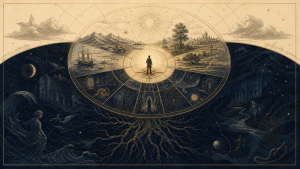
In Jungian psychology, the ego is the central complex of consciousness: the organizing “I” that experiences identity, makes choices, and adapts to inner and outer life.

Self
The Self is Jung’s concept of the whole psyche—conscious and unconscious—and the archetypal principle of its organization, development, and potential integration.
Archetype
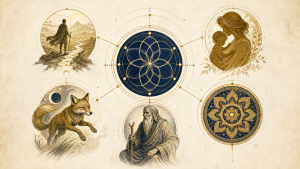
An archetype is an inherited organizing pattern in Jung’s theory that can shape recurring forms of imagery, emotion, perception, and behavior without prescribing one fixed image.

Projection
Projection is the largely unconscious process of experiencing one’s own psychological content as if it belonged primarily or entirely to another person, group, or object.

Transcendent Function
The transcendent function is the new psychological attitude or symbolic possibility that can emerge when conscious and unconscious positions are held in genuine dialogue.

Psychological Opposites
Psychological opposites are conflicting conscious and unconscious positions whose tension can reveal one-sidedness and support development.

Psychological Inflation
Psychological inflation is an expanded or diminished self-estimate caused by identifying the ego with an archetype, role, group, insight, or unconscious content.

Enantiodromia
Enantiodromia is the emergence of an unconscious counter-position after a conscious attitude becomes rigid, extreme, or chronically one-sided.

Coniunctio
Coniunctio is an alchemical image Jung used to explore the psychological union of opposites and the possibility of a new, more inclusive attitude.

Imago
An imago is an internal, subjectively shaped image of another person that must be distinguished from the person’s objective reality.

Constellation
Constellation is the activation of a complex or archetypal pattern by a situation, causing connected emotions, memories, expectations, and behaviors to become unusually available.
Shadow
In Jungian psychology, the shadow is the part of the personality containing qualities, impulses, and capacities that the conscious ego does not recognize or accept as its own.

Personal Unconscious
In Jungian psychology, the personal unconscious contains experiences, perceptions, and emotionally charged material outside an individual’s present awareness.
Related Books

Ego and Archetype
Ego and Archetype is Edward F. Edinger’s influential Jungian study of individuation and the changing relationship between the conscious ego and the Self.

Encounter with the Self
Encounter with the Self is Edward F. Edinger’s Jungian commentary on William Blake’s illustrations of the Book of Job and their imagery of psychic and religious transformation.

Science of the Soul
Science of the Soul is a posthumous collection of five Edinger essays on psychotherapy, transference, vocation, the greater personality, and Jungian psychological method.