
Book
The Sacred Psyche
The Sacred Psyche is Edward F. Edinger’s psychological interpretation of the Psalms, developed from lectures and focused on their continuing significance in individual experience.

Summary
Edinger approaches the Psalms as religious poetry capable of carrying psychologically powerful images of suffering, praise, abandonment, rage, protection, judgment, and renewal. He relates their God-image to the Jungian Self while preserving the work as an interpretation rather than empirical proof.
Key Topics
- Psalms and religious poetry
- The Self and God-image
- Suffering, lament, and praise
- Psychological engagement with scripture
- Religious symbolism
- Individuation and meaning
Reader Guidance
Advanced. Best for readers familiar with Jungian psychology and interested in religion. It is a psychological reading, not a replacement for theology, Hebrew Bible scholarship, Jewish interpretation, history, pastoral care, or clinical treatment.
What Is The Sacred Psyche?
The Sacred Psyche: A Psychological Approach to the Psalms is Edward F. Edinger’s Jungian interpretation of selected Psalms. Developed from a lecture series, it considers why ancient religious poetry can still speak with unusual force during grief, conflict, danger, gratitude, isolation, and renewal.
Edinger treats the Psalms as images through which people have encountered overwhelming psychic and religious realities. His reading links their God-image with the Jungian concept of the Self.
What the Book Examines
The Psalms include praise, lament, accusation, thanksgiving, terror, confidence, longing, and demands for justice. Edinger does not smooth these tensions into a single reassuring message. Their psychological value often lies in the intensity with which contradictory states are expressed.
The book asks how a reader can relate such imagery to contemporary individual experience without reducing scripture to a modern personality manual.
The God-Image and the Self
In analytical psychology, the Self represents psychic totality and an ordering principle greater than the conscious ego. Edinger explores parallels between this idea and the numinous presence encountered in the Psalms.
A parallel is not an identity. Psychological language cannot prove or disprove a theological claim, and the Jungian Self must not be presented as a scientific explanation of God.
Lament, Anger, and Suffering
The Psalms give language to despair, abandonment, humiliation, rage, and fear. Psychologically, this can matter because difficult emotions are acknowledged rather than denied. Expression, however, is not the same as endorsement: violent imagery requires ethical and historical context.
Readers in acute distress should not treat symbolic interpretation as a substitute for appropriate medical, psychological, pastoral, or emergency support.
Praise, Gratitude, and Renewal
Other Psalms portray protection, gratitude, order, beauty, and restored relationship. Edinger reads these states as more than positive thinking. They can represent a changed relationship between the ego and a larger source of meaning.
How to Read the Book Responsibly
- Read the complete Psalm before isolating a psychological image.
- Distinguish Edinger’s Jungian interpretation from the text’s historical settings.
- Consult Jewish and Christian scholarship rather than assuming one universal reading.
- Do not use archetypal claims to erase political, communal, or ethical meanings.
- Treat personal associations as hypotheses, not divine instructions.
Who Should Read It?
The book is suited to readers interested in analytical psychology, scripture, religious experience, and the psychology of meaning. Beginners may want to understand archetype, ego, Self, and individuation first.
Edition Information
Inner City Books lists the volume as Title 108, published in 2004 with 22 illustrations and ISBN 9781894574099. The linked Amazon paperback is ASIN 1894574095.
Sources
Related Concepts

Individuation
Individuation is Jung’s term for the lifelong process of becoming a more differentiated and integrated psychological whole.

Collective Unconscious
In Jungian psychology, the collective unconscious is a proposed inherited layer of the psyche expressed through universal patterns called archetypes.

Complex
In Jungian psychology, a complex is an emotionally charged network of associations that can temporarily influence perception, emotion, and behavior.
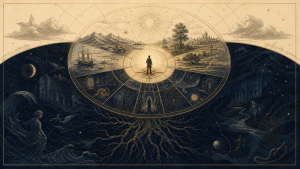
Ego
In Jungian psychology, the ego is the central complex of consciousness: the organizing “I” that experiences identity, makes choices, and adapts to inner and outer life.

Self
The Self is Jung’s concept of the whole psyche—conscious and unconscious—and the archetypal principle of its organization, development, and potential integration.

Archetype
An archetype is an inherited organizing pattern in Jung’s theory that can shape recurring forms of imagery, emotion, perception, and behavior without prescribing one fixed image.

Projection
Projection is the largely unconscious process of experiencing one’s own psychological content as if it belonged primarily or entirely to another person, group, or object.

Transcendent Function
The transcendent function is the new psychological attitude or symbolic possibility that can emerge when conscious and unconscious positions are held in genuine dialogue.

Psychological Opposites
Psychological opposites are conflicting conscious and unconscious positions whose tension can reveal one-sidedness and support development.

Psychological Inflation
Psychological inflation is an expanded or diminished self-estimate caused by identifying the ego with an archetype, role, group, insight, or unconscious content.

Carl Jung and Religion
Carl Jung approached religion as a psychological and symbolic phenomenon whose images can organize experience, while avoiding a clinical proof of theological claims.
Related Practices
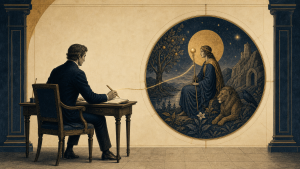
Active Imagination
Active imagination is Jung’s method of consciously engaging emerging images, emotions, or figures through sustained attention and expression while preserving awareness and judgment.

Jungian Dream Analysis
Jungian dream analysis explores a dream’s personal associations, structure, emotional context, and possible compensatory relationship to conscious life without using fixed symbol definitions.

Symbol Amplification
Symbol amplification is a Jungian method of comparing an image with mythic, religious, artistic, historical, and cultural parallels while staying anchored to personal context.

Circumambulation
Circumambulation is a Jungian method of staying close to one image while examining it repeatedly from different personal, emotional, symbolic, and practical viewpoints.
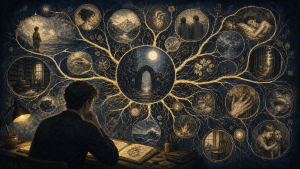
Personal Association in Dream Work
Personal association explores the dreamer’s own memories, feelings, language, culture, sensory responses, and current circumstances around a specific dream image.
Related Psychologists
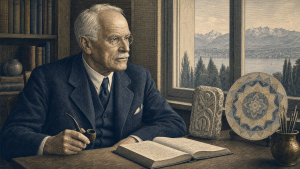
Carl Jung
Carl Gustav Jung was a Swiss psychiatrist who founded analytical psychology and developed influential ideas about complexes, archetypes, the collective unconscious, psychological types, and individuation.

Edward F. Edinger
Edward F. Edinger was an American psychiatrist, Jungian analyst, lecturer, and author who became a prominent interpreter of Jung’s work on the ego, Self, individuation, alchemy, and religious symbolism.