
Book
Encounter with the Self
Encounter with the Self is Edward F. Edinger’s Jungian commentary on William Blake’s illustrations of the Book of Job and their imagery of psychic and religious transformation.
Summary
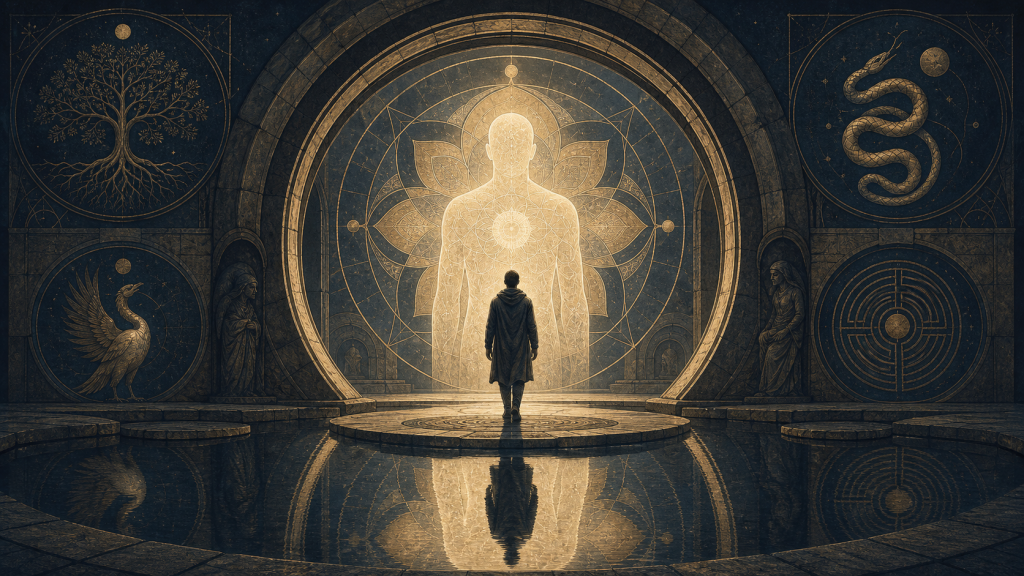
Edinger follows William Blake’s engraved illustrations of the Book of Job as a symbolic drama involving suffering, moral conflict, the God-image, consciousness, and transformation in the ego–Self relationship.
Key Topics
- William Blake
- Book of Job
- The Self and God-image
- Suffering and transformation
- Religious symbolism
- Individuation
- Visual amplification
Reader Guidance
Intermediate to advanced. Read the images and biblical text directly. Edinger offers one Jungian interpretation, not a definitive account of Blake, Job, Judaism, Christianity, suffering, theology, or mental health.
What Is Encounter with the Self?
Encounter with the Self is Edward F. Edinger’s Jungian commentary on William Blake’s illustrations of the Book of Job. Rather than commenting only on the written narrative, Edinger follows Blake’s visual sequence as a psychological drama.
Why Blake’s Images Matter
Blake did not merely illustrate isolated scenes. His arrangement, gestures, borders, instruments, celestial figures, and changes in composition create a visual argument. Edinger treats these details as psychologically meaningful while reading them through analytical psychology.
Job, Suffering, and Consciousness
The story confronts undeserved suffering and the limits of conventional moral explanations. Edinger is interested in what happens when an established relation between the ego, morality, and the God-image breaks down.
A symbolic interpretation must never imply that suffering is deserved, necessary, or secretly beneficial. Real harm requires ethical response, not mythological rationalization.
Encounter with the Self
In Jungian psychology, an encounter with the Self can overwhelm the ordinary standpoint of the ego. It may enlarge consciousness, but it can also create fear, disorientation, or inflation.
The title therefore names a difficult relationship, not a permanent state of enlightenment.
The God-Image
Edinger’s approach examines changes in the psychic image of God. Psychological interpretation addresses how religious images function in experience; it cannot settle whether theological claims are true.
Readers should distinguish the biblical text, Blake’s artistic interpretation, Jung’s psychological arguments, and Edinger’s commentary. These are related but separate layers.
Using the Book for Image Study
- Look at Blake’s complete plate before reading commentary.
- Describe visible details without interpreting them.
- Record emotional and personal associations.
- Compare the plate with its biblical passage.
- Read Edinger’s amplification as one proposal.
- Consult Blake scholarship and biblical scholarship for other contexts.
Connections to Individuation
The sequence can be read as a confrontation with assumptions, a breakdown of an established order, and the emergence of a more complex relation between consciousness and the unconscious. These themes overlap with individuation without establishing a universal developmental route.
Who Should Read It?
The concise volume suits readers interested in Jung, Blake, scripture, visual symbolism, and the psychology of religion. It is approachable after a basic introduction to ego, Self, archetype, and individuation.
Edition Information
Inner City Books lists Title 22 as an 80-page volume published in 1986 with 22 illustrations and ISBN 9780919123212. The Amazon edition is ASIN 091912321X.
Sources
Related Concepts

Shadow
In Jungian psychology, the shadow is the part of the personality containing qualities, impulses, and capacities that the conscious ego does not recognize or accept as its own.

Individuation
Individuation is Jung’s term for the lifelong process of becoming a more differentiated and integrated psychological whole.

Collective Unconscious
In Jungian psychology, the collective unconscious is a proposed inherited layer of the psyche expressed through universal patterns called archetypes.
Ego
In Jungian psychology, the ego is the central complex of consciousness: the organizing “I” that experiences identity, makes choices, and adapts to inner and outer life.

Self
The Self is Jung’s concept of the whole psyche—conscious and unconscious—and the archetypal principle of its organization, development, and potential integration.
Archetype
An archetype is an inherited organizing pattern in Jung’s theory that can shape recurring forms of imagery, emotion, perception, and behavior without prescribing one fixed image.

Projection
Projection is the largely unconscious process of experiencing one’s own psychological content as if it belonged primarily or entirely to another person, group, or object.

Transcendent Function
The transcendent function is the new psychological attitude or symbolic possibility that can emerge when conscious and unconscious positions are held in genuine dialogue.

Psychological Opposites
Psychological opposites are conflicting conscious and unconscious positions whose tension can reveal one-sidedness and support development.

Psychological Inflation
Psychological inflation is an expanded or diminished self-estimate caused by identifying the ego with an archetype, role, group, insight, or unconscious content.
Related Practices

Active Imagination
Active imagination is Jung’s method of consciously engaging emerging images, emotions, or figures through sustained attention and expression while preserving awareness and judgment.

Jungian Dream Analysis
Jungian dream analysis explores a dream’s personal associations, structure, emotional context, and possible compensatory relationship to conscious life without using fixed symbol definitions.

Symbol Amplification
Symbol amplification is a Jungian method of comparing an image with mythic, religious, artistic, historical, and cultural parallels while staying anchored to personal context.

Circumambulation
Circumambulation is a Jungian method of staying close to one image while examining it repeatedly from different personal, emotional, symbolic, and practical viewpoints.
Personal Association in Dream Work
Personal association explores the dreamer’s own memories, feelings, language, culture, sensory responses, and current circumstances around a specific dream image.
Related Psychologists

Carl Jung
Carl Gustav Jung was a Swiss psychiatrist who founded analytical psychology and developed influential ideas about complexes, archetypes, the collective unconscious, psychological types, and individuation.

Edward F. Edinger
Edward F. Edinger was an American psychiatrist, Jungian analyst, lecturer, and author who became a prominent interpreter of Jung’s work on the ego, Self, individuation, alchemy, and religious symbolism.