
Interactive Tool
Active Imagination Session Worksheet
A private browser worksheet for containing, recording, and reviewing an active imagination session without transmitting or storing visitor entries.

Purpose
To establish a safe container, preserve a literal session record, separate observation from interpretation, hold competing hypotheses, and return to ordinary reality.
Instructions
Complete the readiness check first. Set a short duration and stop plan, record the encounter literally, compare at least two interpretations, ground afterward, and do not act automatically on inner imagery.
Privacy
This page does not collect, transmit, or store imagery, dialogue, reflections, or worksheet responses.
Important Disclaimer
Educational only. An imagined figure cannot establish external facts, issue binding commands, diagnose anyone, reveal consent, or replace qualified care. Stop when voluntary control, orientation, or reality testing is uncertain.
Private session worksheet
Contain, record, and review an active imagination session
Set boundaries first, preserve a literal record, and keep symbolic interpretations separate from real-world decisions.
An imagined figure has no authority to command action, reveal external facts, diagnose anyone, or override consent, safety, law, evidence, or professional care. Stop when voluntary control, orientation, or reality testing becomes uncertain.
What Is the Active Imagination Session Worksheet?
The Active Imagination Session Worksheet is a private browser-based tool for containing, recording, and reviewing an active imagination exercise. It separates the literal record from later interpretation and preserves the reader’s responsibility for real-world decisions.
Nothing typed into the worksheet is sent to WordPress or stored by the website. A visitor may choose to print or download a local plain-text copy.
Use the Readiness Check First
Complete the Active Imagination Readiness & Safety Check before beginning. Do not continue alone when orientation, reality testing, voluntary control, or present stability is uncertain.
Why a Written Container Helps
Active imagination asks the ego to attend to inner imagery without either suppressing it or surrendering responsibility to it. A written container establishes a short duration, an exit plan, grounding steps, and a distinction between what occurred in imagination and what can be established externally.
The worksheet also discourages retrospective polishing. Recording exact words, images, emotions, and responses before interpretation makes it easier to notice where expectation or theory may have altered the account.
Five Stages of the Worksheet
- Set the container: record current condition, purpose, duration, stop plan, grounding, and support.
- Record the encounter: preserve imagery, dialogue, emotion, bodily response, choices, and ending.
- Separate observation from interpretation: distinguish the literal account from personal associations and ordinary influences.
- Hold competing hypotheses: develop more than one possible reading and keep contradictions visible.
- Return to ordinary life: ground, identify a modest evidence-based action, and name what you will not act on.
Important Boundaries
- An inner figure is not an external authority.
- Vividness does not prove truth, prediction, recovered memory, or supernatural contact.
- Do not use imagery to diagnose another person or infer consent.
- Do not make financial, medical, legal, relationship, or safety decisions solely from an imagined encounter.
- Stop if the exercise becomes involuntary, disorienting, compulsive, or difficult to distinguish from external reality.
After the Session
Return to food, movement, daylight, ordinary conversation, practical tasks, or another grounding activity. Delay major interpretation until emotional intensity has decreased. Recurrent or distressing material may be better explored with a qualified mental-health professional familiar with imagery-based methods.
Write a Stop Rule Before Beginning
Define the time limit and stopping conditions before engaging the image. Examples include rising panic, loss of orientation, commanding content, inability to end the dialogue, or confusion about whether an event is internal or external. Also record the grounding action and person to contact if needed. A prewritten rule protects judgment when the material becomes emotionally compelling.
Sources and Method
- Daryl Sharp, Jung Lexicon: Active Imagination.
- C. G. Jung’s discussions of active imagination across the Collected Works.
- Original educational worksheet created for Individuationing.
Continue your study
Recommended Reading
Books selected because they directly develop ideas discussed on this page.
The Red Book: Liber Novus
The Red Book: Liber Novus records and artistically develops Carl Jung's confrontation with inner figures and images during a formative period of his psychology.
Memories, Dreams, Reflections
Memories, Dreams, Reflections is a semi-autobiographical account assembled from Carl Jung's recollections, manuscripts, and conversations with editor Aniela Jaffé.
Paid links. As an Amazon Associate I earn from qualifying purchases.
Related Concepts
Shadow
In Jungian psychology, the shadow is the part of the personality containing qualities, impulses, and capacities that the conscious ego does not recognize or accept as its own.

Collective Unconscious
In Jungian psychology, the collective unconscious is a proposed inherited layer of the psyche expressed through universal patterns called archetypes.

Complex
In Jungian psychology, a complex is an emotionally charged network of associations that can temporarily influence perception, emotion, and behavior.
Ego
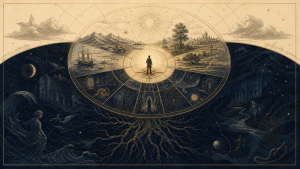
In Jungian psychology, the ego is the central complex of consciousness: the organizing “I” that experiences identity, makes choices, and adapts to inner and outer life.

Self
The Self is Jung’s concept of the whole psyche—conscious and unconscious—and the archetypal principle of its organization, development, and potential integration.

Archetype
An archetype is an inherited organizing pattern in Jung’s theory that can shape recurring forms of imagery, emotion, perception, and behavior without prescribing one fixed image.

Projection
Projection is the largely unconscious process of experiencing one’s own psychological content as if it belonged primarily or entirely to another person, group, or object.
Related Archetypes

Wise Old Person
The Wise Old Person is an archetypal guide figure associated with meaning, counsel, insight, and the danger of identifying with borrowed authority.

Child
The Child archetype represents vulnerable beginnings, unrealized potential, renewal, dependence, abandonment, and a future personality still developing.

Trickster
The Trickster is an archetypal boundary-breaker whose humor, appetite, deception, mistakes, and reversals can expose rigidity while also causing real harm.
Related Dream Symbols

Snake
A snake in a dream can evoke danger, instinct, transformation, healing, sexuality, wisdom, or something unfamiliar—but its meaning depends on the dream’s details and the dreamer’s associations.

House
A house in a dream may represent the dreamer, a structure of personality, family life, memory, safety, or a psychological situation, depending on context.

Water
Water in a dream may relate to emotion, bodily life, the unconscious, renewal, danger, depth, or overwhelming experience, depending on its form and context.

Forest
A forest in a dream may suggest an unfamiliar psychological territory, instinctive life, concealment, danger, refuge, disorientation, or a path of discovery.

Door
A door in a dream may suggest access, exclusion, transition, opportunity, secrecy, protection, choice, or a boundary between psychological situations.

Mirror
A mirror in a dream may concern self-recognition, appearance, identity, reversal, duplication, self-judgment, projection, or the unsettling failure to recognize oneself.
Related Practices

Shadow Work
Shadow work is a modern term for reflective practices that explore qualities, emotions, and patterns a person habitually rejects, hides, or fails to recognize in themselves.

Active Imagination
Active imagination is Jung’s method of consciously engaging emerging images, emotions, or figures through sustained attention and expression while preserving awareness and judgment.

Dream Journaling
Dream journaling is the practice of recording dreams promptly and preserving their sequence, atmosphere, images, emotions, and personal associations.

Symbol Amplification
Symbol amplification is a Jungian method of comparing an image with mythic, religious, artistic, historical, and cultural parallels while staying anchored to personal context.
Related Books

The Red Book: Liber Novus
The Red Book: Liber Novus records and artistically develops Carl Jung's confrontation with inner figures and images during a formative period of his psychology.

Memories, Dreams, Reflections
Memories, Dreams, Reflections is a semi-autobiographical account assembled from Carl Jung's recollections, manuscripts, and conversations with editor Aniela Jaffé.
Related Assessments

Shadow Pattern Self-Reflection
A careful, non-diagnostic self-reflection for noticing recurring projections, disproportionate reactions, hidden strengths, and disowned qualities.

Dream Context Self-Check
A non-diagnostic checklist for testing whether a dream interpretation accounts for personal associations, waking context, emotion, sequence, and external relationships.

Projection Boundary Self-Check
A non-diagnostic reflection checklist for separating observable behavior, personal interpretation, emotional activation, and possible projection in a relationship.

Active Imagination Readiness & Safety Check
A private, non-diagnostic checklist for identifying preparation gaps in grounding, containment, support, interpretation, and action before active imagination.