
Book
Ego and Archetype
Ego and Archetype is Edward F. Edinger’s influential Jungian study of individuation and the changing relationship between the conscious ego and the Self.

Summary
Edinger presents individuation as a developing relationship between ego-consciousness and the Self, using religious images, myths, dreams, art, and clinical interpretation to discuss separation, alienation, encounter, inflation, and renewed relationship.
Key Topics
- Ego and Self
- Individuation
- Alienation and encounter
- Psychological inflation
- Archetypal imagery
- Religion and myth
- Dreams and symbolic experience
Reader Guidance
Intermediate. Read as an influential Jungian interpretation, not as an empirically validated stage theory, diagnosis, universal theology, or substitute for mental-health care.
What Is Ego and Archetype?
Ego and Archetype: Individuation and the Religious Function of the Psyche is Edward F. Edinger’s best-known introduction to the relationship between the conscious ego and the larger psychic totality Jung called the Self.
First published in 1972, the book presents individuation as a changing relationship between ego-consciousness and archetypal experience. Edinger draws on dreams, mythology, religion, art, and clinical material to organize difficult Jungian ideas into a more accessible developmental account.
The Central Question
The book asks how a person can develop a conscious relationship with the Self without either separating from it completely or identifying with its authority. Edinger treats this problem as central to the individuation process.
The ego needs sufficient differentiation to make choices and accept responsibility. At the same time, it must recognize that conscious identity is not the whole psyche.
Ego–Self Separation and Connection
Edinger describes psychological development through recurring experiences of connection, separation, alienation, encounter, and renewed relationship. These movements are not a rigid universal timetable.
Read carefully, the model helps distinguish ordinary ego development from encounters that feel larger than conscious intention. Read carelessly, it can become a hierarchy that labels some people spiritually advanced and others deficient. The book does not justify that use.
Alienation and Encounter
Alienation can appear when the ego experiences itself as cut off from meaning, value, or a larger organizing center. Edinger interprets some periods of guilt, despair, conflict, and disorientation as part of a possible transformation in the ego–Self relationship.
This symbolic account must not replace clinical assessment. Depression, trauma, psychosis, medical illness, substance effects, and immediate safety concerns require appropriate professional attention.
Psychological Inflation
A major danger in the book is psychological inflation: the ego identifies with archetypal power, numinosity, knowledge, or authority. A meaningful dream or religious image can then become evidence of personal greatness or certainty.
Edinger’s framework is most responsible when it increases humility. Archetypal experience does not establish prophecy, diagnosis, moral exemption, or privileged knowledge about another person.
The Religious Function of the Psyche
Edinger approaches religious images psychologically, as expressions that can mediate the ego’s relationship with the Self. His treatment is rooted largely in Western and Christian symbolism.
Psychological interpretation is not the same as theology, history, or the claims of a living faith tradition. Readers should preserve those distinctions and recognize the cultural limits of the book’s examples.
Symbols, Myths, Dreams, and Art
The book uses symbolic material to show how the ego–Self relationship may appear indirectly. A symbol does not provide a fixed code. Its value depends on the complete image, the person’s associations, emotional context, culture, and current life.
Readers working with dreams should begin with personal association before importing Edinger’s mythological or religious parallels.
Who Is This Book For?
- Readers who understand basic Jungian terms and want a structured account of individuation
- Students comparing the ego, Self, archetype, alienation, and inflation
- Clinicians and trainees studying historically influential Jungian interpretations
- Readers interested in the psychological interpretation of religion and myth
It is less suitable as a first introduction for readers unfamiliar with Jungian vocabulary. Begin with the site’s pages on Ego, Self, and Archetype.
How to Read It Critically
- Distinguish Edinger’s interpretation from Jung’s original language.
- Treat the developmental model as an interpretive framework, not an empirically established stage theory.
- Do not romanticize alienation or delay needed mental-health care.
- Do not treat religious parallels as proof of one universal theology.
- Watch for inflation whenever symbolic meaning becomes personal certainty or authority.
- Keep culture, history, embodiment, relationship, and external evidence in view.
Edition Information
The current Shambhala paperback edition was published August 25, 1992. It contains 328 pages and carries ISBN 9780877735762. The original edition appeared in 1972.
Sources
Related Concepts

Individuation
Individuation is Jung’s term for the lifelong process of becoming a more differentiated and integrated psychological whole.

Collective Unconscious
In Jungian psychology, the collective unconscious is a proposed inherited layer of the psyche expressed through universal patterns called archetypes.

Complex
In Jungian psychology, a complex is an emotionally charged network of associations that can temporarily influence perception, emotion, and behavior.
Ego
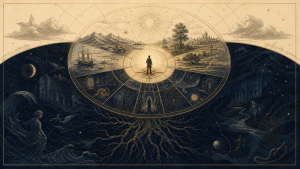
In Jungian psychology, the ego is the central complex of consciousness: the organizing “I” that experiences identity, makes choices, and adapts to inner and outer life.

Self
The Self is Jung’s concept of the whole psyche—conscious and unconscious—and the archetypal principle of its organization, development, and potential integration.
Archetype
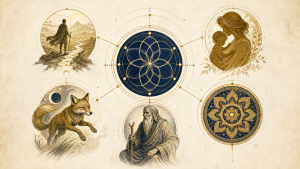
An archetype is an inherited organizing pattern in Jung’s theory that can shape recurring forms of imagery, emotion, perception, and behavior without prescribing one fixed image.

Projection
Projection is the largely unconscious process of experiencing one’s own psychological content as if it belonged primarily or entirely to another person, group, or object.

Transcendent Function
The transcendent function is the new psychological attitude or symbolic possibility that can emerge when conscious and unconscious positions are held in genuine dialogue.

Psychological Opposites
Psychological opposites are conflicting conscious and unconscious positions whose tension can reveal one-sidedness and support development.

Psychological Inflation
Psychological inflation is an expanded or diminished self-estimate caused by identifying the ego with an archetype, role, group, insight, or unconscious content.

Enantiodromia
Enantiodromia is the emergence of an unconscious counter-position after a conscious attitude becomes rigid, extreme, or chronically one-sided.

Coniunctio
Coniunctio is an alchemical image Jung used to explore the psychological union of opposites and the possibility of a new, more inclusive attitude.

Imago
An imago is an internal, subjectively shaped image of another person that must be distinguished from the person’s objective reality.

Constellation
Constellation is the activation of a complex or archetypal pattern by a situation, causing connected emotions, memories, expectations, and behaviors to become unusually available.
Related Practices

Shadow Work
Shadow work is a modern term for reflective practices that explore qualities, emotions, and patterns a person habitually rejects, hides, or fails to recognize in themselves.

Active Imagination
Active imagination is Jung’s method of consciously engaging emerging images, emotions, or figures through sustained attention and expression while preserving awareness and judgment.

Jungian Dream Analysis
Jungian dream analysis explores a dream’s personal associations, structure, emotional context, and possible compensatory relationship to conscious life without using fixed symbol definitions.

Symbol Amplification
Symbol amplification is a Jungian method of comparing an image with mythic, religious, artistic, historical, and cultural parallels while staying anchored to personal context.

Circumambulation
Circumambulation is a Jungian method of staying close to one image while examining it repeatedly from different personal, emotional, symbolic, and practical viewpoints.

Personal Association in Dream Work
Personal association explores the dreamer’s own memories, feelings, language, culture, sensory responses, and current circumstances around a specific dream image.
Related Psychologists

Carl Jung
Carl Gustav Jung was a Swiss psychiatrist who founded analytical psychology and developed influential ideas about complexes, archetypes, the collective unconscious, psychological types, and individuation.

Edward F. Edinger
Edward F. Edinger was an American psychiatrist, Jungian analyst, lecturer, and author who became a prominent interpreter of Jung’s work on the ego, Self, individuation, alchemy, and religious symbolism.