
Archetype
Puer Aeternus
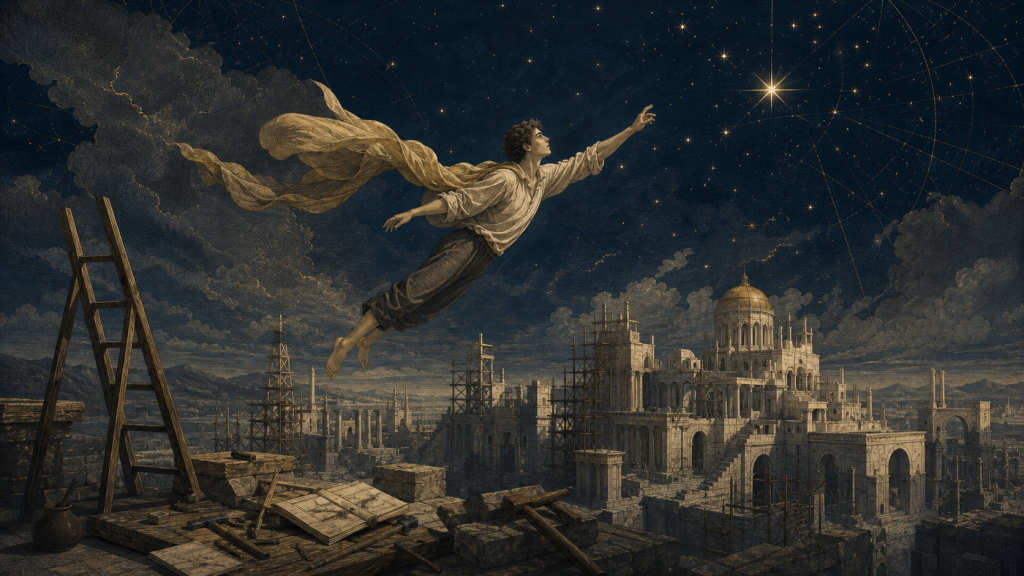
Puer aeternus, the eternal-youth archetype, carries possibility, freedom, renewal, and imagination but becomes one-sided when potential repeatedly replaces commitment and lived experience.
Definition
An archetypal pattern of eternal youth whose creative openness and resistance to dead convention may coexist with provisional living, idealization, dependence, and avoidance of ordinary limits.
Core Characteristics
- Possibility, inspiration, and new beginnings
- Freedom, movement, height, and flight
- Creative sensitivity and resistance to convention
- Provisional living and postponed commitment
- Polarity with the senex pattern of time, order, and responsibility
Constructive Expression
Constructively, puer energy brings imagination, curiosity, play, hope, experimentation, and openness to emerging values. Mature expression gives these qualities a durable form.
Shadow Expression
- Repeated beginnings without completion
- Idealization followed by disappointment
- Dependence disguised as unlimited freedom
- Exceptionalism and avoidance of consequence
- Fantasy, insight, or identity substituting for practice
Associated Symbols
Child-god, beautiful youth, wanderer, wings, aircraft, stars, mountaintop, upper room, ladder, brilliant light, unfinished building, suitcase, distant island, cage, chain, missed departure, and falling. Meaning depends on personal and cultural context.
What Is the Puer Aeternus Archetype?
Puer aeternus is Latin for “eternal child” or “eternal youth.” In mythology it names a child-god who remains forever young. In analytical psychology, it describes an archetypal pattern of possibility, freedom, inspiration, and renewal that can become one-sided when potential repeatedly replaces commitment and lived experience.
The related term puella aeterna has often been used for women. The underlying pattern is not limited to one sex or gender. It can appear in anyone, and it should not be used as a casual diagnosis or insult.
Mythic Image and Psychological Pattern
The eternal youth carries images of flight, height, speed, divine origin, exceptional destiny, new beginnings, and freedom from ordinary limitation. The figure may arrive as a creative messenger, child-god, beautiful youth, wanderer, dreamer, or person who belongs partly to another world.
Psychologically, the image may express genuine openness to future development. It may also support what Jungian writers call a provisional life: the conviction that real life will begin later, after the perfect opportunity, place, relationship, vocation, or inner certainty appears.
The Constructive Puer
The puer pattern is not simply immaturity. Its constructive qualities include:
- Imagination and sensitivity to new possibilities
- Play, humor, curiosity, and creative experimentation
- Resistance to dead convention and empty status
- Hope during periods of rigidity or despair
- Contact with emerging values not yet represented by established structures
A mature relationship to the puer protects these qualities without requiring a person to remain uncommitted, dependent, or exempt from consequence.
Provisional Life
In the provisional pattern, present commitments feel like traps because they exclude imagined alternatives. Work is abandoned when routine begins. Relationships are evaluated against ideal possibilities. Practical limits are experienced as an attack on identity or destiny.
The problem is not changing direction when evidence warrants it. The problem is preserving fantasy by refusing the ordinary tests through which ability, intimacy, and vocation become real. Potential remains impressive precisely because it never has to encounter limitation, repetition, criticism, or failure.
Common Shadow Expressions
- Waiting for the exceptional future while neglecting current responsibilities
- Repeated beginnings with little sustained completion
- Idealization followed by rapid disappointment
- Dependence hidden beneath claims of absolute freedom
- Feeling uniquely exempt from ordinary limits
- Escaping into fantasy, spirituality, travel, romance, or creative identity
- Using insight as a substitute for practice
- Resenting people or structures that require accountability
Any one behavior can have many explanations, including economics, disability, trauma, discrimination, caregiving, illness, or a realistic need to leave a harmful situation. The archetype should never erase context.
Puer and Senex
Jungian writers often pair the puer with the senex, the old-man pattern associated with time, order, discipline, continuity, law, authority, and limitation. Each can become the shadow of the other.
A one-sided puer may experience every structure as imprisonment. A one-sided senex may experience spontaneity and change as chaos. Psychological development does not require destroying either pole. It asks for a workable relationship between possibility and duration, inspiration and craft, renewal and responsibility.
Relationship to the Child Archetype
The puer overlaps with the Child archetype but is not identical to literal childhood. Jung described the child image as carrying both the irrecoverable past and an anticipation of future wholeness. The puer problem emerges when this forward-looking potential is used to avoid present embodiment and development.
Common Images and Dream Motifs
Possible images include flying, aircraft, wings, mountaintops, upper rooms, stars, ladders, brilliant light, youthful heroes, unfinished buildings, suitcases, distant islands, missed departures, cages, chains, falling, or an ideal destination that remains unreachable.
None of these images has a fixed meaning. Flying may express competence, escape, joy, terror, physical memory, or recent media exposure. Personal association and dream context come first.
Working With the Pattern
- Name the valued possibility. What is the dream or freedom you do not want to lose?
- Identify the avoided limit. Which deadline, repetition, body, budget, relationship, or consequence is being postponed?
- Choose a finite commitment. Test the possibility through one real task with a beginning and ending.
- Measure completion, not identity. Record what was done rather than whether you felt exceptional or inspired.
- Protect play deliberately. Give spontaneity a real place instead of making it responsible for every decision.
- Review context. Distinguish archetypal interpretation from structural barriers, illness, trauma, or unsafe conditions.
Questions for Reflection
- What part of my life is always about to begin?
- Which commitment feels like it would eliminate every other possibility?
- Where do I confuse limitation with humiliation or captivity?
- What ordinary repetition would allow a valued possibility to take form?
- Where has discipline become lifeless and in need of renewal?
- What evidence would show that this archetypal reading does not fit?
Freedom and Hidden Dependency
A puer pattern may celebrate independence while relying on another person or institution to absorb rent, administration, emotional fallout, unfinished work, or repeated rescue. The issue is not receiving help; interdependence is ordinary. The question is whether the cost is named, negotiated, and reciprocated. Greater freedom develops when practical dependency becomes conscious and commitments are chosen rather than endlessly displaced onto others.
Sources and Further Reading
- Daryl Sharp, Jung Lexicon: Puer Aeternus and Provisional Life.
- Overview of Marie-Louise von Franz, Puer Aeternus.
- C. G. Jung, “The Psychology of the Child Archetype,” in The Archetypes and the Collective Unconscious.
Continue your study
Recommended Reading
Books selected because they directly develop ideas discussed on this page.
Man and His Symbols
Man and His Symbols is an illustrated introduction to dreams, symbols, archetypes, and individuation written by Carl Jung and four close collaborators for general readers.
The Archetypes and the Collective Unconscious
The Archetypes and the Collective Unconscious collects major essays in which Carl Jung develops his accounts of archetypes, collective psychic patterns, rebirth, the mother, the child,…
The Origins and History of Consciousness
Erich Neumann’s The Origins and History of Consciousness uses mythic sequences to propose an archetypal model of ego development and the differentiation of consciousness.
Paid links. As an Amazon Associate I earn from qualifying purchases.
Related Concepts
Shadow
In Jungian psychology, the shadow is the part of the personality containing qualities, impulses, and capacities that the conscious ego does not recognize or accept as its own.
Persona
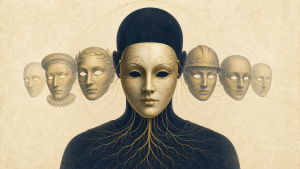
In Jungian psychology, the persona is the social identity or “mask” through which a person adapts to roles, expectations, and relationships.

Individuation
Individuation is Jung’s term for the lifelong process of becoming a more differentiated and integrated psychological whole.
Ego
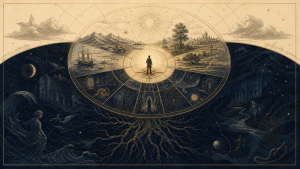
In Jungian psychology, the ego is the central complex of consciousness: the organizing “I” that experiences identity, makes choices, and adapts to inner and outer life.
Archetype
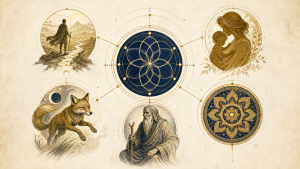
An archetype is an inherited organizing pattern in Jung’s theory that can shape recurring forms of imagery, emotion, perception, and behavior without prescribing one fixed image.
Projection
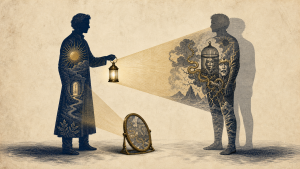
Projection is the largely unconscious process of experiencing one’s own psychological content as if it belonged primarily or entirely to another person, group, or object.
Psychological Opposites
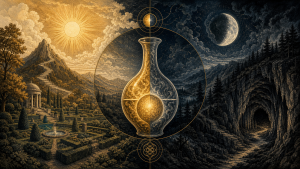
Psychological opposites are conflicting conscious and unconscious positions whose tension can reveal one-sidedness and support development.

Psychological Inflation
Psychological inflation is an expanded or diminished self-estimate caused by identifying the ego with an archetype, role, group, insight, or unconscious content.

Enantiodromia
Enantiodromia is the emergence of an unconscious counter-position after a conscious attitude becomes rigid, extreme, or chronically one-sided.

Coniunctio
Coniunctio is an alchemical image Jung used to explore the psychological union of opposites and the possibility of a new, more inclusive attitude.

Psychic Energy
Psychic energy, often called libido by Jung, is a conceptual way of describing the intensity, direction, and movement of psychological interest and desire.
Related Dream Symbols

House
A house in a dream may represent the dreamer, a structure of personality, family life, memory, safety, or a psychological situation, depending on context.

Forest
A forest in a dream may suggest an unfamiliar psychological territory, instinctive life, concealment, danger, refuge, disorientation, or a path of discovery.

Door
A door in a dream may suggest access, exclusion, transition, opportunity, secrecy, protection, choice, or a boundary between psychological situations.

Bird
A bird in a dream may raise questions about perspective, movement, voice, care, migration, territory, vulnerability, or confinement, depending on the species and complete context.

Mountain
A mountain dream may evoke challenge, perspective, endurance, isolation, boundary, permanence, sacred space, or a goal, depending on the mountain and the dreamer’s relationship to it.
Related Practices

Shadow Work
Shadow work is a modern term for reflective practices that explore qualities, emotions, and patterns a person habitually rejects, hides, or fails to recognize in themselves.
Active Imagination
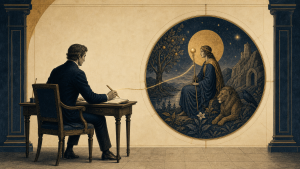
Active imagination is Jung’s method of consciously engaging emerging images, emotions, or figures through sustained attention and expression while preserving awareness and judgment.

Symbol Amplification
Symbol amplification is a Jungian method of comparing an image with mythic, religious, artistic, historical, and cultural parallels while staying anchored to personal context.

Personal Association in Dream Work
Personal association explores the dreamer’s own memories, feelings, language, culture, sensory responses, and current circumstances around a specific dream image.
Related Books

Man and His Symbols
Man and His Symbols is an illustrated introduction to dreams, symbols, archetypes, and individuation written by Carl Jung and four close collaborators for general readers.

The Archetypes and the Collective Unconscious
The Archetypes and the Collective Unconscious collects major essays in which Carl Jung develops his accounts of archetypes, collective psychic patterns, rebirth, the mother, the child, and individuation.

The Origins and History of Consciousness
Erich Neumann’s The Origins and History of Consciousness uses mythic sequences to propose an archetypal model of ego development and the differentiation of consciousness.
Related Psychologists
Carl Jung
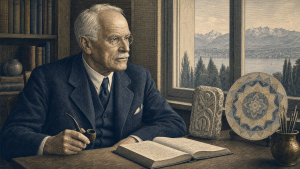
Carl Gustav Jung was a Swiss psychiatrist who founded analytical psychology and developed influential ideas about complexes, archetypes, the collective unconscious, psychological types, and individuation.

Marie-Louise von Franz
Marie-Louise von Franz was a Swiss Jungian analyst and scholar known for her work on dreams, fairy tales, alchemy, and the process of individuation.

Erich Neumann
Erich Neumann was a German-born Israeli analytical psychologist who extended Jungian psychology through studies of consciousness, mythology, ethics, creativity, and Jewish thought.