Dream Symbol
Mountain
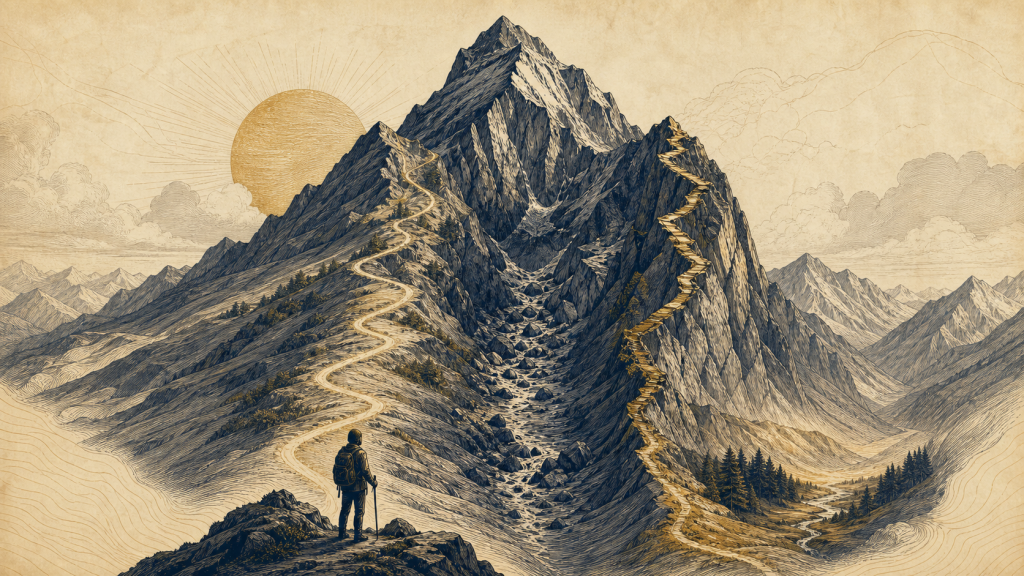
A mountain dream may evoke challenge, perspective, endurance, isolation, boundary, permanence, sacred space, or a goal, depending on the mountain and the dreamer’s relationship to it.
Symbol Overview
Mountain imagery may draw attention to effort, scale, perspective, boundary, endurance, isolation, permanence, or sacred context. Its specific appearance, action, emotional tone, and personal or cultural associations determine which possibilities are relevant.
Possible Contexts
- Climbing: effort, ambition, preparation, or cost
- Summit: perspective, completion, exposure, or isolation
- Blocked path: uncertainty, limits, or an unsuitable route
- Collapse or eruption: destabilization, pressure, danger, or recent disaster imagery
- Descent: return, integration, humility, fatigue, or risk
- Sacred mountain: interpret only within the relevant personal and cultural tradition
Questions for Reflection
- Was the mountain a goal, obstacle, home, witness, or danger?
- What real mountain or life task does it recall?
- Who chose the route and carried the burden?
- What became visible from the elevation?
- What did the dream imply about descent or return?
- What ordinary explanation should remain in consideration?
Interpretation Caution
A mountain has no fixed universal dream meaning. Do not use it to predict success, disaster, spiritual status, or death. Personal history, exact dream details, cultural context, recent experiences, and concrete realities take priority over a symbolic formula.
What Can a Mountain Mean in a Dream?
A mountain in a dream may evoke challenge, perspective, endurance, isolation, danger, ambition, permanence, sacred space, or a goal that reorganizes the journey around it. No single meaning applies to every mountain dream.
The mountain’s condition and the dreamer’s relationship to it matter more than a generic definition. A distant peak, collapsing slope, familiar trail, forbidden summit, sheltering range, and mountain seen from a valley are different images.
Begin With the Actual Mountain
Record what the dream presented before interpreting it:
- Was the mountain familiar, named, imagined, sacred, volcanic, forested, rocky, snowy, or bare?
- Were you below it, climbing, descending, crossing, living on it, trapped, or observing from afar?
- Was there a path, guide, companion, building, animal, storm, boundary, or summit?
- Did the mountain feel protective, indifferent, inviting, overwhelming, beautiful, or dangerous?
- What changed between the beginning and ending of the dream?
Challenge and Effort
An ascent may resemble a difficult task, long commitment, recovery, training process, or ambition. The image may emphasize effort rather than achievement. A steep trail can ask how the dreamer approaches limits, preparation, pacing, help, and risk.
This does not mean every climb represents success. The dream may question an exhausting goal, expose inadequate preparation, or show that the chosen route is not workable.
Perspective and Distance
Height changes perspective. From a summit or ridge, separate paths and landmarks may become visible together. Such a dream may accompany an attempt to see a problem within a wider pattern.
Distance can also separate. Looking down from above may involve clarity, loneliness, detachment, superiority, safety, or disconnection. The emotional tone and waking context help distinguish these possibilities.
Boundary, Obstacle, and Permanence
A mountain can divide territories, block movement, shape weather, or dominate a horizon. In a dream it may resemble a boundary that cannot be crossed casually. That boundary could be protective, frustrating, realistic, inherited, or imposed.
Because mountains outlast individual lives, they may also evoke age, continuity, memory, institutions, ancestors, or forces larger than the ego. This can connect with the Senex pattern of time, structure, limit, and endurance.
Sacred Mountains and Cultural Context
Mountains are sacred in many traditions, but not for one universal reason. Particular mountains may be understood as dwelling places, pilgrimage destinations, ancestors, cosmic centers, protected landscapes, or sites of revelation and retreat.
Interpretation should identify the relevant tradition and the dreamer’s real relationship to it. Borrowing sacred imagery from another culture without context can flatten important differences. Personal history, geography, religion, and community knowledge come before generalized symbolism.
Mountain Dreams and the Hero Pattern
A difficult ascent can resemble a Hero narrative: departure, ordeal, aid, confrontation, achievement, and return. But not every climber is a hero, and reaching the summit is not always the dream’s goal.
Ask whether the dream values conquest, relationship, restraint, survival, return, or a change of route. A heroic reading that ignores exhaustion, companions, ecological damage, or the need to descend may be incomplete.
Common Mountain Scenarios
Climbing
May bring attention to effort, ambition, preparation, persistence, or the cost of a chosen goal. Notice pace, equipment, weather, companions, and whether the route belongs to the dreamer.
Standing at the Summit
May evoke completion, perspective, exposure, isolation, pride, uncertainty about what follows, or the temporary nature of achievement. A summit is also a turning point toward descent.
Unable to Find a Path
May reflect uncertainty, conflicting methods, missing information, or a task approached through the wrong route. It can also reproduce an ordinary concern about navigation or preparedness.
A Collapsing or Erupting Mountain
May evoke destabilization, danger, pressure, anger, environmental memory, or the failure of something assumed permanent. Concrete safety concerns and recent exposure to disasters or news should be considered.
Living Inside or Beneath a Mountain
May suggest shelter, concealment, containment, isolation, buried material, or life organized beneath a powerful structure. The interior may resemble a cave, home, tomb, mine, sanctuary, or workplace, each changing the context.
Descending
Descent may involve return, integration, fatigue, humility, danger, loss of status, or bringing an insight back into ordinary life. It should not automatically be treated as failure.
Personal Association Practice
Use Personal Association in Dream Work before choosing an interpretation. Consider mountains you have visited, avoided, admired, feared, climbed, seen in art, or encountered through family stories and religious traditions.
Then compare those associations with the whole dream. An interpretation is stronger when it explains the mountain’s specific features and role without ignoring ordinary causes or concrete realities.
Questions for Reflection
- What mountain, place, task, or period of life does this image personally recall?
- Was the mountain a goal, obstacle, home, witness, danger, or landscape?
- Who chose the route, and who carried the burden?
- What became visible or invisible because of the elevation?
- Was reaching the summit necessary, possible, or even desirable?
- What did the dream say about descent, return, or responsibility afterward?
- What recent event or ordinary concern could account for the image?
- What evidence would make my preferred interpretation less likely?
Interpretation Boundaries
A mountain dream does not predict success, disaster, spiritual status, or death. It cannot determine another person’s motives or replace medical, legal, financial, environmental, or safety information. Treat the image as material for reflection, not a command.
Cultural Examples and Further Reading
- The Metropolitan Museum of Art: Landscape and Couplet of Chinese Verse, where mountain imagery is joined with solitude and unspoiled nature.
- The Metropolitan Museum of Art: Mount Penglai, an example of a particular auspicious and longevity tradition rather than a universal mountain meaning.
- The Metropolitan Museum of Art: Mount Emei, on pilgrimage and one of China’s sacred mountains.
- Jungian Dream Analysis for a context-first approach to the complete dream.
Route, Scale, and Exposure
A mountain’s meaning changes with the route and the dreamer’s position. Climbing a marked trail differs from being stranded on a summit; viewing a distant peak differs from living beneath unstable rock. Note weather, altitude, equipment, companions, visibility, and whether descent is possible. The image may involve aspiration, obstacle, perspective, isolation, danger, or a literal landscape remembered from waking life.
Continue your study
Recommended Reading
Books selected because they directly develop ideas discussed on this page.
Man and His Symbols
Man and His Symbols is an illustrated introduction to dreams, symbols, archetypes, and individuation written by Carl Jung and four close collaborators for general readers.
Memories, Dreams, Reflections
Memories, Dreams, Reflections is a semi-autobiographical account assembled from Carl Jung's recollections, manuscripts, and conversations with editor Aniela Jaffé.
The Eternal Drama
The Eternal Drama is Edward F. Edinger’s Jungian exploration of major Greek myths and divine figures as recurring images of psychological conflict, development, and transformation.
Paid links. As an Amazon Associate I earn from qualifying purchases.
Related Concepts
Individuation
Individuation is Jung’s term for the lifelong process of becoming a more differentiated and integrated psychological whole.
Collective Unconscious
In Jungian psychology, the collective unconscious is a proposed inherited layer of the psyche expressed through universal patterns called archetypes.
Ego
In Jungian psychology, the ego is the central complex of consciousness: the organizing “I” that experiences identity, makes choices, and adapts to inner and outer life.
Self
The Self is Jung’s concept of the whole psyche—conscious and unconscious—and the archetypal principle of its organization, development, and potential integration.
Archetype
An archetype is an inherited organizing pattern in Jung’s theory that can shape recurring forms of imagery, emotion, perception, and behavior without prescribing one fixed image.
Psychological Opposites
Psychological opposites are conflicting conscious and unconscious positions whose tension can reveal one-sidedness and support development.
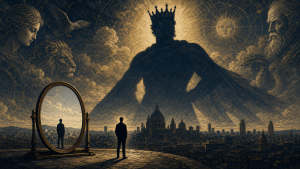
Psychological Inflation
Psychological inflation is an expanded or diminished self-estimate caused by identifying the ego with an archetype, role, group, insight, or unconscious content.
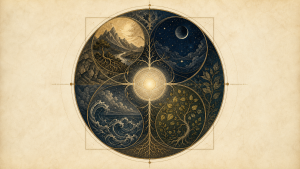
Mandala
A mandala is a centered, often circular symbolic form that Jung associated with psychic order, wholeness, containment, and the Self.
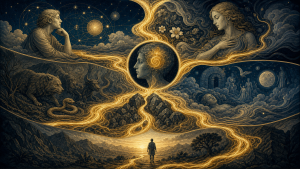
Psychic Energy
Psychic energy, often called libido by Jung, is a conceptual way of describing the intensity, direction, and movement of psychological interest and desire.
Related Archetypes
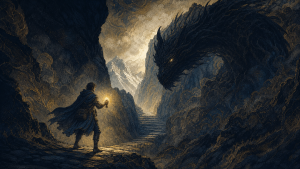
Hero
The Hero is an archetypal motif of confronting danger, overcoming an obstacle, and winning something that can contribute to greater consciousness or renewal.
Wise Old Person
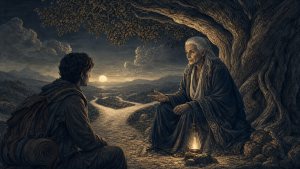
The Wise Old Person is an archetypal guide figure associated with meaning, counsel, insight, and the danger of identifying with borrowed authority.
Puer Aeternus
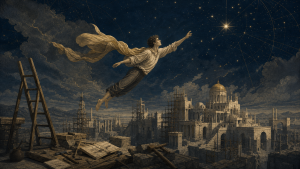
Puer aeternus, the eternal-youth archetype, carries possibility, freedom, renewal, and imagination but becomes one-sided when potential repeatedly replaces commitment and lived experience.

Senex
The Senex archetype carries time, structure, discipline, memory, authority, limit, and responsibility; one-sided, it may harden into rigidity, control, sterility, or punitive order.
Related Practices
Active Imagination
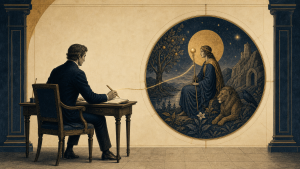
Active imagination is Jung’s method of consciously engaging emerging images, emotions, or figures through sustained attention and expression while preserving awareness and judgment.

Jungian Dream Analysis
Jungian dream analysis explores a dream’s personal associations, structure, emotional context, and possible compensatory relationship to conscious life without using fixed symbol definitions.

Dream Journaling
Dream journaling is the practice of recording dreams promptly and preserving their sequence, atmosphere, images, emotions, and personal associations.
Symbol Amplification
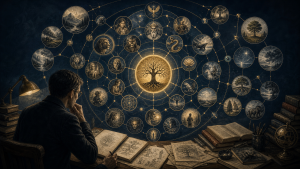
Symbol amplification is a Jungian method of comparing an image with mythic, religious, artistic, historical, and cultural parallels while staying anchored to personal context.
Circumambulation
Circumambulation is a Jungian method of staying close to one image while examining it repeatedly from different personal, emotional, symbolic, and practical viewpoints.
Personal Association in Dream Work
Personal association explores the dreamer’s own memories, feelings, language, culture, sensory responses, and current circumstances around a specific dream image.
Related Books
Man and His Symbols
Man and His Symbols is an illustrated introduction to dreams, symbols, archetypes, and individuation written by Carl Jung and four close collaborators for general readers.
Memories, Dreams, Reflections
Memories, Dreams, Reflections is a semi-autobiographical account assembled from Carl Jung's recollections, manuscripts, and conversations with editor Aniela Jaffé.
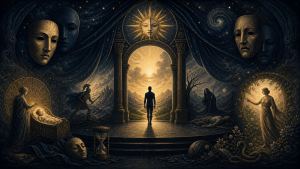
The Eternal Drama
The Eternal Drama is Edward F. Edinger’s Jungian exploration of major Greek myths and divine figures as recurring images of psychological conflict, development, and transformation.