Interactive Tool
Dream Interpretation Evidence Worksheet
A private browser worksheet for auditing a dream interpretation against the complete dream, personal context, supporting and contradictory evidence, alternatives, and reality boundaries.
Purpose
To make selective reasoning visible by separating the interpretation from its supporting details, contradictions, assumptions, rival explanations, and revision conditions.
Instructions
Complete the bias check first. Record the entire dream, add personal and ordinary context, audit the preferred claim, compare alternatives, and finish with a provisional conclusion that cannot override external evidence or safety.
Privacy
This page does not collect, transmit, or store dreams, associations, interpretations, context, or worksheet responses.
Important Disclaimer
Educational only. A dream cannot prove another person’s motives, reveal consent, predict events, diagnose a condition, or replace medical, legal, financial, relationship, or safety guidance.
Private evidence worksheet
Audit a dream interpretation against the complete record
Preserve the dream, collect context, separate claims from evidence, compare alternatives, and keep external reality in charge of action.
A dream is not external evidence. It cannot prove another person’s motives, reveal consent, predict events, diagnose a condition, or override safety, observable facts, and qualified professional guidance.
What Is the Dream Interpretation Evidence Worksheet?
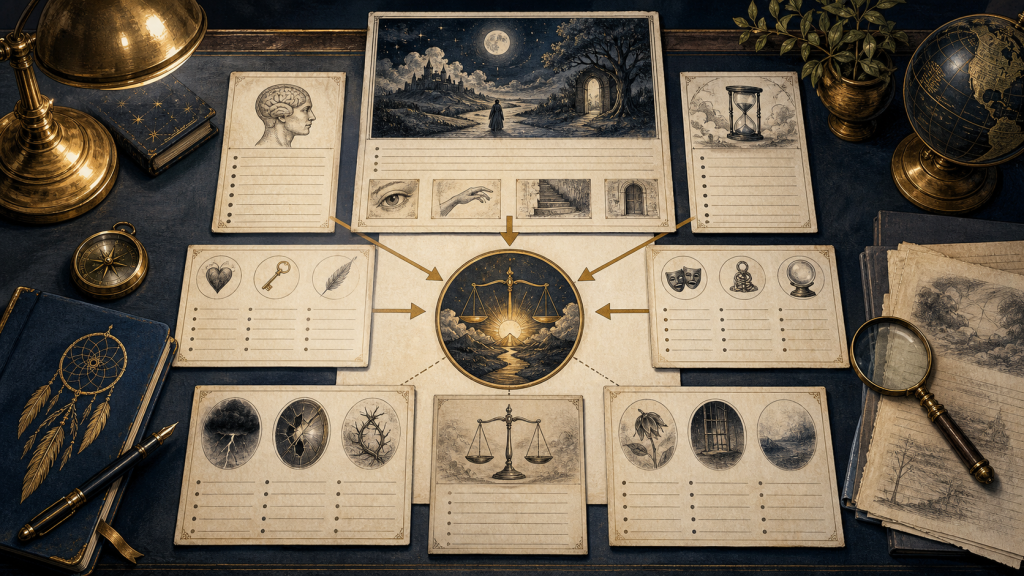
The Dream Interpretation Evidence Worksheet is a private browser tool for testing a dream interpretation against the complete dream, waking-life context, contradictory details, competing explanations, and reality-based boundaries.
It does not generate a meaning. It creates an evidence trail so that an appealing interpretation does not quietly become certainty.
Complete the Bias Check First
Start with the Dream Interpretation Bias Check. The assessment identifies gaps; this worksheet gives you space to work through them.
Why Keep an Evidence Record?
Interpretation is selective. Once one explanation feels right, supportive details become easier to notice and contradictions become easier to dismiss. Recording the entire dream and separating claims from evidence makes that process visible.
The worksheet also preserves ordinary explanations. Recent conversations, media, stress, sleep disruption, illness, medication, pain, and environmental stimuli may contribute to dream content without eliminating its reflective value.
The Five Stages
- Preserve the complete dream: record sequence, literal details, uncertainty, and emotional changes.
- Build the context record: add personal associations, recent events, bodily influences, and cultural setting.
- Audit the preferred interpretation: list support, contradictions, assumptions, and revision conditions.
- Compare alternatives: test two rival symbolic readings and an ordinary explanation.
- Protect reality and action: state what the dream cannot establish and keep the conclusion provisional.
Use Details, Not Symbol Formulas
A general label such as “mountain means achievement” is not evidence. A useful record asks what the specific mountain looked like, what happened there, how the dreamer responded, and what associations belong to that life and context.
Use Personal Association in Dream Work when a central image needs closer exploration.
Privacy
Nothing typed into the worksheet is transmitted to WordPress or stored by the site. It operates in the current browser tab. You may print it or download a plain-text copy to your own device.
Important Limits
- A dream cannot establish another person’s motives or intentions.
- A dream cannot reveal consent, prove wrongdoing, or replace observable evidence.
- A vivid image is not a prediction or diagnosis.
- Symbolic reflection must not override medical, legal, financial, relationship, or safety realities.
- Major decisions require appropriate evidence beyond the dream.
Method Note
This original educational worksheet was created for Individuationing. It is not a diagnostic, psychometric, forensic, or therapeutic instrument.
Separate Claims by Confidence
Mark each conclusion as observation, plausible inference, speculation, or unknown. A remembered line of dialogue is an observation about the dream record; a proposed archetypal meaning is an interpretation; a claim about another person’s motive is usually speculation. Confidence labels make comparison easier and prevent a long worksheet from creating false certainty simply because much has been written.
Continue your study
Recommended Reading
Books selected because they directly develop ideas discussed on this page.
Man and His Symbols
Man and His Symbols is an illustrated introduction to dreams, symbols, archetypes, and individuation written by Carl Jung and four close collaborators for general readers.
Memories, Dreams, Reflections
Memories, Dreams, Reflections is a semi-autobiographical account assembled from Carl Jung's recollections, manuscripts, and conversations with editor Aniela Jaffé.
Paid links. As an Amazon Associate I earn from qualifying purchases.
Related Concepts
Personal Unconscious
In Jungian psychology, the personal unconscious contains experiences, perceptions, and emotionally charged material outside an individual’s present awareness.
Complex
In Jungian psychology, a complex is an emotionally charged network of associations that can temporarily influence perception, emotion, and behavior.
Archetype
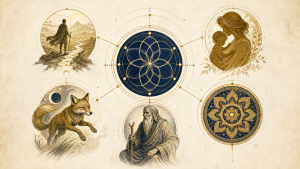
An archetype is an inherited organizing pattern in Jung’s theory that can shape recurring forms of imagery, emotion, perception, and behavior without prescribing one fixed image.
Projection
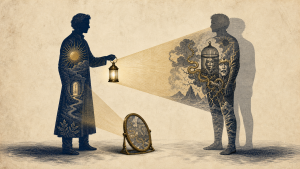
Projection is the largely unconscious process of experiencing one’s own psychological content as if it belonged primarily or entirely to another person, group, or object.
Synchronicity
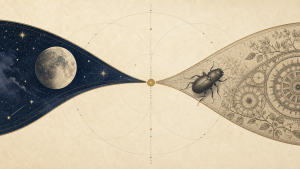
Synchronicity is Jung’s term for a meaningful coincidence between an inner psychological state and an external event when no adequate causal connection is apparent.

Psychological Opposites
Psychological opposites are conflicting conscious and unconscious positions whose tension can reveal one-sidedness and support development.
Participation Mystique
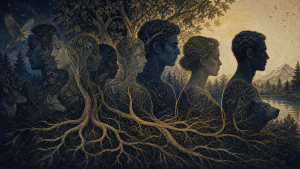
Participation mystique is a Jungian term for an unconscious state of identity in which the boundary between subject and object, self and other, is insufficiently differentiated.
Related Archetypes

Hero
The Hero is an archetypal motif of confronting danger, overcoming an obstacle, and winning something that can contribute to greater consciousness or renewal.

Wise Old Person
The Wise Old Person is an archetypal guide figure associated with meaning, counsel, insight, and the danger of identifying with borrowed authority.

Child
The Child archetype represents vulnerable beginnings, unrealized potential, renewal, dependence, abandonment, and a future personality still developing.

Trickster
The Trickster is an archetypal boundary-breaker whose humor, appetite, deception, mistakes, and reversals can expose rigidity while also causing real harm.
Related Dream Symbols

Snake
A snake in a dream can evoke danger, instinct, transformation, healing, sexuality, wisdom, or something unfamiliar—but its meaning depends on the dream’s details and the dreamer’s associations.

House
A house in a dream may represent the dreamer, a structure of personality, family life, memory, safety, or a psychological situation, depending on context.

Water
Water in a dream may relate to emotion, bodily life, the unconscious, renewal, danger, depth, or overwhelming experience, depending on its form and context.

Forest
A forest in a dream may suggest an unfamiliar psychological territory, instinctive life, concealment, danger, refuge, disorientation, or a path of discovery.

Door
A door in a dream may suggest access, exclusion, transition, opportunity, secrecy, protection, choice, or a boundary between psychological situations.

Mirror
A mirror in a dream may concern self-recognition, appearance, identity, reversal, duplication, self-judgment, projection, or the unsettling failure to recognize oneself.

Bird
A bird in a dream may raise questions about perspective, movement, voice, care, migration, territory, vulnerability, or confinement, depending on the species and complete context.

Mountain
A mountain dream may evoke challenge, perspective, endurance, isolation, boundary, permanence, sacred space, or a goal, depending on the mountain and the dreamer’s relationship to it.
Related Practices

Jungian Dream Analysis
Jungian dream analysis explores a dream’s personal associations, structure, emotional context, and possible compensatory relationship to conscious life without using fixed symbol definitions.

Dream Journaling
Dream journaling is the practice of recording dreams promptly and preserving their sequence, atmosphere, images, emotions, and personal associations.

Symbol Amplification
Symbol amplification is a Jungian method of comparing an image with mythic, religious, artistic, historical, and cultural parallels while staying anchored to personal context.
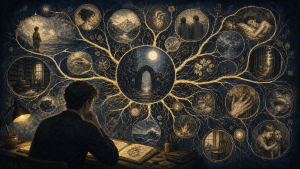
Personal Association in Dream Work
Personal association explores the dreamer’s own memories, feelings, language, culture, sensory responses, and current circumstances around a specific dream image.
Related Books

Man and His Symbols
Man and His Symbols is an illustrated introduction to dreams, symbols, archetypes, and individuation written by Carl Jung and four close collaborators for general readers.

Memories, Dreams, Reflections
Memories, Dreams, Reflections is a semi-autobiographical account assembled from Carl Jung's recollections, manuscripts, and conversations with editor Aniela Jaffé.
Related Assessments

Dream Context Self-Check
A non-diagnostic checklist for testing whether a dream interpretation accounts for personal associations, waking context, emotion, sequence, and external relationships.

Archetypal Image Context Check
A non-diagnostic checklist for deciding whether an image deserves archetypal amplification without ignoring personal history, culture, external reality, or uncertainty.

Symbolic Interpretation Grounding Check
A private educational check for testing whether a symbolic interpretation is grounded in observation, alternatives, context, reality, ethics, and revisability.

Dream Interpretation Bias Check
A private educational check for common dream-interpretation biases involving selective evidence, first impressions, fixed meanings, missing context, and reality boundaries.