Interactive Tool
Carl Jung’s Vocabulary
A plain-language glossary of Carl Jung’s major terms, with links to complete entries that explain context, development, examples, and limitations.

Purpose
Give beginners a reliable map of Jungian terminology without reducing complex ideas to mystical slogans.
Instructions
Start with the five foundational terms, then follow links into type theory, dream work, symbolic processes, and later developments. Definitions here are orientation points, not substitutes for context.
Use the vocabulary guide as a map while reading rather than as a set of isolated dictionary definitions. Jung’s terms often change emphasis across periods, translations, and contexts. Record the work and passage in which a term appears, then compare it with the relevant concept page.
Pay particular attention to words that resemble ordinary language—such as ego, Self, feeling, intuition, and type—because Jung may use them technically. Capitalization and translation choices can also affect meaning.
Privacy
This glossary does not collect personal information.
Important Disclaimer
Jung’s terminology changed across decades and translations. Later Jungian writers sometimes use the same term differently.
Five foundational terms
- Ego
- The center of conscious identity, not the whole psyche.
- Persona
- The adaptive social presentation through which a person meets collective expectations.
- Shadow
- Qualities and potentials excluded from the conscious self-image.
- Self
- The archetype and organizing image of psychic wholeness, encompassing consciousness and unconsciousness.
- Individuation
- The ongoing differentiation and integration of the personality.
The unconscious
- Personal unconscious
- Forgotten, repressed, subliminal, or insufficiently conscious material shaped by individual life.
- Collective unconscious
- Jung’s proposed inherited layer of archetypal predispositions.
- Complex
- An emotionally charged cluster of associations capable of temporarily disrupting conscious intention.
- Archetype
- An organizing predisposition expressed through varied images, stories, emotions, and behavior.
Type theory
Introversion and extraversion describe attitudes of orientation. Thinking, feeling, sensation, and intuition describe psychological functions. Dominant and inferior functions mark relative differentiation, not personal worth.
Symbolic process
Projection, compensation, active imagination, amplification, the transcendent function, synchronicity, and the coniunctio describe different ways Jung approached relations among conscious attitudes, unconscious material, images, and opposites.
Continue your study
Recommended Reading
Books selected because they directly develop ideas discussed on this page.
Man and His Symbols
Man and His Symbols is an illustrated introduction to dreams, symbols, archetypes, and individuation written by Carl Jung and four close collaborators for general readers.
Psychological Types
Carl Jung’s foundational study of introversion, extraversion, and the psychological functions of thinking, feeling, sensation, and intuition.
Two Essays on Analytical Psychology
Two central essays in which Carl Jung explains the ego, personal and collective unconscious, persona, anima, and the movement toward individuation.
Paid links. As an Amazon Associate I earn from qualifying purchases.
Related Concepts

Analytical Psychology
Analytical psychology, often called Jungian psychology, is Carl Jung’s approach to the psyche, unconscious life, symbols, and psychological development.
Ego
In Jungian psychology, the ego is the central complex of consciousness: the organizing “I” that experiences identity, makes choices, and adapts to inner and outer life.
Shadow
In Jungian psychology, the shadow is the part of the personality containing qualities, impulses, and capacities that the conscious ego does not recognize or accept as its own.
Persona
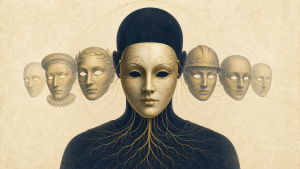
In Jungian psychology, the persona is the social identity or “mask” through which a person adapts to roles, expectations, and relationships.

Self
The Self is Jung’s concept of the whole psyche—conscious and unconscious—and the archetypal principle of its organization, development, and potential integration.

Individuation
Individuation is Jung’s term for the lifelong process of becoming a more differentiated and integrated psychological whole.
Archetype
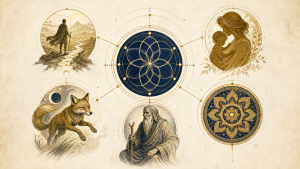
An archetype is an inherited organizing pattern in Jung’s theory that can shape recurring forms of imagery, emotion, perception, and behavior without prescribing one fixed image.

Complex
In Jungian psychology, a complex is an emotionally charged network of associations that can temporarily influence perception, emotion, and behavior.

Personal Unconscious
In Jungian psychology, the personal unconscious contains experiences, perceptions, and emotionally charged material outside an individual’s present awareness.

Collective Unconscious
In Jungian psychology, the collective unconscious is a proposed inherited layer of the psyche expressed through universal patterns called archetypes.

Projection
Projection is the largely unconscious process of experiencing one’s own psychological content as if it belonged primarily or entirely to another person, group, or object.

Anima and Animus
Anima and animus are Jung’s historically gendered terms for inner otherness, relational projection, and qualities excluded from conscious identity.
Psychological Types
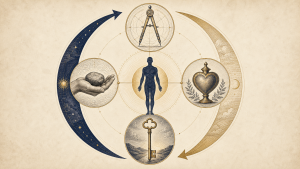
Jung’s psychological types combine two attitudes—introversion and extraversion—with four functions: thinking, feeling, sensation, and intuition.
Synchronicity
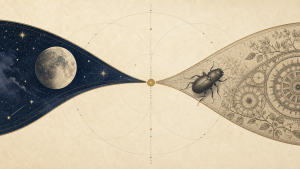
Synchronicity is Jung’s term for a meaningful coincidence between an inner psychological state and an external event when no adequate causal connection is apparent.

Transcendent Function
The transcendent function is the new psychological attitude or symbolic possibility that can emerge when conscious and unconscious positions are held in genuine dialogue.
Related Psychologists
Carl Jung
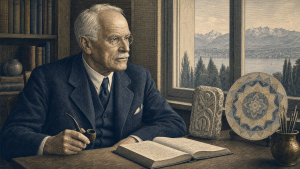
Carl Gustav Jung was a Swiss psychiatrist who founded analytical psychology and developed influential ideas about complexes, archetypes, the collective unconscious, psychological types, and individuation.

Sigmund Freud
Sigmund Freud was an Austrian neurologist and the founder of psychoanalysis whose work on unconscious conflict, dreams, sexuality, and transference profoundly shaped Carl Jung’s early career.

Marie-Louise von Franz
Marie-Louise von Franz was a Swiss Jungian analyst and scholar known for her work on dreams, fairy tales, alchemy, and the process of individuation.
Related Books

Man and His Symbols
Man and His Symbols is an illustrated introduction to dreams, symbols, archetypes, and individuation written by Carl Jung and four close collaborators for general readers.

Psychological Types
Carl Jung’s foundational study of introversion, extraversion, and the psychological functions of thinking, feeling, sensation, and intuition.

Two Essays on Analytical Psychology
Two central essays in which Carl Jung explains the ego, personal and collective unconscious, persona, anima, and the movement toward individuation.
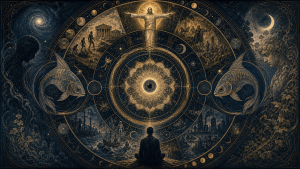
Aion: Researches into the Phenomenology of the Self
Aion is Jung’s advanced study of the Self, the shadow, opposites, and the religious, astrological, Gnostic, and alchemical symbols of psychological totality.