
Interactive Tool
The Red Book: Liber Novus: Reading Companion
A structured companion for reading The Red Book: Liber Novus with historical context, concept links, and practical study questions.
Purpose
Help readers approach The Red Book: Liber Novus critically, choose an appropriate edition, and connect its central ideas to the wider Jungian library.
Instructions
Read the orientation before opening the book, use the questions during close reading, and follow the related resources only when they clarify the text in front of you.
Privacy
This reading companion does not collect, transmit, or store personal information.
Important Disclaimer
Amazon links may be affiliate links. Recommendations are editorial, editions are matched deliberately, and inclusion is not determined by commission.
What this reading companion is for
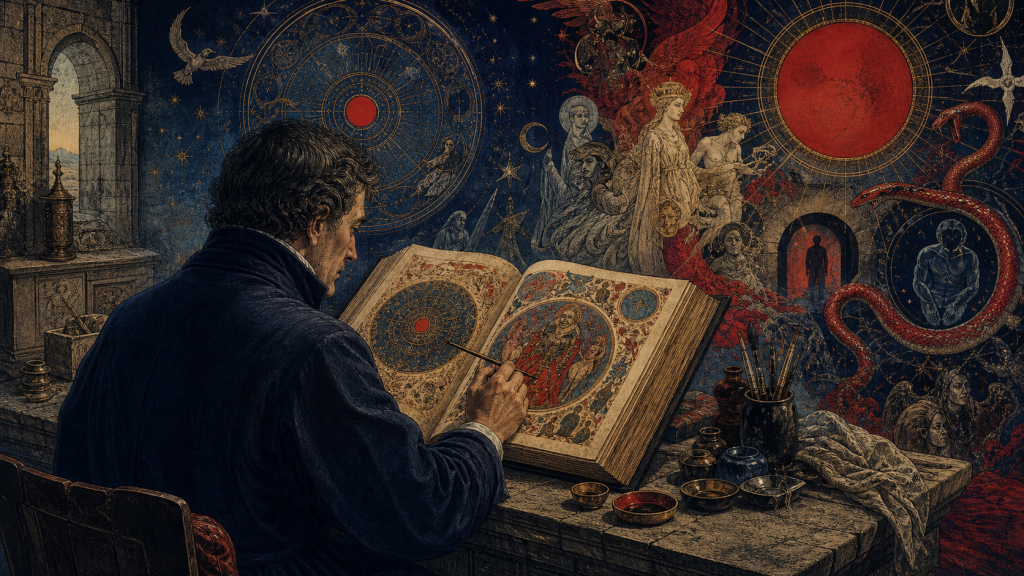
<p>An illuminated manuscript documenting Jung’s imaginative encounters, inner figures, symbolic narratives, and reflections during the period from which central ideas of analytical psychology developed.</p>
This page is designed to sit beside the book, not replace it. Its purpose is to help you establish context before reading, recognize the work’s central questions, and avoid flattening difficult passages into slogans. Jungian writing often moves between clinical observation, mythology, religion, philosophy, and symbolic interpretation. Keeping those levels distinct makes the argument easier to evaluate.
Who should read The Red Book: Liber Novus?
<p>Advanced reading. Begin with the scholarly introduction and do not treat the manuscript as a clinical manual, sacred authority, or prescribed method for reproducing Jung's experience.</p>
If this is your first encounter with analytical psychology, keep the site’s concept pages open while reading. If you already know the basic vocabulary, use this companion to compare the book’s claims with related works and later interpretations. A difficult book is not automatically a better starting point; choose it because its subject matches your question.
Ideas to track while reading
- Active imagination
- Inner figures and symbolic dialogue
- Individuation
- The transcendent function
- Religion, myth, and psychological transformation
For every major claim, note whether the author is describing a clinical pattern, proposing a psychological model, interpreting a cultural image, or making a broader philosophical argument. These categories can overlap, but they should not be treated as interchangeable evidence.
A practical three-pass reading method
- Orientation: Read the introduction, contents, and opening section without trying to settle every unfamiliar term. Write down the book’s main problem in one sentence.
- Close reading: Mark definitions, examples, and transitions in the argument. Record questions beside passages that seem symbolic, historical, or speculative.
- Integration: Revisit your notes and connect the work to the related concepts and books listed below. Separate what the text explicitly argues from what later readers commonly attribute to it.
Questions for your notes
- What problem is the author trying to solve in this section?
- Which terms receive a precise definition, and which remain metaphorical?
- What evidence supports the interpretation being offered?
- Which passages depend on the historical setting of the work?
- How does this account differ from simplified popular versions of Jungian psychology?
Choosing the linked edition
The linked Amazon edition is listed as First Facsimile Edition, hardcover. Confirm format and seller details on Amazon before ordering.
The recommendation is editorial. The Amazon link is provided for convenience and may earn Individuationing a commission at no additional cost to you. Availability and pricing can change on Amazon, so neither is reproduced on this page.
Continue your study
Recommended Reading
Books selected because they directly develop ideas discussed on this page.
The Red Book: Liber Novus
The Red Book: Liber Novus records and artistically develops Carl Jung's confrontation with inner figures and images during a formative period of his psychology.
Paid links. As an Amazon Associate I earn from qualifying purchases.
Related Concepts

Individuation
Individuation is Jung’s term for the lifelong process of becoming a more differentiated and integrated psychological whole.

Collective Unconscious
In Jungian psychology, the collective unconscious is a proposed inherited layer of the psyche expressed through universal patterns called archetypes.

Self
The Self is Jung’s concept of the whole psyche—conscious and unconscious—and the archetypal principle of its organization, development, and potential integration.

Archetype
An archetype is an inherited organizing pattern in Jung’s theory that can shape recurring forms of imagery, emotion, perception, and behavior without prescribing one fixed image.

Anima
Anima is Jung’s historical term for an inner feminine archetypal figure in a man, associated with feeling, relationship, imagery, and mediation between consciousness and the unconscious.

Animus
Animus is Jung’s historical term for an inner masculine archetypal figure in a woman, associated with opinion, agency, meaning, and mediation between consciousness and the unconscious.

Transcendent Function
The transcendent function is the new psychological attitude or symbolic possibility that can emerge when conscious and unconscious positions are held in genuine dialogue.

Psychological Inflation
Psychological inflation is an expanded or diminished self-estimate caused by identifying the ego with an archetype, role, group, insight, or unconscious content.
Mandala
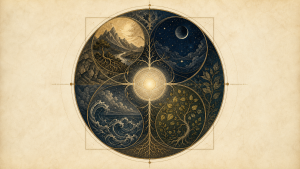
A mandala is a centered, often circular symbolic form that Jung associated with psychic order, wholeness, containment, and the Self.

Participation Mystique
Participation mystique is a Jungian term for an unconscious state of identity in which the boundary between subject and object, self and other, is insufficiently differentiated.

Carl Jung’s Philosophy
Carl Jung’s philosophy centers on psychological wholeness, symbols, opposites, meaning, and the relationship between conscious and unconscious life.

Carl Jung and Art
Carl Jung used drawing, painting, mandalas, sculpture, and symbolic image-making as means of engaging psychic material, while distinguishing this work from aesthetic criticism.
Related Practices

Active Imagination
Active imagination is Jung’s method of consciously engaging emerging images, emotions, or figures through sustained attention and expression while preserving awareness and judgment.

Jungian Dream Analysis
Jungian dream analysis explores a dream’s personal associations, structure, emotional context, and possible compensatory relationship to conscious life without using fixed symbol definitions.

Circumambulation
Circumambulation is a Jungian method of staying close to one image while examining it repeatedly from different personal, emotional, symbolic, and practical viewpoints.

Sandplay Therapy
Sandplay therapy is a clinical, expressive method in which a client creates scenes with sand, water, and miniatures within a protected therapeutic relationship.

Personal Association in Dream Work
Personal association explores the dreamer’s own memories, feelings, language, culture, sensory responses, and current circumstances around a specific dream image.
Related Psychologists

Carl Jung
Carl Gustav Jung was a Swiss psychiatrist who founded analytical psychology and developed influential ideas about complexes, archetypes, the collective unconscious, psychological types, and individuation.

Emma Jung
Emma Jung was a Swiss Jungian analyst and author known for her work on the anima and animus, the Grail legend, and the early analytical psychology movement.

Dora Kalff
Dora Kalff was a Swiss therapist who developed Jungian sandplay therapy by integrating Margaret Lowenfeld’s World Technique with analytical psychology.

Toni Wolff
Toni Wolff was a Swiss analyst, scholar, institutional leader, and close collaborator of Carl Jung who developed four structural forms of the feminine psyche.

Edward F. Edinger
Edward F. Edinger was an American psychiatrist, Jungian analyst, lecturer, and author who became a prominent interpreter of Jung’s work on the ego, Self, individuation, alchemy, and religious symbolism.

Barbara Hannah
Barbara Hannah was a British-born Jungian analyst, lecturer, and author known for her close work with C. G. Jung and Marie-Louise von Franz.