
Book
Aion: Researches into the Phenomenology of the Self
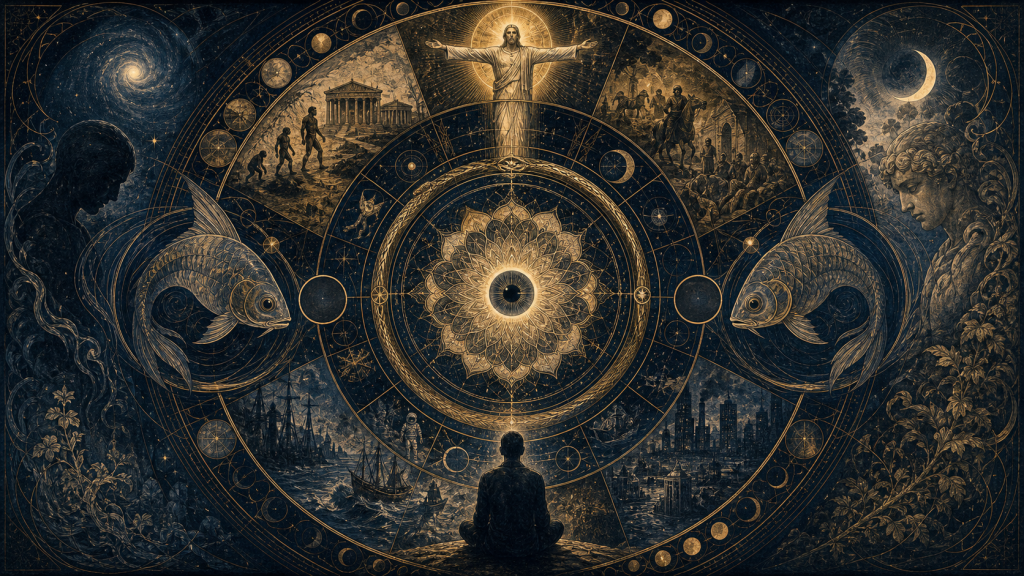
Aion is Jung’s advanced study of the Self, the shadow, opposites, and the religious, astrological, Gnostic, and alchemical symbols of psychological totality.
Summary
Aion examines the archetype of the Self through psychological, religious, astrological, Gnostic, and alchemical symbolism. Its first four chapters provide compact mature accounts of the ego, shadow, anima and animus, and Self.
The later chapters investigate Christ and the fish as symbols, the problem of good and evil, and historical representations of psychic totality. It is an advanced primary source rather than an introductory guide.
Key Topics
- The ego and the Self
- The Jungian shadow
- Anima and animus
- Projection and psychological opposites
- Christ as a symbol of the Self
- The sign and historical symbolism of the fishes
- Gnostic and alchemical symbols
- The structure and dynamics of the Self
Reader Guidance
Difficulty: Advanced. Readers new to Jung can begin with chapters I–IV, which address the ego, shadow, anima and animus, and Self. The later historical argument assumes comfort with theology, astrology, Gnosticism, and alchemy.
Read it as a primary source for Jung’s mature theory. Distinguish Jung’s symbolic interpretations from established historical or scientific conclusions.
What Is Aion?
Aion: Researches into the Phenomenology of the Self is Volume 9, Part 2 of The Collected Works of C. G. Jung. Originally published in German in 1951, it is one of Jung’s major late works and one of his most concentrated examinations of the Self.
The opening chapters summarize the ego, shadow, anima and animus, and Self. The book then develops a much broader historical argument through Christian, astrological, Gnostic, and alchemical symbolism.
What the Book Covers
Jung’s central concern is the symbolic representation of psychological totality. He gives particular attention to Christ as a symbol of the Self, the problem of opposites—especially good and evil—the symbolism of the fish, and the historical character he associates with the Piscean age.
The table of contents moves from concise psychological chapters into extended studies of the sign of the fishes, Nostradamus, alchemical fish symbolism, Gnostic symbols of the Self, and the structure and dynamics of the Self. Readers should expect a work of symbolic and historical interpretation, not a modern introductory psychology textbook.
Why It Matters for Understanding the Shadow
The early chapter on the shadow is brief but foundational. Jung presents recognition of the shadow as a moral problem because it requires more than intellectual agreement. A person must acknowledge qualities that contradict the ego’s preferred self-description.
The discussion also connects shadow recognition with projection: qualities experienced as belonging entirely to other people may partly reflect unconscious contents in the observer. For that reason, Aion remains a primary source for serious study of the Jungian shadow and makes clear why the concept cannot be reduced to a list of negative traits or journal prompts.
The Self and the Problem of Opposites
Jung’s Self is not simply an improved ego. It represents the organization and potential wholeness of the psyche, including conscious and unconscious dimensions. Aion studies images that Jung believed expressed this totality while also examining the difficulty of representing evil, contradiction, and the excluded opposite.
This is one reason the book is demanding: its psychological claims are interwoven with theology, astrology, history, and comparative symbolism. Readers do not need to accept every historical or theoretical conclusion to use the book as evidence of how Jung developed his mature account of the Self.
Who Should Read It?
Aion is best for advanced readers or those already familiar with basic analytical psychology. Beginners primarily interested in personality structure can start with the first four chapters. Those continuing into the later chapters will benefit from background in Christian symbolism, Gnosticism, and alchemy.
For a more accessible introduction to Jung’s ideas, begin with Man and His Symbols or a reliable overview of analytical psychology before returning to Aion.
Edition Represented Here
The structured bibliographic fields on this page represent the Princeton University Press paperback with ISBN-13 9780691018263 and ISBN-10 069101826X. Library and bookseller records identify it as a second-edition Princeton/Bollingen paperback published in 1979. R. F. C. Hull translated the English text.
Other print and digital editions have different ISBNs, dates, pagination, and formats. Any future Amazon link on this page must point to the exact edition described here.
Sources and Further Reading
Related Concepts
Shadow
In Jungian psychology, the shadow is the part of the personality containing qualities, impulses, and capacities that the conscious ego does not recognize or accept as its own.
Persona
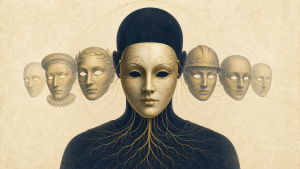
In Jungian psychology, the persona is the social identity or “mask” through which a person adapts to roles, expectations, and relationships.

Individuation
Individuation is Jung’s term for the lifelong process of becoming a more differentiated and integrated psychological whole.

Collective Unconscious
In Jungian psychology, the collective unconscious is a proposed inherited layer of the psyche expressed through universal patterns called archetypes.

Personal Unconscious
In Jungian psychology, the personal unconscious contains experiences, perceptions, and emotionally charged material outside an individual’s present awareness.

Complex
In Jungian psychology, a complex is an emotionally charged network of associations that can temporarily influence perception, emotion, and behavior.
Ego
In Jungian psychology, the ego is the central complex of consciousness: the organizing “I” that experiences identity, makes choices, and adapts to inner and outer life.

Self
The Self is Jung’s concept of the whole psyche—conscious and unconscious—and the archetypal principle of its organization, development, and potential integration.
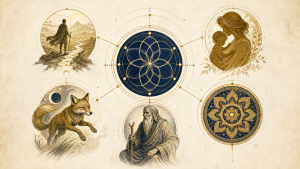
Archetype
An archetype is an inherited organizing pattern in Jung’s theory that can shape recurring forms of imagery, emotion, perception, and behavior without prescribing one fixed image.

Projection
Projection is the largely unconscious process of experiencing one’s own psychological content as if it belonged primarily or entirely to another person, group, or object.

Anima
Anima is Jung’s historical term for an inner feminine archetypal figure in a man, associated with feeling, relationship, imagery, and mediation between consciousness and the unconscious.

Animus
Animus is Jung’s historical term for an inner masculine archetypal figure in a woman, associated with opinion, agency, meaning, and mediation between consciousness and the unconscious.
Synchronicity
Synchronicity is Jung’s term for a meaningful coincidence between an inner psychological state and an external event when no adequate causal connection is apparent.

Participation Mystique
Participation mystique is a Jungian term for an unconscious state of identity in which the boundary between subject and object, self and other, is insufficiently differentiated.

Compensation
Compensation is the psyche’s tendency to balance or supplement a one-sided conscious attitude through dreams, emotions, fantasies, symptoms, and neglected perspectives.

Enantiodromia
Enantiodromia is the emergence of an unconscious counter-position after a conscious attitude becomes rigid, extreme, or chronically one-sided.

Imago
An imago is an internal, subjectively shaped image of another person that must be distinguished from the person’s objective reality.

Psychic Energy
Psychic energy, often called libido by Jung, is a conceptual way of describing the intensity, direction, and movement of psychological interest and desire.

Constellation
Constellation is the activation of a complex or archetypal pattern by a situation, causing connected emotions, memories, expectations, and behaviors to become unusually available.

Analytical Psychology
Analytical psychology, often called Jungian psychology, is Carl Jung’s approach to the psyche, unconscious life, symbols, and psychological development.

Carl Jung’s Theory of Personality
Carl Jung’s personality theory combines psychological attitudes and functions with a broader model of ego, persona, shadow, unconscious life, and individuation.

Carl Jung’s Philosophy
Carl Jung’s philosophy centers on psychological wholeness, symbols, opposites, meaning, and the relationship between conscious and unconscious life.

Is Shadow Work Dangerous?
Shadow Work can become harmful when it overwhelms coping capacity, encourages unsupported certainty, replaces treatment, or is used without appropriate boundaries.

Anima and Animus
Anima and animus are Jung’s historically gendered terms for inner otherness, relational projection, and qualities excluded from conscious identity.

Carl Jung and Religion
Carl Jung approached religion as a psychological and symbolic phenomenon whose images can organize experience, while avoiding a clinical proof of theological claims.
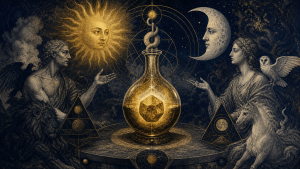
Carl Jung, Psychology, and Alchemy
Carl Jung interpreted alchemical images as historical parallels to unconscious psychological processes, especially projection, transformation, opposites, and individuation.

Carl Jung and Astrology
Carl Jung discussed astrology as a historical symbolic system and explored astrological data in relation to synchronicity, without establishing astrology as validated causal science.

The Four Major Jungian Archetypes
The shadow, persona, anima or animus, and Self are often taught as four major Jungian archetypes, though Jung’s wider theory is not limited to four.
Related Practices

Shadow Work
Shadow work is a modern term for reflective practices that explore qualities, emotions, and patterns a person habitually rejects, hides, or fails to recognize in themselves.

Active Imagination
Active imagination is Jung’s method of consciously engaging emerging images, emotions, or figures through sustained attention and expression while preserving awareness and judgment.

Jungian Dream Analysis
Jungian dream analysis explores a dream’s personal associations, structure, emotional context, and possible compensatory relationship to conscious life without using fixed symbol definitions.

Shadow Work Exercises for Beginners
Beginner Shadow Work exercises focused on observation, projection checks, persona balance, recurring patterns, and responsible action.
Related Psychologists

Carl Jung
Carl Gustav Jung was a Swiss psychiatrist who founded analytical psychology and developed influential ideas about complexes, archetypes, the collective unconscious, psychological types, and individuation.

Marie-Louise von Franz
Marie-Louise von Franz was a Swiss Jungian analyst and scholar known for her work on dreams, fairy tales, alchemy, and the process of individuation.

Aniela Jaffé
Aniela Jaffé was a German-born Swiss Jungian analyst, author, and longtime collaborator who recorded and edited the material behind Memories, Dreams, Reflections.

Emma Jung
Emma Jung was a Swiss Jungian analyst and author known for her work on the anima and animus, the Grail legend, and the early analytical psychology movement.

James Hillman
James Hillman was an American post-Jungian psychologist and writer who founded archetypal psychology, an imaginal approach centered on soul, myth, plurality, and close attention to images.

Edward F. Edinger
Edward F. Edinger was an American psychiatrist, Jungian analyst, lecturer, and author who became a prominent interpreter of Jung’s work on the ego, Self, individuation, alchemy, and religious symbolism.

Jolande Jacobi
Jolande Jacobi was a Swiss psychologist, author, and early interpreter of C. G. Jung whose systematic introductions helped make analytical psychology accessible.