Archetype
Wounded Healer
The Wounded Healer archetype holds vulnerability and the capacity to help in tension while requiring self-knowledge, competence, accountability, and clear boundaries.

Definition
An archetypal relational pattern in which awareness of one’s own vulnerability may deepen care, while unexamined wounds can produce projection, rescuing, inflation, boundary confusion, or harm.
Core Characteristics
- Vulnerability held alongside the capacity to help
- Self-knowledge and continuing examination of personal reactions
- Recognition of healing capacities in the person seeking help
- Tension between empathy and assumed sameness
- Need for competence, supervision, ethics, and role clarity
Constructive Expression
- Humility and awareness of limits
- Empathy grounded in attention
- Respect for agency and mutual humanity
- Integration of lived experience with training
- Presence without promises of rescue
- Responsible use of supervision, referral, rest, and boundaries
Shadow Expression
- Rescuer identity and need to be indispensable
- Inflation or claims of special healing power
- Projection and assumed sameness
- Boundary confusion and exploitation
- Romanticizing trauma or burnout
- Replacing competence with personal experience
- Using another person’s care for the helper’s own repair
Associated Symbols
Injured physician, scarred healer, Chiron, Asclepius, snake and staff, damaged sanctuary, exhausted caregiver, broken medicine vessel, healer unable to treat the self, or patient who becomes a guide. Context determines relevance.
What Is the Wounded Healer Archetype?
The Wounded Healer is an archetypal pattern in which vulnerability and the capacity to help are held in tension. In Jungian writing, it is especially associated with the therapeutic relationship: the helper is not untouched by suffering, and the person seeking help is not without inner capacities for healing.
The image does not mean that suffering automatically creates wisdom, that an unhealed person is qualified to treat others, or that anyone must disclose private wounds to be helpful.
The Central Paradox
The pattern challenges a simple division between “healthy healer” and “wounded patient.” Both people have limits, unconscious material, strengths, and vulnerabilities. In professional care, their roles and responsibilities remain unequal even while their humanity is shared.
A helper’s awareness of personal wounds may support humility and recognition. Unexamined wounds may instead distort judgment, invite overidentification, or turn another person’s needs into material for the helper’s own repair.
Jungian Clinical Context
Jung emphasized that the personality and assumptions of the analyst can become helpful or harmful factors in treatment. Analysts therefore require their own analysis, continuing self-examination, supervision, training, and ethical boundaries.
The Wounded Healer is not permission to rely on intuition instead of competence. Its mature form joins self-knowledge with skill, accountability, referral, evidence, and respect for the other person’s autonomy.
Asclepius, Chiron, and Multiple Traditions
Modern discussions of the Wounded Healer often draw on Greek healing traditions involving Asclepius and on the story of Chiron, the centaur associated with an incurable wound and knowledge of healing. These are related but distinct mythic materials, and later psychological retellings do not always preserve their differences.
Sanctuaries of Asclepius were connected with ritual healing and incubation. Such historical practices belong to specific ancient religious contexts; they should not be presented as modern medical evidence or flattened into a universal story.
Constructive Expressions
- Humility about the limits of one’s knowledge and role
- Empathy grounded in attention rather than assumed sameness
- Willingness to examine personal reactions and seek supervision
- Respect for the other person’s agency and inner resources
- Ability to remain present without promising rescue
- Integration of lived experience with training and ethical practice
- Recognition that healing can involve adaptation, meaning, relationship, and care even when cure is unavailable
Shadow Expressions
- Rescuer identity: needing to be indispensable or to save others
- Inflation: identifying with special healing power, insight, or destiny
- Boundary confusion: making the relationship serve the helper’s emotional needs
- Assumed sameness: believing similar experiences produce identical meanings
- Trauma romanticization: treating suffering as necessary, noble, or automatically transformative
- Competence substitution: using personal experience as a replacement for training or evidence
- Self-neglect: presenting burnout and unlimited availability as proof of devotion
The Wound Does Not Confer Authority
Lived experience can offer valuable perspective, but it does not make someone a therapist, physician, crisis worker, or expert. Professional titles and services require appropriate education, licensure where applicable, scope of practice, and accountability.
Likewise, a helper should not assume that another person wants guidance simply because their pain resembles something familiar. Consent and role clarity come before archetypal identification.
Wounded Healer and Projection
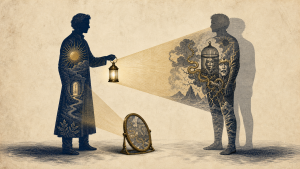
The pattern is vulnerable to Projection. A helper may see a past self in another person, interpret disagreement as resistance, or pursue the outcome the helper once needed. The person receiving help may idealize the helper as uniquely powerful or immune to ordinary limits.
These possibilities do not invalidate care. They make reflection, feedback, supervision, and boundaries essential. The Projection Boundary Self-Check can help separate personal interpretation from observable behavior and consent.
Beyond Therapy
Wounded Healer imagery can appear in teaching, caregiving, peer support, ministry, parenting, medicine, advocacy, art, and community leadership. The same distinction applies everywhere: experience can deepen attention, but it does not erase role limits or guarantee good judgment.
In mutual or peer relationships, care should not become a permanent identity in which one person is always healer and the other always wounded.
Possible Dream Images
The pattern may appear through an injured doctor, exhausted caregiver, scarred animal, broken medicine container, damaged sanctuary, healer who cannot treat the self, patient who becomes a guide, or a wound shared between two figures.
These images have no fixed meaning. A medical dream may also reflect ordinary health concerns, recent appointments, work stress, caregiving demands, or media exposure. Concrete health symptoms require appropriate care rather than symbolic interpretation alone.
Questions for Reflection
- Am I listening to this person, or responding to someone from my own history?
- What role have I actually been asked and qualified to hold?
- Does helping support the other person’s agency, or my need to be needed?
- Which personal reactions need reflection, supervision, rest, or referral?
- Where am I assuming sameness because of a shared experience?
- What boundary protects both people and the purpose of the relationship?
- Am I romanticizing suffering or treating burnout as virtue?
- What evidence would show that the Wounded Healer lens does not fit?
Interpretation Boundaries
The Wounded Healer is not a diagnosis, credential, treatment method, or moral requirement to suffer. It must never excuse impaired practice, exploitation, boundary violations, inadequate training, or refusal to seek help. A wound may invite reflection; responsibility determines how one acts.
Referral Is Part of Care
A mature helper recognizes when another person needs expertise, availability, or protection beyond the helper’s role. Referral is not abandonment when it is explained clearly, coordinated responsibly, and paired with appropriate continuity. The wounded-healer fantasy can make limits feel like failure; ethical care treats limits as information. Knowing when not to serve is part of competence and protects the person seeking help.
Sources and Further Reading
- Daryl Sharp, Jung Lexicon: Wounded Healer, with references to Jung’s Practice of Psychotherapy.
- The Jung Page: the healing doctor-patient relationship.
- The Jung Page: modern medicine and the healing process.
Continue your study
Recommended Reading
Books selected because they directly develop ideas discussed on this page.
Aion: Researches into the Phenomenology of the Self
Aion is Jung’s advanced study of the Self, the shadow, opposites, and the religious, astrological, Gnostic, and alchemical symbols of psychological totality.
Man and His Symbols
Man and His Symbols is an illustrated introduction to dreams, symbols, archetypes, and individuation written by Carl Jung and four close collaborators for general readers.
Memories, Dreams, Reflections
Memories, Dreams, Reflections is a semi-autobiographical account assembled from Carl Jung's recollections, manuscripts, and conversations with editor Aniela Jaffé.
Paid links. As an Amazon Associate I earn from qualifying purchases.
Related Concepts

Shadow
In Jungian psychology, the shadow is the part of the personality containing qualities, impulses, and capacities that the conscious ego does not recognize or accept as its own.
Complex
In Jungian psychology, a complex is an emotionally charged network of associations that can temporarily influence perception, emotion, and behavior.
Ego
In Jungian psychology, the ego is the central complex of consciousness: the organizing “I” that experiences identity, makes choices, and adapts to inner and outer life.

Self
The Self is Jung’s concept of the whole psyche—conscious and unconscious—and the archetypal principle of its organization, development, and potential integration.
Archetype
An archetype is an inherited organizing pattern in Jung’s theory that can shape recurring forms of imagery, emotion, perception, and behavior without prescribing one fixed image.
Projection
Projection is the largely unconscious process of experiencing one’s own psychological content as if it belonged primarily or entirely to another person, group, or object.

Psychological Inflation
Psychological inflation is an expanded or diminished self-estimate caused by identifying the ego with an archetype, role, group, insight, or unconscious content.

Participation Mystique
Participation mystique is a Jungian term for an unconscious state of identity in which the boundary between subject and object, self and other, is insufficiently differentiated.

Compensation
Compensation is the psyche’s tendency to balance or supplement a one-sided conscious attitude through dreams, emotions, fantasies, symptoms, and neglected perspectives.

Constellation
Constellation is the activation of a complex or archetypal pattern by a situation, causing connected emotions, memories, expectations, and behaviors to become unusually available.
Related Dream Symbols

Snake
A snake in a dream can evoke danger, instinct, transformation, healing, sexuality, wisdom, or something unfamiliar—but its meaning depends on the dream’s details and the dreamer’s associations.

Water
Water in a dream may relate to emotion, bodily life, the unconscious, renewal, danger, depth, or overwhelming experience, depending on its form and context.

Mirror
A mirror in a dream may concern self-recognition, appearance, identity, reversal, duplication, self-judgment, projection, or the unsettling failure to recognize oneself.

Bird
A bird in a dream may raise questions about perspective, movement, voice, care, migration, territory, vulnerability, or confinement, depending on the species and complete context.
Related Practices

Shadow Work
Shadow work is a modern term for reflective practices that explore qualities, emotions, and patterns a person habitually rejects, hides, or fails to recognize in themselves.

Active Imagination
Active imagination is Jung’s method of consciously engaging emerging images, emotions, or figures through sustained attention and expression while preserving awareness and judgment.

Jungian Dream Analysis
Jungian dream analysis explores a dream’s personal associations, structure, emotional context, and possible compensatory relationship to conscious life without using fixed symbol definitions.

Dream Journaling
Dream journaling is the practice of recording dreams promptly and preserving their sequence, atmosphere, images, emotions, and personal associations.

Sandplay Therapy
Sandplay therapy is a clinical, expressive method in which a client creates scenes with sand, water, and miniatures within a protected therapeutic relationship.

Personal Association in Dream Work
Personal association explores the dreamer’s own memories, feelings, language, culture, sensory responses, and current circumstances around a specific dream image.
Related Books
Aion: Researches into the Phenomenology of the Self
Aion is Jung’s advanced study of the Self, the shadow, opposites, and the religious, astrological, Gnostic, and alchemical symbols of psychological totality.

Man and His Symbols
Man and His Symbols is an illustrated introduction to dreams, symbols, archetypes, and individuation written by Carl Jung and four close collaborators for general readers.

Memories, Dreams, Reflections
Memories, Dreams, Reflections is a semi-autobiographical account assembled from Carl Jung's recollections, manuscripts, and conversations with editor Aniela Jaffé.

The Red Book: Liber Novus
The Red Book: Liber Novus records and artistically develops Carl Jung's confrontation with inner figures and images during a formative period of his psychology.

The Archetypes and the Collective Unconscious
The Archetypes and the Collective Unconscious collects major essays in which Carl Jung develops his accounts of archetypes, collective psychic patterns, rebirth, the mother, the child, and individuation.

Re-Visioning Psychology
Re-Visioning Psychology is James Hillman’s foundational statement of archetypal psychology and its imaginal approach to soul, symptoms, myth, and psychological plurality.
Related Psychologists

Carl Jung
Carl Gustav Jung was a Swiss psychiatrist who founded analytical psychology and developed influential ideas about complexes, archetypes, the collective unconscious, psychological types, and individuation.

Marie-Louise von Franz
Marie-Louise von Franz was a Swiss Jungian analyst and scholar known for her work on dreams, fairy tales, alchemy, and the process of individuation.

Aniela Jaffé
Aniela Jaffé was a German-born Swiss Jungian analyst, author, and longtime collaborator who recorded and edited the material behind Memories, Dreams, Reflections.

Emma Jung
Emma Jung was a Swiss Jungian analyst and author known for her work on the anima and animus, the Grail legend, and the early analytical psychology movement.

Dora Kalff
Dora Kalff was a Swiss therapist who developed Jungian sandplay therapy by integrating Margaret Lowenfeld’s World Technique with analytical psychology.

Erich Neumann
Erich Neumann was a German-born Israeli analytical psychologist who extended Jungian psychology through studies of consciousness, mythology, ethics, creativity, and Jewish thought.

James Hillman
James Hillman was an American post-Jungian psychologist and writer who founded archetypal psychology, an imaginal approach centered on soul, myth, plurality, and close attention to images.

Toni Wolff
Toni Wolff was a Swiss analyst, scholar, institutional leader, and close collaborator of Carl Jung who developed four structural forms of the feminine psyche.