Psychologist
Edward F. Edinger
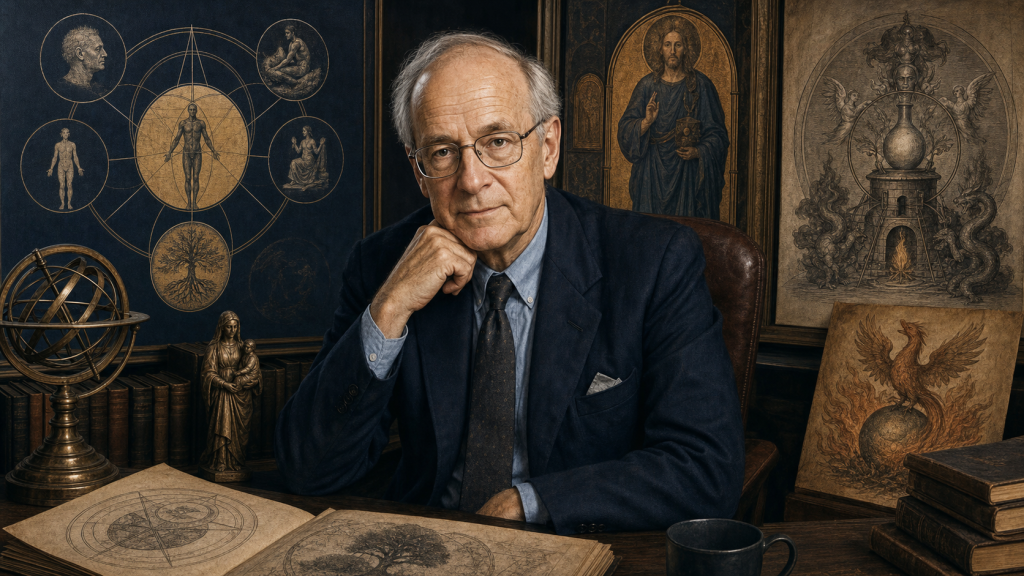
Edward F. Edinger was an American psychiatrist, Jungian analyst, lecturer, and author who became a prominent interpreter of Jung’s work on the ego, Self, individuation, alchemy, and religious symbolism.
Known For
Jungian analysis; the ego–Self relationship; individuation; psychological interpretations of alchemy, religion, mythology, and literature; and making classical Jungian thought accessible to a wider audience.
Biography
Edinger earned an M.D. from Yale in 1946, served as a U.S. Army medical officer, and began analysis with M. Esther Harding in 1951. He became a founding member of the C. G. Jung Institute and Foundation of New York in 1962, served as Institute president from 1968 to 1979, and later worked as an analyst, faculty member, and supervisor in Los Angeles.
Who Was Edward F. Edinger?
Edward F. Edinger (1922–1998) was an American psychiatrist, Jungian analyst, lecturer, and author known for explaining C. G. Jung’s analytical psychology to a broad English-speaking audience. A recurring focus of his work was the relationship between the conscious ego and the larger psychic totality Jung called the Self.
Edinger combined clinical interpretation with sustained study of alchemy, religion, mythology, literature, and cultural symbolism. His books are influential within Jungian communities but should be read as works of analytical psychology, not as summaries of current scientific consensus.
Education and Medical Career
Edinger was born in Cedar Rapids, Iowa, on December 13, 1922. He earned his medical degree from Yale University in 1946 and served as a medical officer in the United States Army from 1947 to 1949.
He later worked at Rockland State Hospital in New York. In 1951 he began analysis with M. Esther Harding, a physician and Jungian analyst whose work helped establish analytical psychology in the United States.
Institutional Work
Edinger was a founding member of the C. G. Jung Institute of New York and the C. G. Jung Foundation of New York in 1962. He served as president of the Institute from 1968 to 1979.
After moving to Los Angeles, he worked as an analyst, faculty member, and supervisor at the C. G. Jung Institute of Los Angeles until near the end of his life. He died on July 17, 1998.
Ego and Self
Edinger’s best-known theme is the ego–Self relationship. The Ego is the center of conscious identity; the Self represents the psyche as a whole and functions as an organizing image of wholeness in Jung’s theory.
Edinger described psychological development through changing relations between these centers. His account emphasizes a recurring movement between connection, separation, alienation, encounter, and a more conscious relationship. This should not be turned into a rigid stage system or used to rank people’s development.
Inflation and Responsibility
When the ego identifies with the power, authority, or numinosity associated with the Self, Jungian psychology calls the result psychological inflation. Edinger repeatedly examined the danger of confusing an archetypal experience with personal greatness or certainty.
In practical terms, a powerful dream, religious image, creative breakthrough, or synchronistic experience does not make a person infallible. Meaning must remain joined to ethical responsibility, ordinary evidence, relationship, and limits.
Alchemy as Psychological Imagery
In Anatomy of the Psyche, Edinger organized alchemical images around processes such as separation, dissolution, mortification, conjunction, and transformation. He treated these images as parallels for psychological experience rather than instructions for laboratory chemistry.
Alchemy is historically complex and cannot be reduced to a code for modern therapy. Edinger’s interpretation represents a particular Jungian reading shaped by Jung’s own engagement with Western alchemical texts.
Religion, Myth, and Culture
Edinger wrote extensively about Christian imagery, biblical texts, Greek mythology, Faust, Moby-Dick, and the symbolic consequences of modern secularization. He believed religious images could be approached psychologically as expressions of the psyche.
Readers should distinguish psychological interpretation from theology, history, and claims made within living faith traditions. Edinger’s focus on Western and Christian material also limits how broadly his cultural conclusions can be applied.
Major Works
- Ego and Archetype: Individuation and the Religious Function of the Psyche
- Melville’s Moby-Dick: An American Nekyia
- Anatomy of the Psyche: Alchemical Symbolism in Psychotherapy
- The Christian Archetype
- Goethe’s Faust: Notes for a Jungian Commentary
- Transformation of the God-Image
- The Eternal Drama
- Science of the Soul
How to Read Edinger Critically
- Separate Edinger’s interpretation from Jung’s original wording.
- Treat mythological and religious parallels as interpretive proposals, not historical proof.
- Do not convert ego–Self language into a hierarchy of superior and inferior people.
- Retain the differences among psychology, religion, literature, cultural history, and empirical science.
- Ask which traditions and social contexts are absent from the analysis.
- Use numinous language with particular caution around authority, diagnosis, and consequential decisions.
Legacy
Edinger became one of the most recognizable American interpreters of classical Jungian psychology. His clear thematic organization made difficult Jungian material more approachable and helped carry it into later training, lectures, and study groups.
The Library of Congress holds the Edward F. Edinger Papers, including correspondence, writings, lectures, and material documenting his theoretical interests and institutional work.
Commentary Is Not the Primary Text
Edinger’s lectures and books are interpretations of Jung, scripture, myth, literature, and alchemy. Their clarity makes them useful guides, but readers should return to the source being interpreted and consult other scholarly traditions. Keep separate what the primary text says, what Jung proposes, and how Edinger develops that proposal. This prevents a persuasive commentary from silently becoming the only available meaning.
Sources and Further Reading
Continue your study
Recommended Reading
Books selected because they directly develop ideas discussed on this page.
Aion: Researches into the Phenomenology of the Self
Aion is Jung’s advanced study of the Self, the shadow, opposites, and the religious, astrological, Gnostic, and alchemical symbols of psychological totality.
Man and His Symbols
Man and His Symbols is an illustrated introduction to dreams, symbols, archetypes, and individuation written by Carl Jung and four close collaborators for general readers.
The Red Book: Liber Novus
The Red Book: Liber Novus records and artistically develops Carl Jung's confrontation with inner figures and images during a formative period of his psychology.
Paid links. As an Amazon Associate I earn from qualifying purchases.
Related Concepts

Individuation
Individuation is Jung’s term for the lifelong process of becoming a more differentiated and integrated psychological whole.

Collective Unconscious
In Jungian psychology, the collective unconscious is a proposed inherited layer of the psyche expressed through universal patterns called archetypes.

Complex
In Jungian psychology, a complex is an emotionally charged network of associations that can temporarily influence perception, emotion, and behavior.
Ego
In Jungian psychology, the ego is the central complex of consciousness: the organizing “I” that experiences identity, makes choices, and adapts to inner and outer life.

Self
The Self is Jung’s concept of the whole psyche—conscious and unconscious—and the archetypal principle of its organization, development, and potential integration.
Archetype
An archetype is an inherited organizing pattern in Jung’s theory that can shape recurring forms of imagery, emotion, perception, and behavior without prescribing one fixed image.

Transcendent Function
The transcendent function is the new psychological attitude or symbolic possibility that can emerge when conscious and unconscious positions are held in genuine dialogue.

Psychological Opposites
Psychological opposites are conflicting conscious and unconscious positions whose tension can reveal one-sidedness and support development.

Psychological Inflation
Psychological inflation is an expanded or diminished self-estimate caused by identifying the ego with an archetype, role, group, insight, or unconscious content.
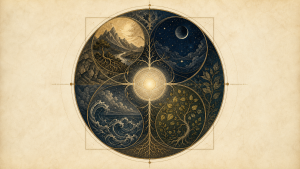
Mandala
A mandala is a centered, often circular symbolic form that Jung associated with psychic order, wholeness, containment, and the Self.

Enantiodromia
Enantiodromia is the emergence of an unconscious counter-position after a conscious attitude becomes rigid, extreme, or chronically one-sided.

Coniunctio
Coniunctio is an alchemical image Jung used to explore the psychological union of opposites and the possibility of a new, more inclusive attitude.

Analytical Psychology
Analytical psychology, often called Jungian psychology, is Carl Jung’s approach to the psyche, unconscious life, symbols, and psychological development.

Carl Jung and Religion
Carl Jung approached religion as a psychological and symbolic phenomenon whose images can organize experience, while avoiding a clinical proof of theological claims.
Carl Jung, Psychology, and Alchemy
Carl Jung interpreted alchemical images as historical parallels to unconscious psychological processes, especially projection, transformation, opposites, and individuation.
Related Books
Aion: Researches into the Phenomenology of the Self
Aion is Jung’s advanced study of the Self, the shadow, opposites, and the religious, astrological, Gnostic, and alchemical symbols of psychological totality.

Man and His Symbols
Man and His Symbols is an illustrated introduction to dreams, symbols, archetypes, and individuation written by Carl Jung and four close collaborators for general readers.
The Red Book: Liber Novus
The Red Book: Liber Novus records and artistically develops Carl Jung's confrontation with inner figures and images during a formative period of his psychology.
The Archetypes and the Collective Unconscious
The Archetypes and the Collective Unconscious collects major essays in which Carl Jung develops his accounts of archetypes, collective psychic patterns, rebirth, the mother, the child, and individuation.
The Origins and History of Consciousness
Erich Neumann’s The Origins and History of Consciousness uses mythic sequences to propose an archetypal model of ego development and the differentiation of consciousness.

Ego and Archetype
Ego and Archetype is Edward F. Edinger’s influential Jungian study of individuation and the changing relationship between the conscious ego and the Self.

The Eternal Drama
The Eternal Drama is Edward F. Edinger’s Jungian exploration of major Greek myths and divine figures as recurring images of psychological conflict, development, and transformation.
Anatomy of the Psyche
Anatomy of the Psyche is Edward F. Edinger’s Jungian study of Western alchemical images and operations as symbolic parallels for psychological processes and psychotherapy.

The Sacred Psyche
The Sacred Psyche is Edward F. Edinger’s psychological interpretation of the Psalms, developed from lectures and focused on their continuing significance in individual experience.
The Mystery of the Coniunctio
The Mystery of the Coniunctio is Edward F. Edinger’s compact Jungian study of alchemical union as an image of the relationship and possible integration of psychological opposites.

Encounter with the Self
Encounter with the Self is Edward F. Edinger’s Jungian commentary on William Blake’s illustrations of the Book of Job and their imagery of psychic and religious transformation.

The Creation of Consciousness
The Creation of Consciousness is Edward F. Edinger’s concise proposal for a modern Jungian worldview joining the scientific pursuit of knowledge with the religious search for meaning.
The Christian Archetype
The Christian Archetype is Edward F. Edinger’s Jungian commentary on central episodes in the life of Christ and their possible psychological significance.
Transformation of the God-Image
Transformation of the God-Image is Edinger’s Jungian elucidation of Answer to Job, developed from seminars at the C. G. Jung Institute of Los Angeles.

Science of the Soul
Science of the Soul is a posthumous collection of five Edinger essays on psychotherapy, transference, vocation, the greater personality, and Jungian psychological method.

Goethe’s Faust: Notes for a Jungian Commentary
Goethe’s Faust is Edinger’s Jungian commentary on Goethe’s drama as a psychological portrait, symbolic analytic process, and bridge to alchemy.

Melville’s Moby-Dick: An American Nekyia
Melville’s Moby-Dick is Edinger’s Jungian interpretation of Melville’s novel as an American nekyia—a descent into dangerous and transformative psychic depths.

Ego and Self: The Old Testament Prophets
Ego and Self is Edinger’s psychological commentary on the prophetic books of the Hebrew Bible, continuing the work begun in The Bible and the Psyche.
The Mysterium Lectures
The Mysterium Lectures is Edinger’s extensive chapter-by-chapter guide to Jung’s Mysterium Coniunctionis and its relevance to dreams and psychological life.
The Bible and the Psyche
The Bible and the Psyche is Edinger’s Jungian commentary on individuation symbolism in biblical books from Genesis through Esther.
The Psyche in Antiquity, Book One
The Psyche in Antiquity, Book One is Edinger’s psychological tour of early Greek philosophy from the Milesians through Plotinus.
The Psyche on Stage
The Psyche on Stage is Edinger’s Jungian study of Measure for Measure, Romeo and Juliet, Oedipus the King, and Oedipus at Colonus.
The Aion Lectures
The Aion Lectures is Edinger’s edited lecture companion to C. G. Jung’s Aion, originally delivered in Los Angeles in 1988–89.
Psychology and Alchemy
Carl Jung’s major study connecting dream series, Christian symbolism, and Western alchemy with projection and the psychological process of individuation.
Related Practices

Shadow Work
Shadow work is a modern term for reflective practices that explore qualities, emotions, and patterns a person habitually rejects, hides, or fails to recognize in themselves.

Active Imagination
Active imagination is Jung’s method of consciously engaging emerging images, emotions, or figures through sustained attention and expression while preserving awareness and judgment.

Jungian Dream Analysis
Jungian dream analysis explores a dream’s personal associations, structure, emotional context, and possible compensatory relationship to conscious life without using fixed symbol definitions.

Symbol Amplification
Symbol amplification is a Jungian method of comparing an image with mythic, religious, artistic, historical, and cultural parallels while staying anchored to personal context.

Circumambulation
Circumambulation is a Jungian method of staying close to one image while examining it repeatedly from different personal, emotional, symbolic, and practical viewpoints.
Personal Association in Dream Work
Personal association explores the dreamer’s own memories, feelings, language, culture, sensory responses, and current circumstances around a specific dream image.