
Jungian Concept
Personal Unconscious
In Jungian psychology, the personal unconscious contains experiences, perceptions, and emotionally charged material outside an individual’s present awareness.

Definition
In Carl Jung's analytical psychology, the personal unconscious is the part of the unconscious associated with an individual's own life. Its contents may include forgotten experiences, perceptions that never reached full awareness, material set aside by conscious attention, and thoughts or feelings that conflict with the conscious personality.
The term does not imply that everything outside awareness is traumatic, shameful, or permanently buried. Much of the personal unconscious may be ordinary: details no longer being considered, impressions noticed only faintly, undeveloped possibilities, or emotional associations that become visible under particular circumstances.
What the Personal Unconscious Contains
Conscious attention is limited. At any moment, people are aware of only a small part of what they have experienced, perceived, remembered, or felt. Jung used the personal unconscious to describe material connected to the individual that is currently outside this field of awareness.
Some contents were once conscious and later forgotten. Others may have been registered without becoming a clear conscious thought. Still others may be avoided or excluded because they conflict with a person’s self-image, values, social role, or present priorities. Jungian theory also allows for constructive material—creative possibilities, insights, or qualities that the conscious personality has not yet developed.
Complexes
Complexes are especially important in Jung’s account of the personal unconscious. A complex is an emotionally charged grouping of associations organized around a theme. Family relationships, authority, belonging, inferiority, achievement, or abandonment can become centers around which memories, expectations, emotions, and interpretations gather.
A complex is not simply a bad habit or a diagnosis. It may become noticeable when a situation produces a reaction that feels unusually intense, repetitive, or difficult to explain. Jung described complexes as having a degree of autonomy because they can temporarily influence attention and behavior before the person understands what has been activated.
Personal and Collective Unconscious
The collective unconscious is a separate theoretical level in Jung’s model. The personal unconscious develops in connection with an individual’s experience. The collective unconscious refers to inherited psychological predispositions or organizing patterns that Jung believed humanity shares.
This does not mean the collective unconscious contains literal ancestral memories. Nor are the two levels always easy to separate in an actual image or dream. A symbol can carry personal associations while also resembling a broader archetypal pattern. Jungian interpretation considers both without assuming that one explanation automatically excludes the other.
Role in Individuation
Within individuation, becoming aware of personal unconscious material can reveal discrepancies between a person’s conscious identity and the attitudes or emotions operating outside it. This may include recognizing a shadow quality, noticing an unresolved complex, or discovering a capacity that has been neglected.
Integration does not mean acting on every impulse or treating every interpretation as true. It means developing enough awareness to reflect on unconscious influences rather than being governed by them automatically. In Jungian theory, this work can prepare the way for engagement with broader archetypal material, but individuation is not a checklist with guaranteed stages or outcomes.
Contemporary Perspective and Caution
The personal unconscious belongs to a historical depth-psychology model. Contemporary psychology uses several different frameworks to explain memory, attention, automatic processing, emotion, and behavior outside awareness. Those modern concepts should not be treated as simple scientific proof of every claim in Jung’s model.
Self-reflection may help someone notice patterns, but memories and interpretations are fallible. A powerful emotional reaction does not prove that a particular hidden event caused it. Readers should avoid diagnosing themselves or others through a single dream, association, or symbolic interpretation. Distressing memories or persistent psychological symptoms are better discussed with a qualified professional than treated through an online definition alone.
Memory Is Reconstructive
Contents of the personal unconscious are not a perfect recording of the past. Memory is selective and reconstructive; dreams, images, bodily reactions, and strong feelings do not by themselves establish that a specific event occurred. Psychological meaning and historical accuracy are different questions. When factual claims matter, rely on corroboration and appropriate professional methods rather than treating symbolic material as recovered proof.
Sources and Further Reading
Origin and Development
Jung’s distinction between personal and collective layers of the unconscious developed as analytical psychology took shape apart from Freud’s psychoanalysis. Both thinkers assigned importance to mental activity outside consciousness, but their terminology and larger models of the psyche differ.
Jung discussed the personal and collective unconscious in works collected in Two Essays on Analytical Psychology and developed his archetypal theory extensively in The Archetypes and the Collective Unconscious. The personal unconscious is commonly associated with complexes, while archetypes belong to his theory of the collective unconscious.
Examples
Suppose someone becomes unusually defensive whenever a supervisor offers routine feedback. A Jungian inquiry might explore the person’s associations with criticism, authority, competence, and earlier relationships. A network of emotionally charged memories and expectations could suggest that a complex has been activated.
This is a hypothetical illustration, not a diagnosis. The reaction could have many causes, and reflection does not establish that one forgotten event explains it. The value of the example is in showing how present situations may activate patterns whose full emotional background is not immediately conscious.
Common Misconceptions
- It is not made only of repressed trauma. Forgotten details, faint perceptions, undeveloped qualities, and ordinary emotional associations may also lie outside awareness.
- It is not identical to the collective unconscious. Personal unconscious material is connected to individual experience; the collective unconscious concerns Jung’s proposed shared archetypal structure.
- A complex is not automatically an illness. In Jungian theory, complexes are common features of psychological life, although some can become disruptive.
- Remembering something does not guarantee an accurate explanation. Memory and interpretation can both be mistaken or incomplete.
- Awareness does not instantly eliminate a pattern. Recognizing an association may begin reflection, but it does not promise immediate emotional relief or behavioral change.
Continue your study
Recommended Reading
Books selected because they directly develop ideas discussed on this page.
Aion: Researches into the Phenomenology of the Self
Aion is Jung’s advanced study of the Self, the shadow, opposites, and the religious, astrological, Gnostic, and alchemical symbols of psychological totality.
Anatomy of the Psyche
Anatomy of the Psyche is Edward F. Edinger’s Jungian study of Western alchemical images and operations as symbolic parallels for psychological processes and psychotherapy.
The Creation of Consciousness
The Creation of Consciousness is Edward F. Edinger’s concise proposal for a modern Jungian worldview joining the scientific pursuit of knowledge with the religious search for…
Paid links. As an Amazon Associate I earn from qualifying purchases.
Related Concepts

Shadow
In Jungian psychology, the shadow is the part of the personality containing qualities, impulses, and capacities that the conscious ego does not recognize or accept as its own.
Persona
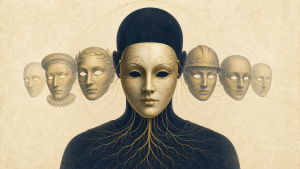
In Jungian psychology, the persona is the social identity or “mask” through which a person adapts to roles, expectations, and relationships.

Individuation
Individuation is Jung’s term for the lifelong process of becoming a more differentiated and integrated psychological whole.

Collective Unconscious
In Jungian psychology, the collective unconscious is a proposed inherited layer of the psyche expressed through universal patterns called archetypes.

Complex
In Jungian psychology, a complex is an emotionally charged network of associations that can temporarily influence perception, emotion, and behavior.

Ego
In Jungian psychology, the ego is the central complex of consciousness: the organizing “I” that experiences identity, makes choices, and adapts to inner and outer life.

Self
The Self is Jung’s concept of the whole psyche—conscious and unconscious—and the archetypal principle of its organization, development, and potential integration.

Archetype
An archetype is an inherited organizing pattern in Jung’s theory that can shape recurring forms of imagery, emotion, perception, and behavior without prescribing one fixed image.

Projection
Projection is the largely unconscious process of experiencing one’s own psychological content as if it belonged primarily or entirely to another person, group, or object.

Anima
Anima is Jung’s historical term for an inner feminine archetypal figure in a man, associated with feeling, relationship, imagery, and mediation between consciousness and the unconscious.

Animus
Animus is Jung’s historical term for an inner masculine archetypal figure in a woman, associated with opinion, agency, meaning, and mediation between consciousness and the unconscious.

Synchronicity
Synchronicity is Jung’s term for a meaningful coincidence between an inner psychological state and an external event when no adequate causal connection is apparent.
Psychological Types
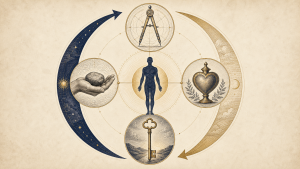
Jung’s psychological types combine two attitudes—introversion and extraversion—with four functions: thinking, feeling, sensation, and intuition.

Introversion
Introversion is a Jungian attitude in which conscious energy and motivation give greater priority to the subject’s inner impressions, ideas, and standpoint.

Extraversion
Extraversion is a Jungian attitude in which conscious energy and motivation give greater priority to external people, events, objects, and shared conditions.

Transcendent Function
The transcendent function is the new psychological attitude or symbolic possibility that can emerge when conscious and unconscious positions are held in genuine dialogue.

Psychological Opposites
Psychological opposites are conflicting conscious and unconscious positions whose tension can reveal one-sidedness and support development.

Participation Mystique
Participation mystique is a Jungian term for an unconscious state of identity in which the boundary between subject and object, self and other, is insufficiently differentiated.

Imago
An imago is an internal, subjectively shaped image of another person that must be distinguished from the person’s objective reality.

Analytical Psychology
Analytical psychology, often called Jungian psychology, is Carl Jung’s approach to the psyche, unconscious life, symbols, and psychological development.

Recurring Dreams
Recurring dreams repeat a theme, setting, conflict, or emotional pattern and are best studied as a series rather than decoded from one symbol.
Carl Jung vs. Sigmund Freud
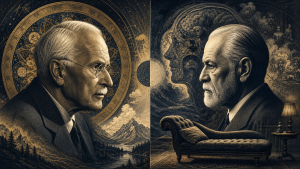
Carl Jung and Sigmund Freud shared an early psychoanalytic alliance but diverged over libido, religion, symbols, the unconscious, and the aims of psychological development.

Personal Unconscious vs Collective Unconscious
The personal unconscious contains forgotten or repressed individual material, while the collective unconscious names inherited archetypal patterns shared across human life.
Related Dream Symbols

House
A house in a dream may represent the dreamer, a structure of personality, family life, memory, safety, or a psychological situation, depending on context.

Water
Water in a dream may relate to emotion, bodily life, the unconscious, renewal, danger, depth, or overwhelming experience, depending on its form and context.

Forest
A forest in a dream may suggest an unfamiliar psychological territory, instinctive life, concealment, danger, refuge, disorientation, or a path of discovery.

Door
A door in a dream may suggest access, exclusion, transition, opportunity, secrecy, protection, choice, or a boundary between psychological situations.

Mirror
A mirror in a dream may concern self-recognition, appearance, identity, reversal, duplication, self-judgment, projection, or the unsettling failure to recognize oneself.

Cave
A cave in a dream may evoke concealment, shelter, descent, gestation, fear, burial, or contact with what lies outside ordinary awareness.

River
A river in a dream may evoke movement, time, emotion, direction, boundary, renewal, danger, or a process larger than conscious control.

Stairs
Stairs in a dream may emphasize gradual movement between levels, effort, access, hierarchy, descent, ascent, repetition, or an interrupted transition.

Fish Dream Meaning
Fish in dreams may involve vitality, nourishment, depth, adaptation, capture, abundance, vulnerability, spiritual imagery, or ordinary experience with water and food.

Dream Within a Dream Meaning
A dream within a dream may involve false awakening, uncertainty, layered perspective, sleep disruption, reality checking, narrative complexity, or anxiety about being unable to wake.

Snow Dream Meaning
Snow in dreams may involve quiet, cold, concealment, renewal, isolation, danger, play, seasonal memory, or an ordinary response to weather.

Drowning Dream Meaning
A drowning dream may involve panic, helplessness, emotional overwhelm, rescue, bodily breathing disturbance, grief, or a literal fear of water.
Related Practices

Shadow Work
Shadow work is a modern term for reflective practices that explore qualities, emotions, and patterns a person habitually rejects, hides, or fails to recognize in themselves.

Active Imagination
Active imagination is Jung’s method of consciously engaging emerging images, emotions, or figures through sustained attention and expression while preserving awareness and judgment.

Jungian Dream Analysis
Jungian dream analysis explores a dream’s personal associations, structure, emotional context, and possible compensatory relationship to conscious life without using fixed symbol definitions.

Dream Journaling
Dream journaling is the practice of recording dreams promptly and preserving their sequence, atmosphere, images, emotions, and personal associations.

Symbol Amplification
Symbol amplification is a Jungian method of comparing an image with mythic, religious, artistic, historical, and cultural parallels while staying anchored to personal context.

Sandplay Therapy
Sandplay therapy is a clinical, expressive method in which a client creates scenes with sand, water, and miniatures within a protected therapeutic relationship.

Personal Association in Dream Work
Personal association explores the dreamer’s own memories, feelings, language, culture, sensory responses, and current circumstances around a specific dream image.
Related Books

Aion: Researches into the Phenomenology of the Self
Aion is Jung’s advanced study of the Self, the shadow, opposites, and the religious, astrological, Gnostic, and alchemical symbols of psychological totality.

Anatomy of the Psyche
Anatomy of the Psyche is Edward F. Edinger’s Jungian study of Western alchemical images and operations as symbolic parallels for psychological processes and psychotherapy.
The Creation of Consciousness
The Creation of Consciousness is Edward F. Edinger’s concise proposal for a modern Jungian worldview joining the scientific pursuit of knowledge with the religious search for meaning.

Science of the Soul
Science of the Soul is a posthumous collection of five Edinger essays on psychotherapy, transference, vocation, the greater personality, and Jungian psychological method.

Melville’s Moby-Dick: An American Nekyia
Melville’s Moby-Dick is Edinger’s Jungian interpretation of Melville’s novel as an American nekyia—a descent into dangerous and transformative psychic depths.

The Mysterium Lectures
The Mysterium Lectures is Edinger’s extensive chapter-by-chapter guide to Jung’s Mysterium Coniunctionis and its relevance to dreams and psychological life.

The Bible and the Psyche
The Bible and the Psyche is Edinger’s Jungian commentary on individuation symbolism in biblical books from Genesis through Esther.

The Psyche in Antiquity, Book One
The Psyche in Antiquity, Book One is Edinger’s psychological tour of early Greek philosophy from the Milesians through Plotinus.
The Aion Lectures
The Aion Lectures is Edinger’s edited lecture companion to C. G. Jung’s Aion, originally delivered in Los Angeles in 1988–89.

Two Essays on Analytical Psychology
Two central essays in which Carl Jung explains the ego, personal and collective unconscious, persona, anima, and the movement toward individuation.
Related Psychologists

Carl Jung
Carl Gustav Jung was a Swiss psychiatrist who founded analytical psychology and developed influential ideas about complexes, archetypes, the collective unconscious, psychological types, and individuation.

Sigmund Freud
Sigmund Freud was an Austrian neurologist and the founder of psychoanalysis whose work on unconscious conflict, dreams, sexuality, and transference profoundly shaped Carl Jung’s early career.