
Psychologist
Carl Jung
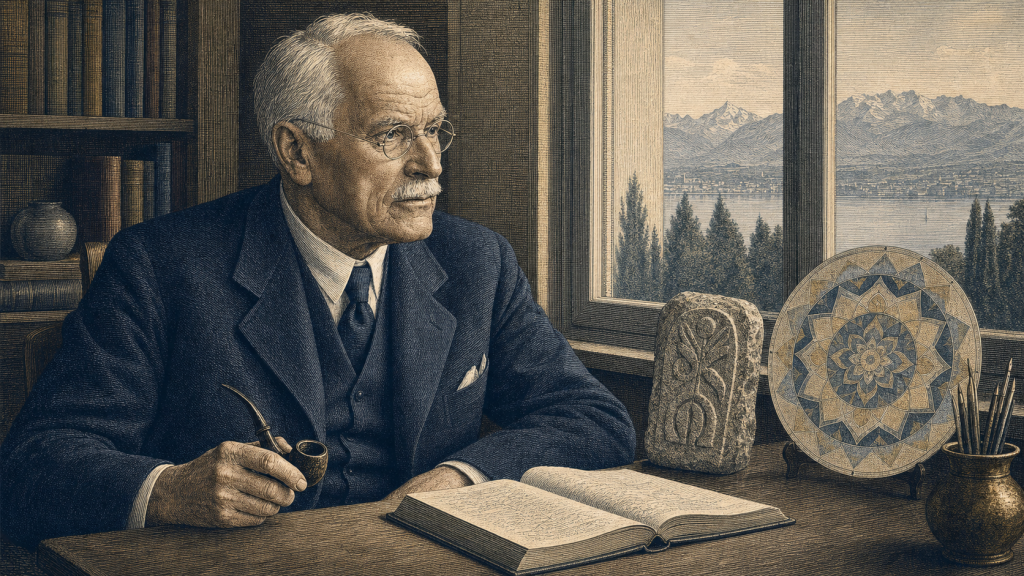
Carl Gustav Jung was a Swiss psychiatrist who founded analytical psychology and developed influential ideas about complexes, archetypes, the collective unconscious, psychological types, and individuation.
Known For
Founder of analytical psychology; complexes; archetypes; the collective unconscious; psychological types; dream analysis; and individuation.
Biography
Carl Gustav Jung was born on July 26, 1875, in Switzerland. He studied medicine at the University of Basel and trained in psychiatry at the Burghölzli hospital in Zürich, where his association experiments and work on complexes brought him early recognition.
Jung collaborated closely with Sigmund Freud beginning in 1907, but their theoretical and personal differences led to a break in 1913. Jung subsequently developed analytical psychology and wrote extensively about psychological types, dreams, archetypes, religion, alchemy, and individuation. He married Emma Rauschenbach in 1903, and they had five children. Jung died on June 6, 1961.
Key Ideas
- Analytical psychology: Jung’s distinct school of depth psychology.
- Complexes: emotionally charged organizations of ideas, memories, and reactions.
- Personal and collective unconscious: two dimensions of unconscious psychological life in Jung’s model.
- Archetypes: inherited organizing patterns expressed through variable images and behavior.
- Persona, shadow, and Self: concepts describing social identity, disowned qualities, and psychic wholeness.
- Individuation: the continuing process of differentiation and psychological integration.
- Psychological types: introversion, extraversion, and the functions of thinking, feeling, sensation, and intuition.
- Dreams and active imagination: methods for engaging symbolic and unconscious material.
Who Was Carl Jung?
Carl Gustav Jung (1875–1961) was a Swiss psychiatrist and the founder of analytical psychology. His work explored how conscious identity relates to personal experience, emotionally charged complexes, dreams, symbols, and the broader patterns he called archetypes.
Jung’s ideas have had a lasting influence on psychotherapy, religious studies, literature, art, and popular discussions of personality and self-development. That influence should not be confused with universal scientific acceptance: some Jungian concepts remain theoretical, difficult to test, or interpreted differently by contemporary clinicians and researchers.
Early Career and Word-Association Research
Jung studied medicine at the University of Basel and began psychiatric work at the Burghölzli hospital in Zürich. His early word-association experiments examined delayed or unusual responses to stimulus words. He interpreted patterns in those responses as evidence of emotionally charged groups of ideas, helping establish his early reputation and his account of psychological complexes.
Relationship With Freud
Jung met Sigmund Freud in 1907 and became an important figure in the early psychoanalytic movement. Their collaboration eventually broke down as their theories diverged. Jung rejected a primarily sexual account of psychic motivation and developed a broader model of the unconscious, symbolism, religion, and psychological development. Their split became public in 1913.
Analytical Psychology
Jung named his approach analytical psychology. It treats the unconscious not only as a repository of repressed material but also as a potential source of compensatory images, conflicts, and possibilities. Jung distinguished the personal unconscious from the collective unconscious, which he associated with inherited organizing patterns called archetypes.
Other central ideas include the persona, the shadow, the Self, psychological types, dream interpretation, active imagination, and individuation. These concepts form a connected theory rather than a collection of personality labels.
Psychological Types
In Psychological Types, published in 1921, Jung described introversion and extraversion as orientations of psychic energy and combined them with four functions: thinking, feeling, sensation, and intuition. Later personality systems drew inspiration from this framework, but they should not be treated as identical to Jung’s original model.
The Red Book and Later Work
After the break with Freud, Jung undertook an extended period of self-exploration involving dreams, fantasies, imagery, and active imagination. He documented much of this material in the manuscript later published as The Red Book in 2009. His later writings developed his accounts of archetypes, alchemy, religion, synchronicity, and the symbolic dimensions of psychological life.
Legacy and Critical Perspective
Jung’s strongest legacy may be his insistence that symptoms, dreams, images, and conflicts can be approached for their possible meaning as well as their immediate causes. Jungian psychotherapy remains an active clinical tradition, supported by international training institutes and professional organizations.
Readers should also approach Jung historically and critically. His work reflects assumptions and language from his era, and scholars continue to debate aspects of his cultural interpretations, gender theories, political judgment, and relationship to scientific evidence. A responsible introduction distinguishes Jung’s documented ideas from later popular simplifications and does not present symbolic interpretation as diagnosis or fact.
Read Jung Historically
Jung’s concepts changed across decades and were shaped by European medicine, philosophy, religion, colonial-era scholarship, and his personal circumstances. Cite the specific text and date rather than treating “Jung said” as a timeless authority. His influence does not make every historical, cultural, or scientific claim correct. A responsible reading compares primary texts with biography, archival scholarship, contemporary psychology, and voices excluded from his original framework.
Sources and Further Reading
- C.G. Jung Institute of San Francisco: C. G. Jung and His Legacy
- C.G. Jung Institute of San Francisco: Analytical Psychology
- International Association for Analytical Psychology: research and evidence base
- Jung’s Psychology and its relationship with the behavioral sciences
People Who Shaped Early Analytical Psychology
Analytical psychology developed through a wider network as well as Jung’s writing. Explore the distinct contributions of Toni Wolff, Emma Jung, Jolande Jacobi, and Aniela Jaffé. For the major objections to Jung’s work, see criticisms of Carl Jung’s theories and Jungian responses.
Continue your study
Recommended Reading
Books selected because they directly develop ideas discussed on this page.
Aion: Researches into the Phenomenology of the Self
Aion is Jung’s advanced study of the Self, the shadow, opposites, and the religious, astrological, Gnostic, and alchemical symbols of psychological totality.
Man and His Symbols
Man and His Symbols is an illustrated introduction to dreams, symbols, archetypes, and individuation written by Carl Jung and four close collaborators for general readers.
Memories, Dreams, Reflections
Memories, Dreams, Reflections is a semi-autobiographical account assembled from Carl Jung's recollections, manuscripts, and conversations with editor Aniela Jaffé.
Paid links. As an Amazon Associate I earn from qualifying purchases.
Public-domain audio
Listen free on LibriVox
Related Concepts
Shadow
In Jungian psychology, the shadow is the part of the personality containing qualities, impulses, and capacities that the conscious ego does not recognize or accept as its own.
Persona
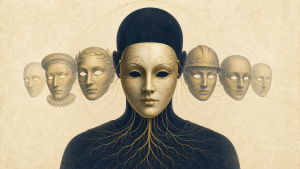
In Jungian psychology, the persona is the social identity or “mask” through which a person adapts to roles, expectations, and relationships.

Individuation
Individuation is Jung’s term for the lifelong process of becoming a more differentiated and integrated psychological whole.
Collective Unconscious
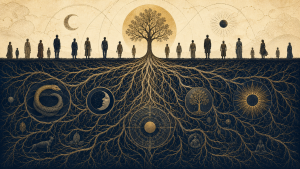
In Jungian psychology, the collective unconscious is a proposed inherited layer of the psyche expressed through universal patterns called archetypes.

Personal Unconscious
In Jungian psychology, the personal unconscious contains experiences, perceptions, and emotionally charged material outside an individual’s present awareness.
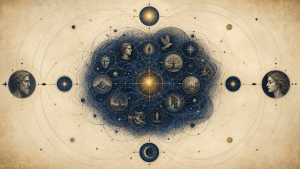
Complex
In Jungian psychology, a complex is an emotionally charged network of associations that can temporarily influence perception, emotion, and behavior.
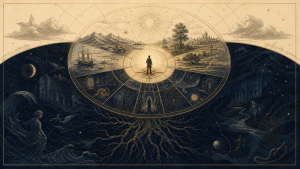
Ego
In Jungian psychology, the ego is the central complex of consciousness: the organizing “I” that experiences identity, makes choices, and adapts to inner and outer life.

Self
The Self is Jung’s concept of the whole psyche—conscious and unconscious—and the archetypal principle of its organization, development, and potential integration.
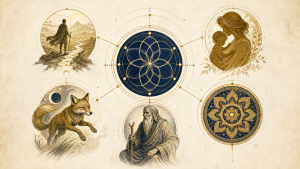
Archetype
An archetype is an inherited organizing pattern in Jung’s theory that can shape recurring forms of imagery, emotion, perception, and behavior without prescribing one fixed image.
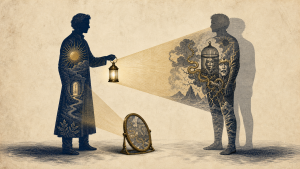
Projection
Projection is the largely unconscious process of experiencing one’s own psychological content as if it belonged primarily or entirely to another person, group, or object.

Anima
Anima is Jung’s historical term for an inner feminine archetypal figure in a man, associated with feeling, relationship, imagery, and mediation between consciousness and the unconscious.
Animus
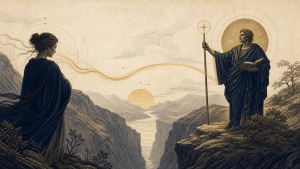
Animus is Jung’s historical term for an inner masculine archetypal figure in a woman, associated with opinion, agency, meaning, and mediation between consciousness and the unconscious.
Synchronicity
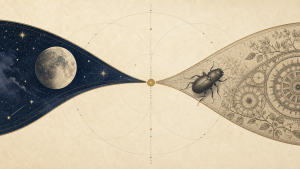
Synchronicity is Jung’s term for a meaningful coincidence between an inner psychological state and an external event when no adequate causal connection is apparent.
Psychological Types
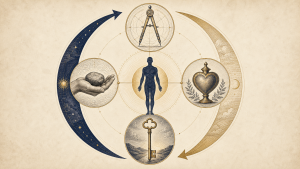
Jung’s psychological types combine two attitudes—introversion and extraversion—with four functions: thinking, feeling, sensation, and intuition.

Introversion
Introversion is a Jungian attitude in which conscious energy and motivation give greater priority to the subject’s inner impressions, ideas, and standpoint.

Extraversion
Extraversion is a Jungian attitude in which conscious energy and motivation give greater priority to external people, events, objects, and shared conditions.

Thinking
Thinking is the Jungian function that evaluates experience through concepts, logical relationships, and judgments about what something means.

Feeling
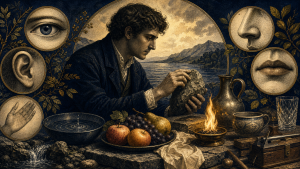
Feeling is the Jungian function that evaluates experience by assigning value: acceptable or unacceptable, important or unimportant, welcomed or rejected.
Sensation
Sensation is the Jungian function that perceives immediate concrete reality through the physical senses and awareness of bodily states.

Intuition
Intuition is the Jungian function that perceives possibilities, patterns, and implications through unconscious processes rather than direct sensory evidence.

Dominant Function
The dominant function is the psychological function a person uses most habitually and has developed most fully under conscious control.

Auxiliary Function
The auxiliary function supports the dominant function by adding a different mode of perception or judgment and helping consciousness adapt more flexibly.

Inferior Function
The inferior function is the least differentiated function in a person's conscious typology and the opposite of the dominant function.

Transcendent Function
The transcendent function is the new psychological attitude or symbolic possibility that can emerge when conscious and unconscious positions are held in genuine dialogue.
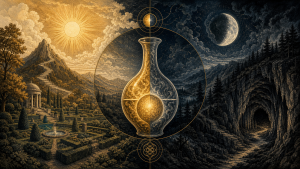
Psychological Opposites
Psychological opposites are conflicting conscious and unconscious positions whose tension can reveal one-sidedness and support development.

Psychological Inflation
Psychological inflation is an expanded or diminished self-estimate caused by identifying the ego with an archetype, role, group, insight, or unconscious content.
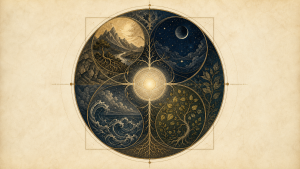
Mandala
A mandala is a centered, often circular symbolic form that Jung associated with psychic order, wholeness, containment, and the Self.

Participation Mystique
Participation mystique is a Jungian term for an unconscious state of identity in which the boundary between subject and object, self and other, is insufficiently differentiated.

Compensation
Compensation is the psyche’s tendency to balance or supplement a one-sided conscious attitude through dreams, emotions, fantasies, symptoms, and neglected perspectives.

Enantiodromia
Enantiodromia is the emergence of an unconscious counter-position after a conscious attitude becomes rigid, extreme, or chronically one-sided.

Coniunctio
Coniunctio is an alchemical image Jung used to explore the psychological union of opposites and the possibility of a new, more inclusive attitude.

Imago
An imago is an internal, subjectively shaped image of another person that must be distinguished from the person’s objective reality.

Psychic Energy
Psychic energy, often called libido by Jung, is a conceptual way of describing the intensity, direction, and movement of psychological interest and desire.

Constellation
Constellation is the activation of a complex or archetypal pattern by a situation, causing connected emotions, memories, expectations, and behaviors to become unusually available.

Analytical Psychology
Analytical psychology, often called Jungian psychology, is Carl Jung’s approach to the psyche, unconscious life, symbols, and psychological development.

Carl Jung’s Theory of Personality
Carl Jung’s personality theory combines psychological attitudes and functions with a broader model of ego, persona, shadow, unconscious life, and individuation.

Carl Jung’s Philosophy
Carl Jung’s philosophy centers on psychological wholeness, symbols, opposites, meaning, and the relationship between conscious and unconscious life.

Anima and Animus
Anima and animus are Jung’s historically gendered terms for inner otherness, relational projection, and qualities excluded from conscious identity.
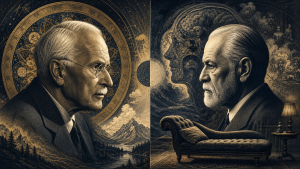
Carl Jung vs. Sigmund Freud
Carl Jung and Sigmund Freud shared an early psychoanalytic alliance but diverged over libido, religion, symbols, the unconscious, and the aims of psychological development.

Carl Jung and Religion
Carl Jung approached religion as a psychological and symbolic phenomenon whose images can organize experience, while avoiding a clinical proof of theological claims.

Carl Jung and Art
Carl Jung used drawing, painting, mandalas, sculpture, and symbolic image-making as means of engaging psychic material, while distinguishing this work from aesthetic criticism.
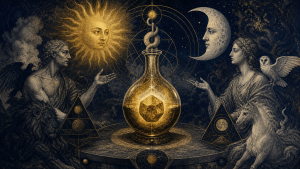
Carl Jung, Psychology, and Alchemy
Carl Jung interpreted alchemical images as historical parallels to unconscious psychological processes, especially projection, transformation, opposites, and individuation.

Carl Jung and Astrology
Carl Jung discussed astrology as a historical symbolic system and explored astrological data in relation to synchronicity, without establishing astrology as validated causal science.

Carl Jung and MBTI
The Myers-Briggs Type Indicator was inspired by Carl Jung’s psychological types, but its four-letter system and assessment method were developed by Katharine Cook Briggs and Isabel Briggs Myers.
Symbolic Attitude
A symbolic attitude is the willingness to hold an image, event, or conflict as potentially meaningful without forcing it into a literal or fixed explanation.
Ego–Self Axis
The ego–Self axis is Edward Edinger’s influential model for the changing relationship between conscious identity and the wider psychic totality Jung called the Self.
Archetypal Possession
Archetypal possession describes a state in which an impersonal pattern overwhelms ordinary perspective and is experienced as if it defines the whole person or situation.
Autonomy of Complexes
The autonomy of complexes refers to the way emotionally charged patterns can interrupt intention, capture attention, and produce reactions that feel partly outside conscious control.
The Numinous
The numinous is an experience of compelling awe, fascination, dread, or significance that seems greater than ordinary conscious intention.
Libido in Jungian Psychology
In Jungian psychology, libido means general psychic energy rather than sexual drive alone.
Psychological Differentiation
Psychological differentiation is the development of clearer distinctions among functions, values, roles, emotions, and unconscious influences.
Psychological Integration
Psychological integration is the ongoing work of bringing previously excluded experience into a more conscious and responsible relationship with the personality.
Psychological Wholeness
Psychological wholeness is Jung’s ideal of a personality able to relate consciously to its tensions, limits, and wider range rather than identifying with a narrow self-image.

Teleology in Jungian Psychology
Teleology in Jungian psychology is the practice of asking what direction or future possibility a psychological event may be moving toward, alongside asking what caused it.
Related Books
Aion: Researches into the Phenomenology of the Self
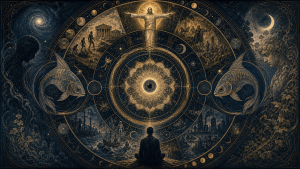
Aion is Jung’s advanced study of the Self, the shadow, opposites, and the religious, astrological, Gnostic, and alchemical symbols of psychological totality.

Man and His Symbols
Man and His Symbols is an illustrated introduction to dreams, symbols, archetypes, and individuation written by Carl Jung and four close collaborators for general readers.

Memories, Dreams, Reflections
Memories, Dreams, Reflections is a semi-autobiographical account assembled from Carl Jung's recollections, manuscripts, and conversations with editor Aniela Jaffé.
The Red Book: Liber Novus
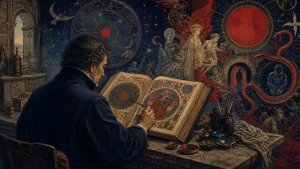
The Red Book: Liber Novus records and artistically develops Carl Jung's confrontation with inner figures and images during a formative period of his psychology.
The Archetypes and the Collective Unconscious
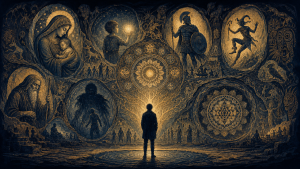
The Archetypes and the Collective Unconscious collects major essays in which Carl Jung develops his accounts of archetypes, collective psychic patterns, rebirth, the mother, the child, and individuation.

The Origins and History of Consciousness
Erich Neumann’s The Origins and History of Consciousness uses mythic sequences to propose an archetypal model of ego development and the differentiation of consciousness.

Re-Visioning Psychology
Re-Visioning Psychology is James Hillman’s foundational statement of archetypal psychology and its imaginal approach to soul, symptoms, myth, and psychological plurality.

Senex & Puer
Senex & Puer collects James Hillman’s essays on the archetypal polarity between time, structure, authority, and the youthful forces of possibility, freedom, and renewal.

Ego and Archetype
Ego and Archetype is Edward F. Edinger’s influential Jungian study of individuation and the changing relationship between the conscious ego and the Self.

The Eternal Drama
The Eternal Drama is Edward F. Edinger’s Jungian exploration of major Greek myths and divine figures as recurring images of psychological conflict, development, and transformation.
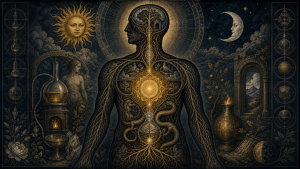
Anatomy of the Psyche
Anatomy of the Psyche is Edward F. Edinger’s Jungian study of Western alchemical images and operations as symbolic parallels for psychological processes and psychotherapy.

The Sacred Psyche
The Sacred Psyche is Edward F. Edinger’s psychological interpretation of the Psalms, developed from lectures and focused on their continuing significance in individual experience.
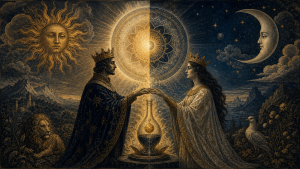
The Mystery of the Coniunctio
The Mystery of the Coniunctio is Edward F. Edinger’s compact Jungian study of alchemical union as an image of the relationship and possible integration of psychological opposites.

Encounter with the Self
Encounter with the Self is Edward F. Edinger’s Jungian commentary on William Blake’s illustrations of the Book of Job and their imagery of psychic and religious transformation.
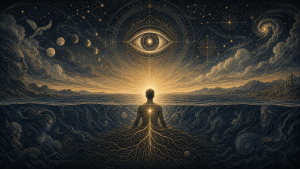
The Creation of Consciousness
The Creation of Consciousness is Edward F. Edinger’s concise proposal for a modern Jungian worldview joining the scientific pursuit of knowledge with the religious search for meaning.
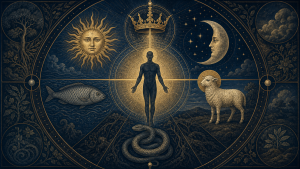
The Christian Archetype
The Christian Archetype is Edward F. Edinger’s Jungian commentary on central episodes in the life of Christ and their possible psychological significance.
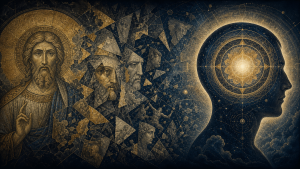
Transformation of the God-Image
Transformation of the God-Image is Edinger’s Jungian elucidation of Answer to Job, developed from seminars at the C. G. Jung Institute of Los Angeles.

Science of the Soul
Science of the Soul is a posthumous collection of five Edinger essays on psychotherapy, transference, vocation, the greater personality, and Jungian psychological method.

Goethe’s Faust: Notes for a Jungian Commentary
Goethe’s Faust is Edinger’s Jungian commentary on Goethe’s drama as a psychological portrait, symbolic analytic process, and bridge to alchemy.

Melville’s Moby-Dick: An American Nekyia
Melville’s Moby-Dick is Edinger’s Jungian interpretation of Melville’s novel as an American nekyia—a descent into dangerous and transformative psychic depths.
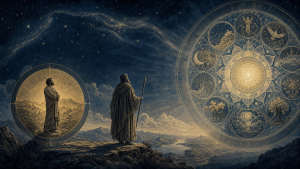
Ego and Self: The Old Testament Prophets
Ego and Self is Edinger’s psychological commentary on the prophetic books of the Hebrew Bible, continuing the work begun in The Bible and the Psyche.
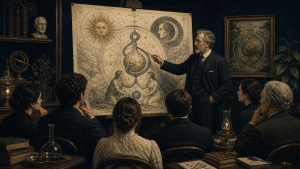
The Mysterium Lectures
The Mysterium Lectures is Edinger’s extensive chapter-by-chapter guide to Jung’s Mysterium Coniunctionis and its relevance to dreams and psychological life.

The Bible and the Psyche
The Bible and the Psyche is Edinger’s Jungian commentary on individuation symbolism in biblical books from Genesis through Esther.
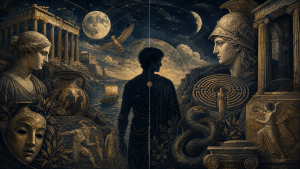
The Psyche in Antiquity, Book One
The Psyche in Antiquity, Book One is Edinger’s psychological tour of early Greek philosophy from the Milesians through Plotinus.
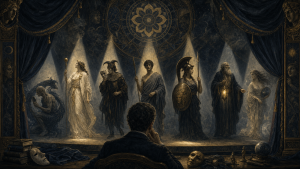
The Psyche on Stage
The Psyche on Stage is Edinger’s Jungian study of Measure for Measure, Romeo and Juliet, Oedipus the King, and Oedipus at Colonus.
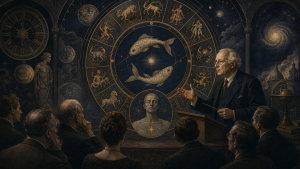
The Aion Lectures
The Aion Lectures is Edinger’s edited lecture companion to C. G. Jung’s Aion, originally delivered in Los Angeles in 1988–89.

Psychological Types
Carl Jung’s foundational study of introversion, extraversion, and the psychological functions of thinking, feeling, sensation, and intuition.

Synchronicity: An Acausal Connecting Principle
Carl Jung’s principal essay proposing synchronicity as a framework for meaningful coincidence not adequately described by ordinary causal explanation.

The Black Books
Carl Jung’s private notebooks recording fantasies, dreams, dialogues, and reflections from the period that also produced The Red Book.

Two Essays on Analytical Psychology
Two central essays in which Carl Jung explains the ego, personal and collective unconscious, persona, anima, and the movement toward individuation.

Psychology and Alchemy
Carl Jung’s major study connecting dream series, Christian symbolism, and Western alchemy with projection and the psychological process of individuation.
Related Practices

Shadow Work
Shadow work is a modern term for reflective practices that explore qualities, emotions, and patterns a person habitually rejects, hides, or fails to recognize in themselves.

Sandplay Therapy
Sandplay therapy is a clinical, expressive method in which a client creates scenes with sand, water, and miniatures within a protected therapeutic relationship.
Dialoguing with a Dream Figure
This reflective practice helps a reader explore a remembered dream figure through written questions and imagined responses while preserving uncertainty.
Mandala Journaling
Mandala journaling combines a simple circular drawing with written reflection on balance, conflict, mood, and changing inner organization.

Jungian Typology Reflection
Typology reflection uses Jung’s attitudes and functions to notice habitual strengths and neglected perspectives without reducing identity to a label.
Complex Trigger Mapping
Complex trigger mapping helps identify recurring situations in which emotion, expectation, memory, and behavior become tightly linked.
Symbol Series Review
Symbol series review examines how an image changes across several dreams, drawings, or reflections instead of treating one appearance as final.